
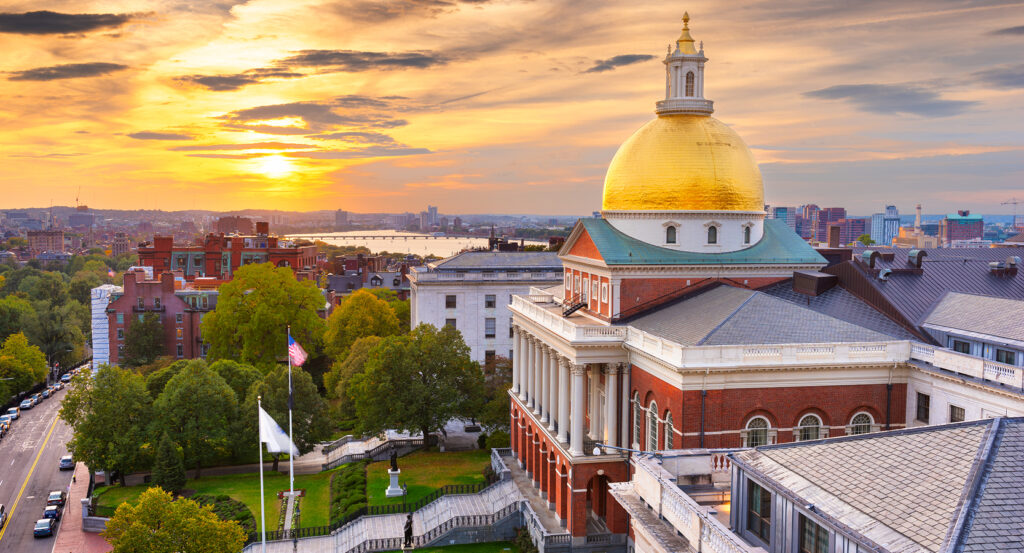
Why you should experience Hilton Boston Park Plaza in Boston, Massachusetts.
Hilton Boston Park Plaza is where classic Boston elegance converges with genuine urban energy, a hotel that feels both rooted in the city's storied past and fully engaged with its energetic present.
Located at the intersection of Back Bay and Downtown across from the Boston Common and Public Garden, Hilton Boston Park Plaza occupies a position that feels intrinsic to the city's everyday life. This isn't a hotel tucked away in an isolated corner; it stands in the middle of Boston's civic pulse, where historic avenues, cultural institutions, theater, shopping, and green spaces weave together into a rich urban fabric. From the moment you approach, the hotel's façade, a composed blend of early 20th-century lines and subtle detail, signals a presence that feels established. Step inside and the lobby welcomes you with an atmosphere of poised hospitality: elevated interiors that combine timeless materials, clean sightlines, and a warmth that suggests ease. There is an immediacy here, a sense that this place understands how people move through cities, how they transition from day to night, and how a hotel can be both sanctuary and springboard. Guest rooms reflect this understanding with rooms that are generous, purposeful, and quietly sophisticated. Expect beds wrapped in crisp linens that invite rest without ceremony, thoughtful work and seating areas that support concentration and comfort alike, and windows that frame views of Boston's structured streets, glimpses of verdant parkland, or the distant curvature of the skyline. The design palette leans toward soft neutrals enriched by subtle accent tones, creating a space that feels calm without being anonymous, and tailored without being formal. Bathrooms are luminous and refined, walk-in showers or deep soaking tubs, quality fixtures, bright mirrors, and amenities selected for both practicality and pleasure. What distinguishes Hilton Boston Park Plaza is its coherence: every detail feels calibrated to support a stay that blends purpose and repose, activity and reflection, never at the cost of place or presence. Downstairs, dining and social spaces mirror this balance: lounges, restaurants, and bars that feel alive but not noisy, social yet composed, and attentive to mood. Service throughout the hotel is warm, skilled, and genuinely human, staff who guide with local knowledge and thoughtful precision, making you feel supported. Step outside and Boston unfolds in every direction: walk past the verdure of the Public Garden, join the footpaths of the Freedom Trail, explore Newbury Street's boutiques and cafés, or step into the Theater District's cultural pulse. Hilton Boston Park Plaza is ideal for travelers who value connectivity, thoughtful comfort, and a sense of place that feels both elegant and alive, a hotel that amplifies your experience of Boston.
What you should know about Hilton Boston Park Plaza.
Hilton Boston Park Plaza occupies a landmark site shaped by Boston's layered civic, cultural, and architectural evolution, a location where the city's public life and architectural ambition have long intersected.
The hotel stands on a corner overlooking Boston Common and the Public Garden, spaces that are among the oldest and most cherished civic landscapes in America. The Common dates back to the 17th century as a communal grazing green and militia muster point, and the Public Garden, established in the 1830s, became the nation's first public botanical garden. Together, these parks have anchored Boston's urba character for centuries, serving as gathering places, celebratory stages, protest corridors, and reflective retreats. Hilton Boston Park Plaza's position directly adjacent to these foundational urban spaces places it within the city's historical heartbeat. The building itself, originally opened in 1927 as the Statler Hotel, is an architectural marker from a time when Boston was asserting itself as a modern city while still deeply connected to its historic roots. The transition from the Statler to the Park Plaza name and character reflects broader patterns of urban evolution, adaptive reuse, changing ideas about hospitality, and the city's negotiation between preservation and experience. Rather than masking this history, the hotel's design and spatial logic allow it to remain in conversation with the city's architectural narrative. Public spaces are composed to allow light, flow, and social interaction, encouraging guests to move through and beyond the property. A lesser-known detail about the immediate area is how many layers of civic transformation are embedded just beneath the surface: the parklands were shaped by landfill and careful planning; the streets were redrawn over decades to support transit, commerce, and pedestrian life; and the surrounding façades narrate shifts in architectural philosophy from nineteenth-century ornateness to twentieth-century restraint and modern adaptation. Hilton Boston Park Plaza's interiors and public spaces don't attempt to recreate any of these histories; instead, they respond to the context's cumulative weight through proportion, material integrity, and spatial logic. In doing so, the hotel becomes not an isolated artifact but an active participant in Boston's ongoing urban narrative, a structure that acknowledges civic character as both inherited and lived. Staying here places you in a lineage where parkland, public life, architecture, and daily urban rhythm converge, allowing you to experience the city's layered character in motion.
How to fold Hilton Boston Park Plaza into your trip.
Hilton Boston Park Plaza works best when you let its prime positioning shape your days, using it as both compass and refuge in a city that rewards presence, movement, and discovery.
Begin your mornings with a walk into Boston Common before breakfast, letting open green space and early light orient your sense of place before the city's rhythm builds. Step outside to explore the Public Garden's winding paths or follow the Freedom Trail through historic streets that trace colonial and civic history at pavement level. Midday, wander toward Newbury Street's boutiques and cafés, appreciating how architectural continuity and pedestrian life dissolve barriers between destinations. Return to the hotel for a deliberate reset, a quiet shower, a light lunch, or a moment looking out over parkland before you head back into the city's diverse neighborhoods. In the afternoon, consider visiting cultural institutions like the Museum of Fine Arts, Boston or the Isabella Stewart Gardner Museum, or walk to Back Bay's architectural corridors for further discovery. As evening approaches, let the hotel's dining or lounge spaces serve as your staging ground for dinner, or step out to nearby acclaimed restaurants in the Theater District before returning on foot through streets softened by night light. After dinner, take a late-night walk under lamplight through the Common or along Boylston Street, noticing how familiar façades gain new nuance in dusk and shadow. On your final morning, linger over breakfast or coffee, appreciating how the hotel's presence and place supported a journey woven through parkland, history, architecture, and urban life.
Where your story begins.
Foresyte Travel reveals places that feel extraordinary long before you arrive.
Experience premium editorial crafted for luxury travelers.







































































































