Why you should experience Hungarian National Museum in Budapest, Hungary.
In the grand center of Budapest, Hungary stands not only as the guardian of a nation's history but as a temple of identity, art, and endurance.
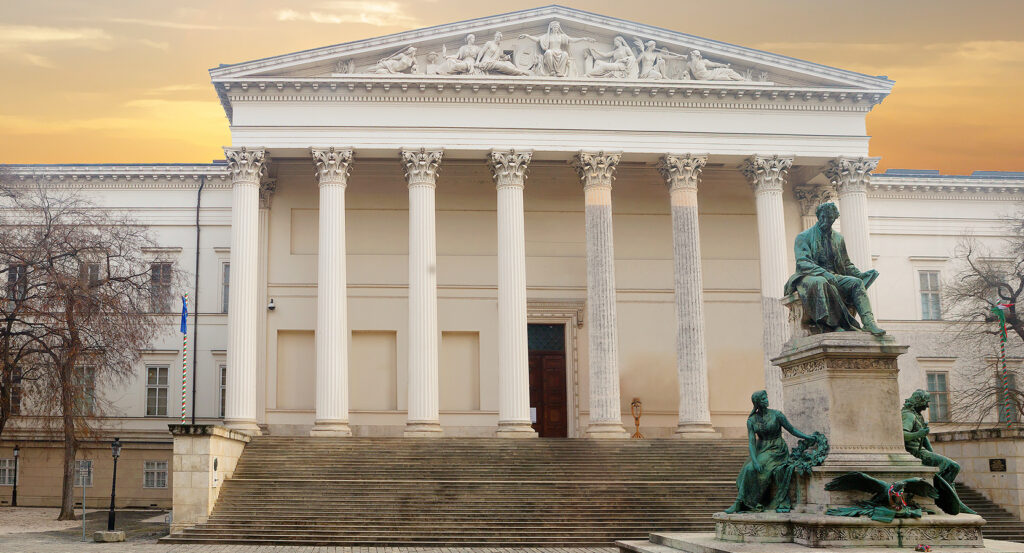
Founded in 1802 by Count Ferenc Széchényi, this neoclassical masterpiece was built to preserve the soul of a people whose story spans conquest, revolution, and rebirth. Its stately façade, designed by Mihály Pollack, commands respect with Corinthian columns and marble steps that have borne witness to some of Hungary's most defining moments. Step through its vast doors, and you enter a world where every exhibit pulses with national pride and collective memory. The museum's seven floors trace the evolution of Hungarian civilization from prehistoric Carpathian tribes to the modern European republic. Within these marble-lined halls, you'll find royal regalia, medieval armor, intricately embroidered folk costumes, and relics from the 1848 Revolution, a period when Hungarian independence burned fiercely in the hearts of its citizens. Yet, what makes the museum extraordinary isn't just the artifacts themselves, but the atmosphere: a sense of reverence that lingers in the silence between glass cases. Standing before the Holy Crown of Hungary, said to have graced the heads of nearly every Hungarian king since the 11th century, you feel not as a spectator, but as a participant in an ongoing story, one that still shapes the identity of the Hungarian people today.
What you didn’t know about Hungarian National Museum.
Hungarian National Museum has long been more than a collection of objects, it's a symbol of resistance, resilience, and renewal.
When Count Széchényi first donated his personal collection of books, coins, and antiquities in 1802, he set in motion a cultural revolution. At a time when Hungary was under Habsburg rule, the museum became a quiet assertion of national pride and intellectual freedom. The building itself, completed in 1847, soon took on a role far greater than its architectural splendor. It was on these very steps, on March 15, 1848, that poet Sándor Petőfi recited his revolutionary National Song, igniting Hungary's War of Independence. The steps remain a sacred space for Hungarians, a gathering place for commemorations and peaceful demonstrations that celebrate the same ideals of liberty and unity. Inside, the museum houses more than a million artifacts, including ancient Roman mosaics from Pannonia, Avar gold jewelry, medieval manuscripts, and Renaissance artworks that reflect centuries of cultural fusion. Few realize that the museum's archives also preserve vast ethnographic and natural history collections that once formed the foundation for Hungary's other national museums. Even the building's details hold meaning: its frescoes by Károly Lotz depict allegories of science, history, and the arts, while the grand dome floods the interior with light, a metaphor for enlightenment after centuries of darkness. Hungarian National Museum is both a physical and spiritual cornerstone, reminding visitors that culture is not static; it evolves, endures, and continues to define what it means to be Hungarian.
How to fold Hungarian National Museum into your trip.
A visit to Hungarian National Museum offers one of Budapest's most profound cultural experiences, a journey that requires both time and reflection.
Set aside at least two to three hours to explore its permanent and rotating exhibitions, allowing space for moments of quiet contemplation. Begin on the ground floor, where Hungary's earliest archaeological finds, Paleolithic tools, Bronze Age urns, and Roman relics, reveal how deeply rooted civilization has been in the Carpathian Basin. Ascend to the historical galleries, which lead you through medieval Hungary's rise, Ottoman occupation, and Habsburg domination, culminating in the revolutionary fervor of the 19th century. Be sure to linger before the Coronation Mantle, a breathtaking silk relic embroidered with Byzantine imagery, symbolizing Hungary's union of East and West. The museum's Modern Hungary exhibits, meanwhile, trace the country's 20th-century transformations, from the devastation of two world wars to the quiet triumph of regaining democracy. After exploring the galleries, step into the central garden, a serene courtyard dotted with statues of Hungary's intellectual and political heroes, including Széchényi and Petőfi. It's the perfect spot to rest, reflect, or simply watch locals reading and picnicking on the lawns. The museum's location on Múzeum körút, near Kálvin tér, places it within walking distance of Central Market Hall and the Danube River, making it easy to weave into a day of sightseeing. For the best experience, visit in the late afternoon when the sun bathes the façade in golden light, the same glow that once touched the faces of poets, patriots, and dreamers. Leaving Hungarian National Museum, you'll carry with you not just a memory of Hungary's history, but an understanding of its heart, proud, enduring, and endlessly alive.
Where your story begins.
Start your planning journey with Foresyte Travel.
Experience immersive stories crafted for luxury travelers.