
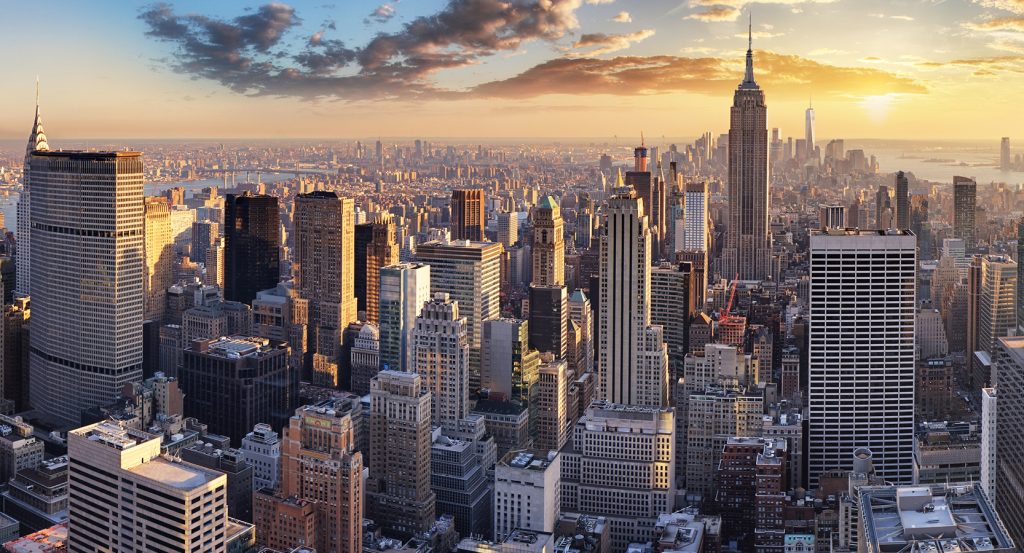
Why you should experience Hyatt Regency Times Square in New York, NY.
Hyatt Regency Times Square is a theatrical luxury hotel where Theater District's Broadway performance, neon mythology, entertainment culture and relentless metropolitan energy converge within a soaring glass tower directly above the action.
Set along Broadway near West 48th Street and just steps from Palace Theatre, the hotel rises 46 stories above Times Square within the former Crowne Plaza building, whose original Alan Lapidus architecture used reflective glass, pink granite and an immense Broadway-facing arch to embrace the visual intensity of its surroundings. Gensler's recent redesign shifted the interior language toward warm wood, stone-clad columns, bronze screens and residentially scaled furnishings, while colorful translucent ceiling discs reinterpret the geometry and illumination of theater marquees. A luminous porte cochere lined with programmable LED fins leads into a two-story lobby and glass atrium overlooking Broadway, creating an arrival sequence conceived around the district's relationship with light and performance. The result is a hotel where Alan Lapidus's exuberant tower and Gensler's contemporary interiors turn Theater District's visual language into architecture at one of Broadway's most conspicuous addresses.
What you should know about Hyatt Regency Times Square.
Hyatt Regency Times Square is best known for making its Manhattan debut on July 15, 2025 as the borough's first Hyatt Regency, introducing 795 newly renovated guestrooms at 1605 Broadway under owner Argent Ventures and manager Highgate after a multimillion-dollar overhaul led by Lucid in collaboration with Gensler and Hyatt. Gensler redesigned the 795-key property through a two-story lobby framed by stone-clad columns, bronze screens and marquee-inspired ceiling discs, while guestrooms combine oversized windows, channel-tufted headboards, marble accents, rust-toned seating and integrated millwork for storage and workspaces. The 46-story building places all guestrooms on upper floors, with accommodations exceeding 300 square feet and sightlines extending across Times Square, Manhattan and the Hudson River, while the largest Penthouse Suite reaches 969 square feet. Hyatt also partnered with MAMMA MIA! on a dedicated Greek-island-inspired guestroom tied to the musical's return to Broadway, extending the theatrical design concept into an accommodation created around a specific production. Manhattan's first Hyatt Regency, the 795-room program, Gensler interiors, Lucid development collaboration and Broadway production partnership collectively give the property an unusually direct relationship with the entertainment district surrounding it.
Architect Alan Lapidus established the building's original architectural personality through a 480-foot tower whose Broadway elevation centers on a 100-foot granite arch conceived with the visual exuberance of Wurlitzer organs from the early twentieth century. William Zeckendorf Jr. had assembled the site for the original hotel development, and Lapidus conceived an exterior of reflective glass and pink granite capable of supporting the enormous illuminated advertising surfaces becoming integral to Times Square's architectural identity. CUE 48 now develops the Hyatt chapter at lobby level through a marketplace modeled on a New York bodega and an all-day social restaurant serving New York-inspired shareable dishes and cocktails against views of Times Square. Together, Alan Lapidus, William Zeckendorf Jr., Gensler and CUE 48 connect the building's exuberant original architecture with its contemporary hospitality identity, preserving the essential relationship between 1605 Broadway and the theatrical performance outside its windows.
How to fold Hyatt Regency Times Square into your trip.
Hyatt Regency Times Square works as the anchor for an afternoon tracing Broadway history, American popular music and the machinery of live performance through the Theater District.
Begin at Museum of Broadway, where costumes, scenic models, photographs and production artifacts trace the evolution of New York theater through the writers, directors, designers, performers and productions that shaped Broadway across generations. Continue to Carnegie Hall, where Andrew Carnegie commissioned architect William Burnet Tuthill to create an auditorium that opened with Pyotr Ilyich Tchaikovsky participating in the inaugural festival and subsequently became one of New York's defining stages for classical music, jazz and popular performance. Conclude at Radio City Music Hall, where architect Edward Durell Stone and designer Donald Deskey created an immense Art Deco theater whose interiors, Great Stage and precision performance traditions expanded Midtown entertainment culture beyond Broadway's dramatic houses. The progression moves from Broadway's production history through the musical lineage of Carnegie Hall into Donald Deskey's theatrical architecture at Radio City Music Hall, revealing the concentration of performance culture surrounding Hyatt Regency Times Square.
Where your story begins.
Foresyte Travel reveals places that feel extraordinary long before you arrive.
Experience premium editorial crafted for luxury travelers.







































































































