
Why Carnegie Hall matters.
Carnegie Hall is a storied concert complex where Midtown's performing-arts culture meets Italian Renaissance architecture, three purpose-built auditoriums and an international musical legacy extending across more than 135 years.
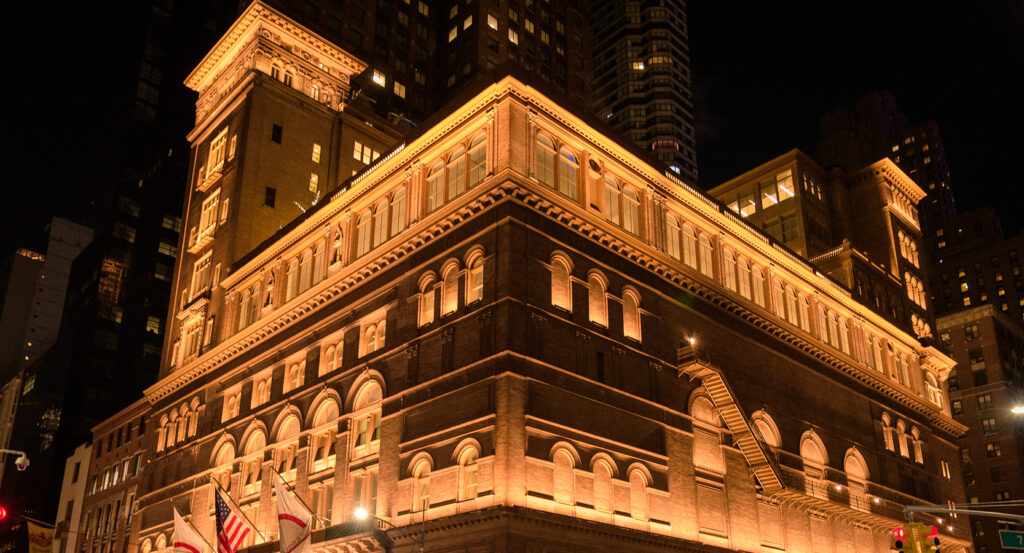
Set at 7th Avenue and West 57th Street near Broadway and just steps from the Russian Tea Room, the building occupies a prominent corner parcel where its reddish-brown Roman brick elevations extend along both major street fronts. William Burnet Tuthill organized the exterior through round arches, pilasters, horizontal bandcourses and architectural terra cotta, giving the substantial masonry structure a restrained Italian Renaissance character. Five great arches originally formed the principal 57th Street entrance composition, with the central openings leading toward the main auditorium and the outer openings feeding upper-level circulation. Upper floors rise through additional arcades and studio levels whose height gives the complex a vertical presence unusual for a nineteenth-century concert building. The result is an architecturally coherent arts complex whose brick massing, Renaissance detailing, arched entrances and stacked upper stories preserve the physical character of Tuthill's 1891 design amid Midtown's far taller twentieth-century skyline.
What defines Carnegie Hall.
Carnegie Hall is best known for becoming one of the principal stages of international music after Andrew Carnegie's patronage and conductor Walter Damrosch's ambitions produced a permanent New York home for large-scale concerts. Carnegie and his wife Louise met Damrosch during an Atlantic crossing in 1887, and the relationship developed into plans for the new Music Hall, with Tuthill receiving the architectural commission and construction beginning in 1889. Pyotr Ilyich Tchaikovsky became the special guest conductor for the five-day opening festival beginning May 5, 1891, placing one of Europe's foremost composers before New York audiences at the building's debut. Antonín Dvořák's Symphony No. 9, From the New World, received its world premiere there with the New York Philharmonic in 1893, two years after the opening festival. African American composer and baritone Harry T. Burleigh, whose spirituals influenced Dvořák during their association at the National Conservatory of Music, had already sung at Carnegie Hall with soprano Sissieretta Jones in 1892. James Reese Europe brought his Clef Club Orchestra to the hall for a 1912 Concert of Negro Music, creating another major chapter in the building's relationship with Black American music. Marian Anderson made her Carnegie Hall solo recital debut in 1928, eleven years before her celebrated Lincoln Memorial concert. Benny Goodman's orchestra followed with its January 16, 1938 concert, an important jazz event featuring an integrated group of musicians within a major concert auditorium. These successive appearances placed European symphonic premieres, Black classical performance and jazz within the same institution, giving Carnegie Hall an unusually broad role in the development of American concert culture.
A threat of demolition produced an equally consequential second life for the institution after owner Robert E. Simon Jr. placed Carnegie Hall on the market in 1955 and the planned departure of the New York Philharmonic for Lincoln Center weakened its commercial future. A preservation campaign gathered momentum after a January 1960 demolition announcement, with violinist Isaac Stern working alongside philanthropist Jacob M. Kaplan and drawing support from Eleanor Roosevelt, Jascha Heifetz, Arthur Rubinstein, Marian Anderson, Van Cliburn, Leopold Stokowski and other prominent figures. The Carnegie Hall Bill passed through the New York Legislature that April, enabling New York City to purchase the building and establish the nonprofit Carnegie Hall Corporation with Stern as its president. A $60 million campaign during the 1980s supported a 28-week restoration of the principal auditorium and recital hall, with the smaller room reopening in January 1987 as Joan and Sanford I. Weill Recital Hall. The lower auditorium followed a more unusual sequence: the original 1,200-seat Recital Hall became the 800-seat Carnegie Lyceum in 1896, Carnegie Playhouse in 1956 and Carnegie Hall Cinema in 1961 before a complete 1999-2003 reconstruction created the 599-seat Zankel Hall. Carnegie Hall subsequently converted its historic upper studio floors through the Studio Towers Renovation Project, creating the Resnick Education Wing, ensemble rooms, teaching studios, practice rooms and a dedicated home for the institution's archives. The preservation campaign that prevented demolition evolved into decades of architectural reinvestment, restoring two historic halls, reclaiming a third for live performance and converting former studio floors into an education center without abandoning the building that Stern fought to retain.
How Carnegie Hall fits.
Carnegie Hall works as the anchor for a Midtown outing connecting municipal performing arts, New York Reform Judaism and a Gilded Age private collection transformed into a public museum.
Begin at New York City Center, constructed in 1923 as the Shriners' Mecca Temple before Mayor Fiorello La Guardia and City Council President Newbold Morris rescued the threatened building and reopened it in 1943 as Manhattan's first performing-arts center. La Guardia conceived the institution as an affordable municipal theater for music and drama, creating a civic arts model distinct from the commercial Broadway houses surrounding Midtown. New York City Opera emerged there under Laszlo Halasz, and George Balanchine and Lincoln Kirstein established New York City Ballet at City Center in 1948; later performers included Leonard Bernstein, Paul Robeson, Beverly Sills, Helen Hayes, Orson Welles and Marcel Marceau. Continue to Central Synagogue, whose parent congregations Shaar Hashomayim and Ahawath Chesed originated among German-speaking immigrants in 1839 and 1846. Ahawath Chesed's 140 families commissioned Jewish architect Henry Fernbach to create a sanctuary seating more than 1,400 people on Lexington Avenue, dedicating the building in 1872 as the congregation followed New York's population northward. Ahawath Chesed merged with Shaar Hashomayim in 1898, adopted the Central Synagogue name in 1918 and remained at the site despite earlier consideration of another uptown move. Conclude at The Frick Collection, where industrialist Henry Clay Frick commissioned Carrère and Hastings in 1913 to design a 5th Avenue residence capable of housing his growing art collection and eventually becoming a public institution. Frick died in 1919 leaving the house, furnishings and art for a future gallery alongside a $15 million endowment; after Adelaide Frick's death in 1931, John Russell Pope expanded the residence with new galleries, a lecture and music room and the enclosed Garden Court. The museum opened publicly in 1935, and its holdings have since grown to 1,800 works spanning European fine and decorative arts, supplemented by the Frick Art Research Library founded by Helen Clay Frick. A comprehensive 2021-2025 project by Selldorf Architects expanded public access within the historic residence before the 5th Avenue museum reopened on April 17, 2025. The progression moves from La Guardia's municipal performing-arts institution through Fernbach's home for a growing Jewish congregation and culminates in Frick's private residence becoming a museum, connecting three distinct forms of cultural institution-building across Midtown and the Upper East Side.
Where your story begins.
Foresyte Travel reveals places that feel extraordinary long before you arrive.
Enjoy editorial crafted for luxury travelers.
Foresyte may earn a commission when you book.







































































































