Why you should experience Istanbul Archaeological Museums in Istanbul, Türkiye.
In the heart of Istanbul, tucked beside the storied walls of Topkapi Palace, Istanbul Archaeological Museums stand as a breathtaking gateway to the ancient world, a treasure trove where empires, faiths, and civilizations converge.
Wandering through its marble halls feels like stepping into a living chronicle of human history. The museum complex, which actually comprises three distinct institutions, the Archaeological Museum, the Museum of the Ancient Orient, and the Tiled Kiosk Museum, reveals the astonishing depth of Istanbul's heritage as the crossroads of East and West. Inside, thousands of artifacts whisper stories that span over 5,000 years: Hittite tablets etched with early cuneiform, Greco-Roman statues still radiant in their broken majesty, and Ottoman ceramics glowing with intricate geometry. Yet few exhibits command the same reverence as the Alexander Sarcophagus, an exquisite marble masterpiece discovered in Lebanon and believed to depict scenes from the life of Alexander the Great. Every hall exudes a hushed grandeur, as if time itself slows to honor what remains of the civilizations that once rose and fell along the Bosphorus. Outside, in shaded courtyards framed by ancient stone reliefs, you can feel the pulse of antiquity beneath your feet. Istanbul Archaeological Museums are not just a destination, they are the heart of Istanbul's eternal dialogue between the past and the present.
What you didn’t know about Istanbul Archaeological Museums.
Founded in 1891 by the visionary painter and archaeologist Osman Hamdi Bey, Istanbul Archaeological Museums were among the first modern museums in the world and the first of their kind in the Ottoman Empire.
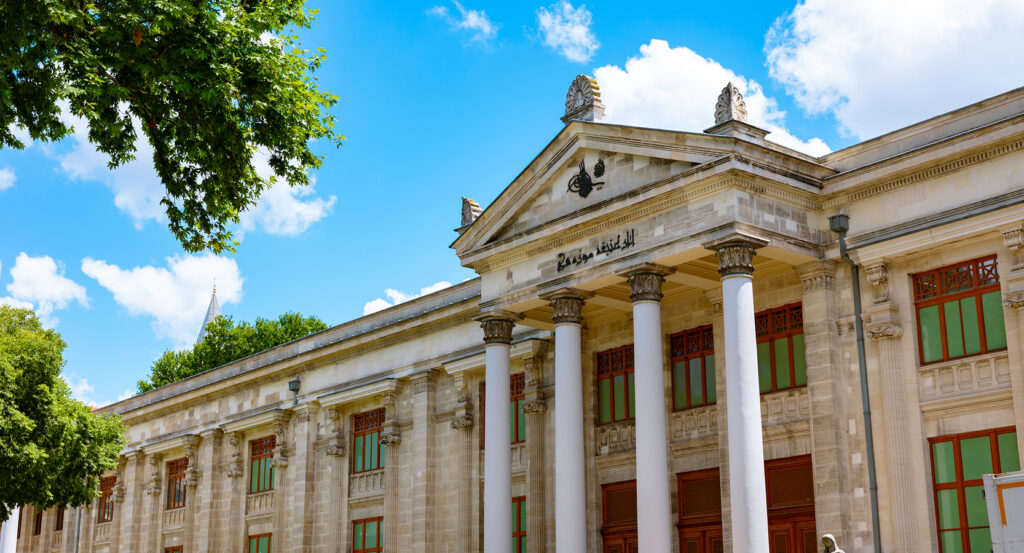
Hamdi Bey's mission was revolutionary: to preserve the empire's vast archaeological heritage within its own borders. He also famously excavated the Necropolis of Sidon, where he unearthed the legendary Alexander Sarcophagus and other monumental finds that became the museum's crown jewels. The main building's neoclassical façade, inspired by ancient Greek temples, symbolizes Istanbul's bridging of worlds, East and West, Islam and antiquity, memory and modernity. But the museum's collection extends far beyond the borders of Turkey. It houses artifacts from Mesopotamia, Egypt, Persia, and the Levant, including the world's earliest peace treaty, the Treaty of Kadesh, carved in cuneiform on a clay tablet more than 3,000 years ago. The Museum of the Ancient Orient offers a window into the dawn of civilization, while the Tiled Kiosk Museum, built in 1472, immerses visitors in the artistry of Iznik tilework and Seljuk design. Few realize that the museum was instrumental in shaping modern archaeology itself, pioneering conservation methods, artifact cataloging, and cultural preservation laws that influenced museum practices across Europe. Even today, ongoing restoration efforts and rotating exhibitions ensure that the Istanbul Archaeological Museums remain a living, evolving institution, one that honors the layered soul of a city once known as Byzantium and Constantinople.
How to fold Istanbul Archaeological Museums into your trip.
Visiting Istanbul Archaeological Museums is a journey through time that rewards patience and quiet curiosity.
Set aside at least three hours, ideally half a day, to explore the three museums at a comfortable pace. Begin in the Archaeological Museum, where monumental sarcophagi and marble statues fill vast galleries with echoes of empire. Don't rush, take a moment to admire the intricate carvings on the Alexander Sarcophagus, where battle scenes flow like living frescoes across stone. Then move to the Museum of the Ancient Orient, whose dimly lit halls and clay tablets create an almost sacred atmosphere. Here, you'll encounter relics from Babylon, Assyria, and ancient Anatolia that speak of humankind's first steps toward written history. Finally, wander into the Tiled Kiosk Museum, a serene oasis of color and geometry where turquoise and cobalt tiles shimmer under soft light, a perfect close to a day immersed in antiquity. Between museums, pause in the courtyard to take in the scent of aged stone and magnolia trees, with the faint call to prayer echoing from nearby mosques. The complex sits within Gülhane Park, a short walk from Topkapi Palace and the Hagia Sophia, making it easy to fold into a broader day of cultural exploration in Istanbul's historic peninsula. By the time you step back into the city's hum, you'll realize you haven't just seen history, you've stood in the presence of it. Istanbul Archaeological Museums remind you that every stone, script, and shard is part of a larger story, one that began millennia ago and still shapes the world we know today.
Where your story begins.
Start your planning journey with Foresyte Travel.
Experience immersive stories crafted for luxury travelers.