
Why Danube River matters.
Danube River is where the Budapest's heartbeat is most alive, the waterway that binds, divides, and defines the city.
Standing at its edge, watching boats glide beneath the arches of the bridges, you can feel the rhythm of centuries pulsing through the current. The Danube isn't just a river here; it's the thread that weaves two halves of a single soul, Buda, noble and storied, and Pest, animated and electric. Crossing it is more than a commute; it's a ritual. Whether you walk the Széchenyi Chain Bridge at dawn, ride the tram that skirts the riverbank, or drift across by night ferry under a ceiling of stars, each passage feels like an act of reverence. The view alone stops time, domes, spires, and bridges shimmering in gold and glass. Crossing Danube River is not about getting from one side to the other. It's about standing in the middle, suspended between worlds, and realizing that connection is the city's truest art form.
What defines Danube River.
Danube has been both lifeline and battleground for millennia, shaping every chapter of Budapest's story.
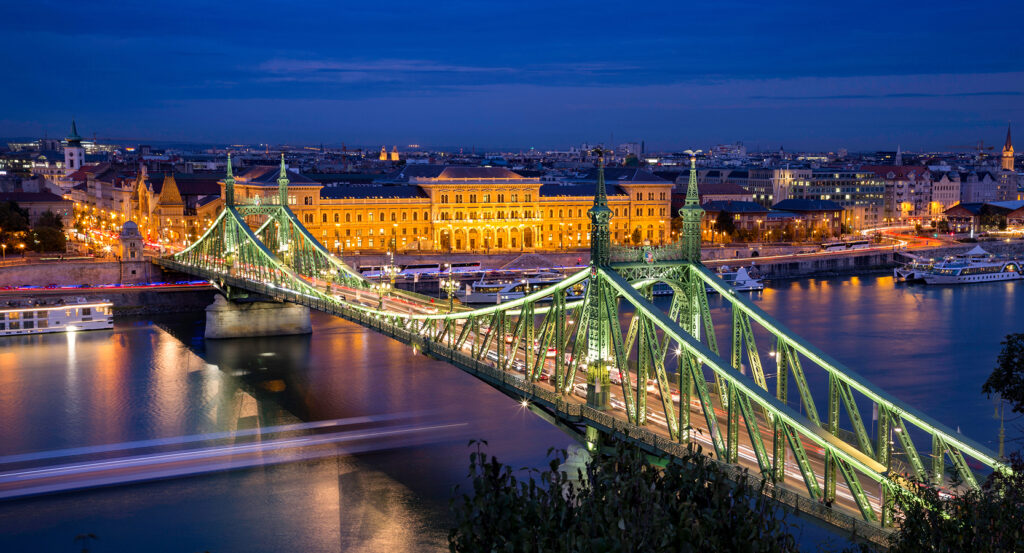
In Roman times, it marked the empire's northern frontier, a natural border that separated civilizations. Later, it became the artery of trade that brought silk, spices, and song from Vienna to Belgrade. The first permanent bridge across these waters, the Széchenyi Chain Bridge, opened in 1849, symbolizing not just progress but unity, stitching Buda and Pest into the single metropolis we know today. The Danube itself, Europe's second-longest river, runs through ten countries, but it belongs to Budapest in a way no map can explain. Beneath its serene surface lies a living archive, stories of emperors, poets, lovers, and revolutionaries carried downstream. Each bridge tells its own tale: Liberty Bridge with its emerald ironwork and Art Nouveau flair, Margaret Bridge curving gracefully toward its island oasis, and Elizabeth Bridge spanning the river like a white ribbon of light. Few realize that beneath the waves, an intricate network of cables and pipelines links both sides of the city, unseen veins sustaining the lifeblood of a capital forever looking toward the water.
How Danube River fits.
Experience Danube not as a backdrop, but as a journey in itself.
Begin with a walk across the Chain Bridge, it's best just before sunset, when the city begins to glow and the river mirrors every flicker of light. Continue along the Danube Promenade, letting your eyes trace the skyline: Parliament to the north, Gellért Hill rising to the south. For a slower rhythm, board a river cruise after dusk; as the lights of Buda Castle, the Fisherman's Bastion, and St. Stephen's Basilica ignite, the water becomes a mirror of heaven. If you visit in summer, take the tram along the embankment, Line 2 is often called the world's most beautiful commute, and watch the bridges drift by like moving monuments. Pause at Liberty Bridge to watch locals gather, drink wine, and watch the sunset. In winter, when mist rolls low across the water, stand by the riverbanks and listen, the Danube hums softly, as if whispering the city's oldest secrets. Danube River is Budapest's living pulse, an ever-moving reflection of resilience, connection, and grace.
Where your story begins.
Foresyte Travel reveals places that feel extraordinary long before you arrive.
Enjoy editorial crafted for luxury travelers.
Foresyte may earn a commission when you book.





































































































