
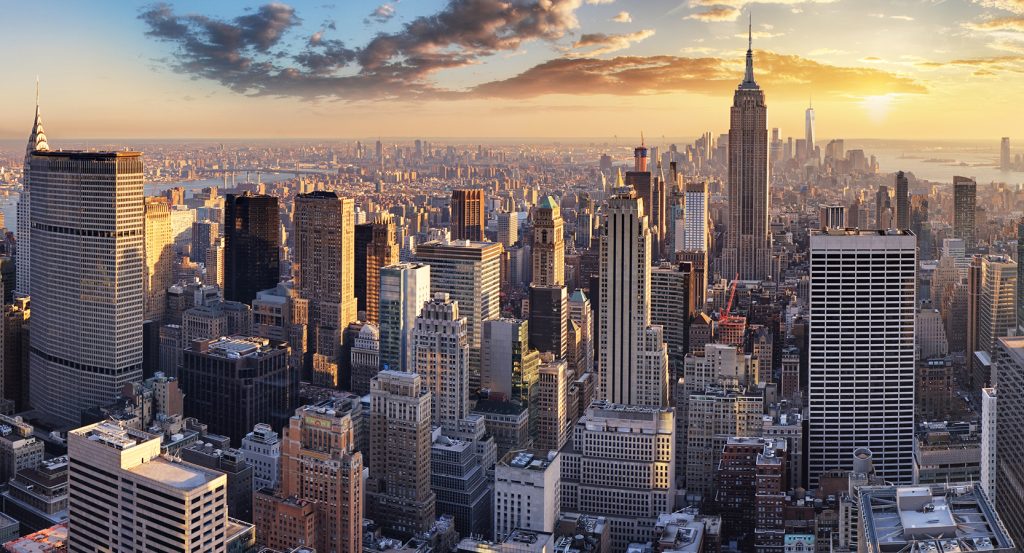
Why Manhattan Center matters.
Manhatta is an elevated contemporary American restaurant where the Financial District's skyscraper architecture meets Danny Meyer's hospitality philosophy, panoramic views of New York Harbor and a culinary program shaped by the traditions of French fine dining.
Set atop 28 Liberty Street near Nassau Street and just steps from Federal Plaza, the restaurant occupies the sixtieth floor of a modernist office tower rising above the dense commercial streets of Lower Manhattan. Floor-to-ceiling windows frame an expansive panorama encompassing the East River, Brooklyn Bridge, Hudson River and the waterways surrounding the southern tip of Manhattan. The interior combines warm wood, polished stone, upholstered seating and carefully arranged lighting with an open architectural composition that gives the skyline a commanding presence throughout the dining room. A dedicated bar and lounge extend the setting beyond formal dining, creating distinct environments for cocktails, conversation and meals overlooking the surrounding city. The result is a restaurant whose extraordinary elevation and architectural setting transform the geography of New York into a defining part of the dining encounter.
What defines Manhattan Center.
Manhatta is best known for bringing Danny Meyer's Union Square Hospitality Group into the upper floors of a landmark modernist skyscraper through a contemporary American restaurant that combines ambitious cooking with one of New York's most expansive dining-room panoramas. Meyer established Union Square Cafe in 1985, developing an approach to hospitality centered on service, staff relationships and the social importance of restaurants. Gramercy Tavern followed in 1994, strengthening his reputation for creating dining institutions that combined sophisticated cooking with a welcoming atmosphere. His organization subsequently developed restaurants including The Modern, reinforcing its position within New York's fine-dining culture. Manhatta opened in 2018 inside the former One Chase Manhattan Plaza, introducing a major restaurant into a tower associated with the transformation of Lower Manhattan's corporate architecture during the postwar decades. Skidmore, Owings & Merrill designed the building under Gordon Bunshaft, whose work helped establish the style of American corporate modernism. Completed in 1961, the tower became a defining project of David Rockefeller's effort to consolidate Chase Manhattan Bank operations in the Financial District. Its steel-and-glass exterior, expansive plaza and disciplined structural grid introduced a new architectural scale into an area historically dominated by narrower streets and older commercial buildings. Fosun International acquired the property in 2013, and the building subsequently received the 28 Liberty Street address. Manhatta entered this architectural setting as part of the tower's repositioning, bringing public hospitality into a building originally conceived around corporate banking operations. Jason Pfeifer became the restaurant's founding executive chef, bringing experience from Gramercy Tavern and Maialino to a menu grounded in contemporary American cooking. The restaurant's original format centered on a prix fixe dining experience supported by the expansive views and Union Square Hospitality Group's established service standards. Manhatta subsequently evolved its culinary and hospitality program, expanding the relationship between formal dining, bar service and a broader range of guest occasions. The restaurant's development connects a major New York hospitality organization with the architectural history of Lower Manhattan's financial institutions and the transformation of corporate towers into destinations for public dining.
Manhatta's culinary character draws on French technique and seasonal American ingredients through compositions that emphasize precision, concentrated flavor and carefully controlled presentation. Executive chef Justin Bogle brought experience from several of the country's most demanding fine-dining kitchens, including Le Bernardin and Gilt, before taking a leading role in the restaurant's culinary direction. His background established a foundation in classical technique, seafood preparation and the disciplined execution associated with tasting-menu restaurants. The kitchen develops dishes through the relationship between a principal ingredient and a tightly constructed group of supporting components, allowing sauces, garnishes and textures to contribute distinct functions within each plate. Seafood preparations emphasize accurate cooking temperatures and the preservation of delicate natural flavors, supported by reductions and acidic elements that sharpen the composition. Meat courses introduce deeper stocks, carefully managed fats and concentrated sauces, establishing greater intensity within the sequence. Seasonal vegetables contribute changes in sweetness, bitterness and texture, giving the menu a direct relationship with agricultural availability throughout the year. The restaurant's pastry program extends that precision through composed desserts built around fruit, chocolate, creams and contrasting temperatures. Wine service connects the culinary program with established European regions and American producers, creating pairings that respond to the sequence of flavors across a meal. The bar develops another dimension through cocktails that combine classic foundations with contemporary ingredients and presentation. Service coordinates these elements through attentive pacing and detailed knowledge of the menu, maintaining continuity between the kitchen, dining room and surrounding skyline. The culinary approach places technical refinement and seasonal variation at the center of a restaurant whose setting gives every meal a powerful geographical context.
How Manhattan Center fits.
Manhatta works as the dining centerpiece for a Lower Manhattan itinerary connecting the history of American finance, the origins of New York's federal government and one of the city's most significant surviving colonial churches.
Begin at Federal Hall National Memorial, occupying the site where New York's original City Hall became the first capitol building of the United States under the Constitution. George Washington took the presidential oath on its balcony on April 30, 1789, establishing the location as a central site in the formation of the federal government. The First Congress met there and adopted legislation establishing major institutions of the new republic, including the federal judiciary. The original structure was demolished in 1812, and the surviving Greek Revival building was completed in 1842 as the United States Custom House. Architects Ithiel Town and Alexander Jackson Davis developed the design, drawing on classical forms associated with ancient democratic government. Continue to Museum of American Finance, founded in 1988 by financial historian John E. Herzog to preserve and interpret the history of American financial markets and institutions. Its collections encompass securities, currency, financial documents and objects connected with the development of banking, investment and commerce. The institution occupied the former Bank of New York headquarters at 48 Wall Street, a building associated with one of the country's oldest banking organizations. Exhibitions have examined figures including Alexander Hamilton and the development of the securities markets that helped establish New York as a global financial center. The museum's educational mission connects the district's historic banking institutions with the economic systems that shaped American business. Conclude at Trinity Church, whose congregation received a royal charter from William III in 1697 and developed into one of colonial New York's most influential religious institutions. The original church was destroyed during the Great Fire of 1776, and a second building subsequently occupied the site before structural deterioration required replacement. Richard Upjohn designed the surviving Gothic Revival church, completed in 1846 with a prominent spire that dominated the Manhattan skyline during the nineteenth century. Its churchyard contains the graves of Alexander Hamilton, Elizabeth Schuyler Hamilton and other figures associated with the city's early political and commercial history. The progression moves from the establishment of the federal government through the development of American financial institutions and culminates in a colonial religious foundation whose architecture and burial ground preserve centuries of Lower Manhattan history.
Where your story begins.
Foresyte Travel reveals places that feel extraordinary long before you arrive.
Enjoy editorial crafted for luxury travelers.
Foresyte may earn a commission when you book.







































































































