
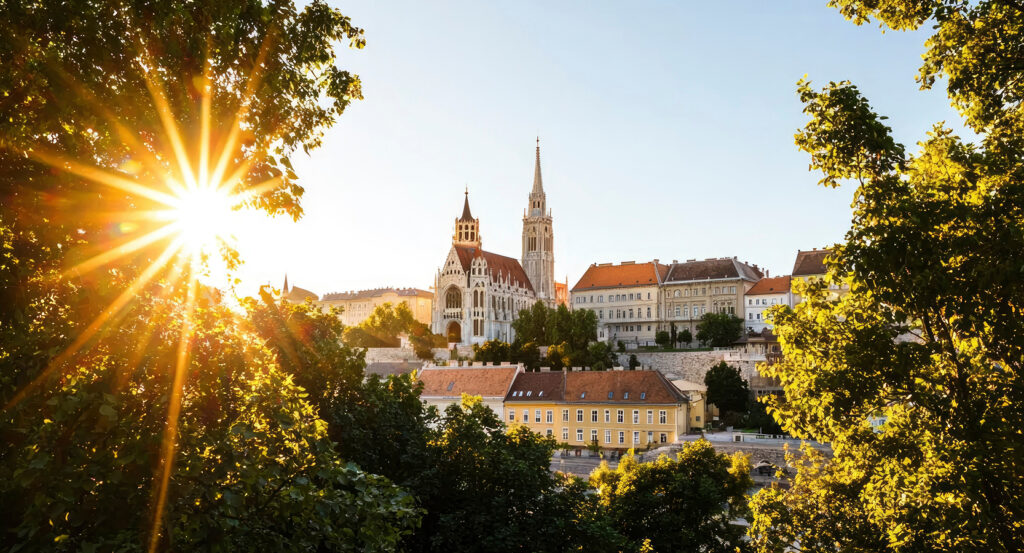
Why The Church of Our Lady of Buda Castle matters.
The Church of Our Lady of Buda Castle is a Gothic church where Castle District's royal legacy, medieval craftsmanship, centuries of worship, and Hungarian statehood have shaped one of Budapest's most treasured sacred spaces.
Set along Szentháromság tér near Országház utca and just steps from Fisherman's Bastion, this richly ornamented church welcomes visitors through soaring ribbed vaults, painted chapels, stained-glass windows, sculpted stone columns, intricate tracery, and one of Europe's most distinctive patterned ceramic roofs. Every interior reveals another chapter of Hungarian history as royal ceremonies, coronations, military occupations, religious transformation, and meticulous restoration have each left enduring marks upon the building. Rising above Castle Hill with its slender Neo-Gothic tower, the church remains the spiritual centerpiece of historic Buda through nearly a millennium of faith, craftsmanship, and national history.
What defines The Church of Our Lady of Buda Castle.
The Church of Our Lady of Buda Castle is best known for tracing its origins to the reign of Saint Stephen I during the early eleventh century before King Béla IV rebuilt the church between 1255 and 1269 following the Mongol invasion, establishing the Gothic structure that became the principal parish church of medieval Buda. During the reign of King Matthias Corvinus between 1458 and 1490, the church underwent substantial expansion with the construction of its soaring southern bell tower, while the king celebrated both of his marriages within its walls, giving rise to the widely used name Matthias Church despite its formal dedication to the Virgin Mary. Following the Ottoman conquest of Buda in 1541, the building served as the city's principal mosque for 145 years after Christian imagery was removed and the interior adapted for Islamic worship before Catholic services resumed following the Habsburg reconquest in 1686. Between 1873 and 1896, architect Frigyes Schulek directed an exhaustive restoration that removed many Baroque additions, reconstructed Gothic architectural elements using archaeological evidence, introduced the colorful Zsolnay ceramic roof tiles, commissioned richly painted interior decoration by artists Bertalan Székely and Károly Lotz, and simultaneously designed neighboring Fisherman's Bastion to frame the church during Hungary's Millennium celebrations. The church later hosted the coronations of Emperor Franz Joseph I and Queen Elisabeth in 1867, followed by King Charles IV and Queen Zita in 1916, while today it forms part of the UNESCO-listed Buda Castle Quarter and continues serving as an active Roman Catholic parish alongside one of Central Europe's most significant medieval churches.
Centuries of political and religious change remain visible throughout the interior. Visitors encounter the red marble tomb of King Béla III and Queen Agnes of Antioch, transferred here in 1898 after their remains were rediscovered at Székesfehérvár, together with Gothic chapels, medieval stone carvings, historic organs, royal memorials, surviving Ottoman inscriptions, ecclesiastical treasures, liturgical objects, and stained glass that collectively preserve nearly one thousand years of Hungarian royal, artistic, and religious history. Every gallery, chapel, and architectural detail reflects the evolving character of a church that has stood at the center of Hungary's national story for generations.
How The Church of Our Lady of Buda Castle fits.
The Church of Our Lady of Buda Castle works as the centerpiece of an exploration through Castle Hill's royal and religious heritage.
Begin at Fisherman's Bastion, where sweeping terraces overlooking the Danube establish the historic atmosphere before entering The Church of Our Lady of Buda Castle. Continue to Buda Castle, whose royal courtyards, museums, and centuries of Hungarian history deepen appreciation for the district's importance. Conclude at Hospital in the Rock Museum, where underground tunnels and wartime history reveal another dimension of Castle Hill beneath the streets above. The progression moves naturally from panoramic viewpoints to sacred history before concluding below the hill itself, revealing why this church remains central to understanding Budapest's historic core.
Where your story begins.
Foresyte Travel reveals places that feel extraordinary long before you arrive.
Enjoy editorial crafted for luxury travelers.
Foresyte may earn a commission when you book.





































































































