
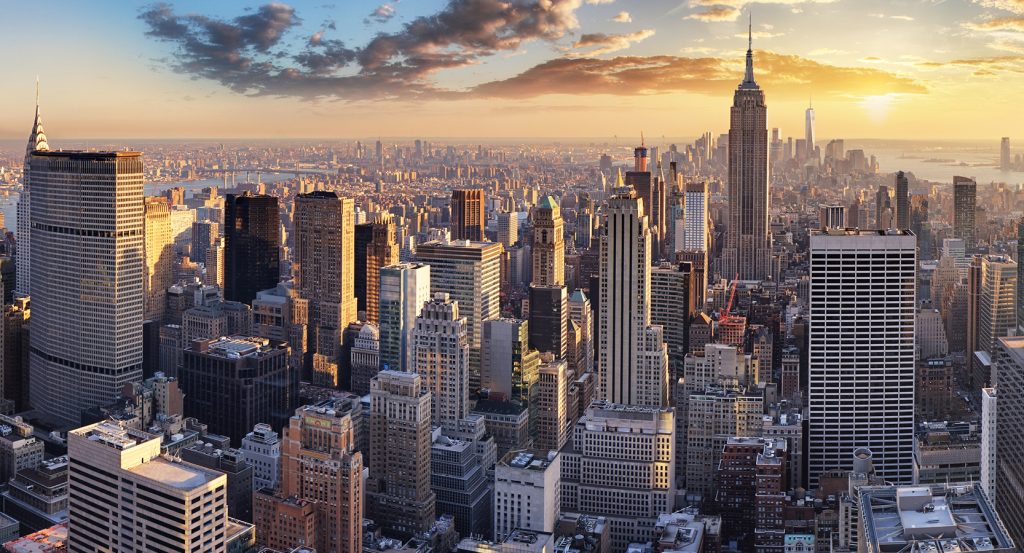
Why you should experience Moxy NYC Times Square in New York, NY.
Moxy NYC Times Square is an inventive lifestyle hotel where the Garment District's manufacturing ingenuity, fashion lineage, design experimentation and rebellious social energy converge within a former early twentieth-century hotel reworked around compact living and expansive communal space.
Set along 7th Avenue near West 36th Street and just steps from Herald Square, the hotel occupies the former New Mills Hotel, built in 1907 before Lightstone commissioned Stonehill Taylor, Yabu Pushelberg and Rockwell Group to reinterpret the substantial Midtown structure through three distinct layers of architecture, accommodation and social design. Stonehill Taylor handled the architectural conversion, while Yabu Pushelberg treated guestrooms as highly engineered environments where peg walls, under-bed storage and foldaway desks, chairs and luggage racks replace much of the fixed furniture associated with conventional Manhattan hotels. Rockwell Group concentrated a contrasting sense of scale in the communal interiors, creating gathering spaces whose theatrical visual language draws guests away from the deliberately efficient rooms and into the building's shared social environment. The result is a hotel where Stonehill Taylor, Yabu Pushelberg and Rockwell Group turn the Garment District's longstanding culture of fabrication and spatial problem-solving into a hospitality concept built around collaboration between architecture, furniture and entertainment.
What you should know about Moxy NYC Times Square.
Moxy NYC Times Square is best known for opening in 2017 as a 612-room Marriott property developed by Lightstone inside the former New Mills Hotel, establishing one of the largest early American expressions of the Moxy brand through a collaboration among Yabu Pushelberg, Rockwell Group and TAO Group. The property combines 612 Yabu Pushelberg-designed guestrooms with more than 22,000 square feet of event space, while accommodation configurations range from kings and doubles to quad bunk rooms and queen rooms with elevated twin loft beds. Rockwell Group designed the hotel's dining and entertainment environments for TAO Group, including Bar Moxy, Legasea Bar & Grill and Magic Hour, extending the design program from compact sleeping quarters into substantially larger gathering spaces. Magic Hour occupies 10,000 square feet of weatherized indoor and outdoor rooftop space, incorporating multiple bars, Empire State Building views, garden-inspired areas and a rotating seating installation within a deliberately carnivalesque environment. Lightstone's development scale, Marriott's Moxy platform, Yabu Pushelberg's room engineering, Rockwell Group's entertainment architecture and TAO Group's operating program established the property as a significant experiment in concentrating private space while dramatically expanding the social life of a Manhattan hotel.
Blind Barber deepens that collaborative model through the company's first hotel barbershop location, placing a four-chair grooming studio directly inside Moxy NYC Times Square as an operating business. Yabu Pushelberg extends the same philosophy of functional compression through open peg walls and furniture designed to fold away, allowing individual pieces to alternate among working, eating, storage and seating functions. TAO Group reverses that compression upstairs at Magic Hour, where 10,000 square feet accommodate separate indoor and outdoor environments, multiple bars, audiovisual infrastructure and year-round programming beneath a weatherized rooftop enclosure. Together, Blind Barber, Yabu Pushelberg, TAO Group and Magic Hour demonstrate how Moxy NYC Times Square distributes different functions among specialized collaborators, turning guestrooms, grooming, dining and nightlife into interconnected components of a single hospitality concept.
How to fold Moxy NYC Times Square into your trip.
Moxy NYC Times Square works as the anchor for an afternoon tracing fashion craftsmanship, literary collecting and skyscraper ambition through the blocks surrounding the Garment District.
Begin at Museum at FIT, where Fashion Institute of Technology maintains a collection exceeding 50,000 garments and accessories dating from the eighteenth century to the present, connecting the district's manufacturing history with designers including Chanel, Dior, Balenciaga and Comme des Garçons. Continue to The Morgan Library & Museum, where financier J. Pierpont Morgan commissioned Charles Follen McKim to create his private library, surrounding manuscripts, rare books and works on paper with marble, carved wood, painted ceilings and Renaissance-inspired architectural composition. Conclude at Empire State Building, where Shreve, Lamb & Harmon translated the commercial ambition of interwar Manhattan into a skyscraper whose steel frame rose with remarkable speed and permanently altered the visual character of Midtown. The progression moves from the materials and construction techniques preserved by Fashion Institute of Technology through McKim's architecture of collecting into the engineering ambition of Shreve, Lamb & Harmon, revealing the culture of making, design and vertical invention surrounding Moxy NYC Times Square.
Where your story begins.
Foresyte Travel reveals places that feel extraordinary long before you arrive.
Experience premium editorial crafted for luxury travelers.







































































































