
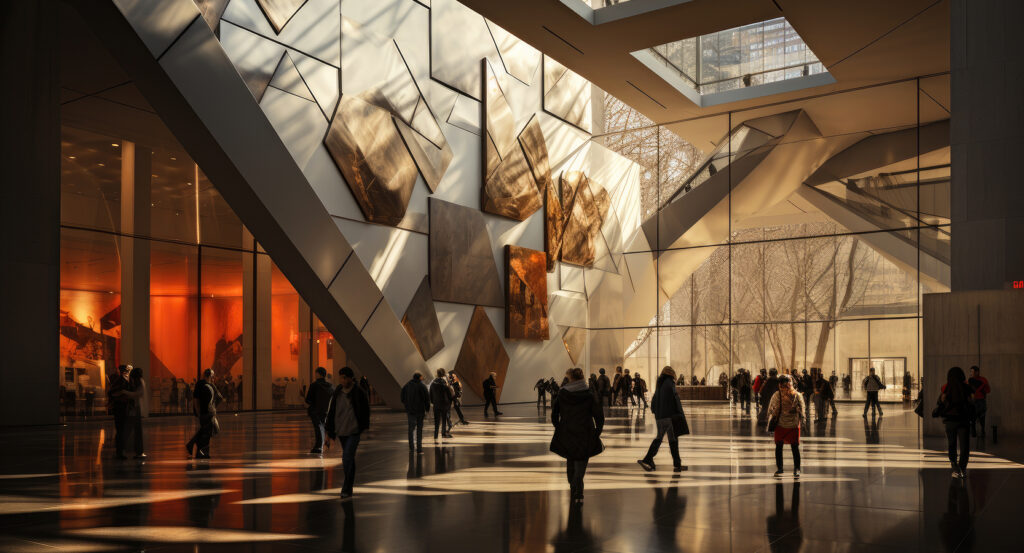
Why The Museum of Modern Art matters.
The Museum of Modern Art is a pioneering art museum where Midtown's cultural concentration meets an encyclopedic collection spanning painting, sculpture, photography, film, architecture, design, performance and new media across a continually evolving Manhattan campus.
Set along West 53rd Street near 5th Avenue and just steps from Rockefeller Center, the museum occupies a deep Midtown site extending toward West 54th Street, with galleries arranged around a central atrium and multiple vertical routes linking its street-level spaces to six floors of art. Diller Scofidio + Renfro with Gensler completed a major expansion in 2019 that added more than 40,000 square feet of gallery space and opened new ground-floor galleries directly toward the surrounding streets. Broad interior openings connect galleries across floors, allowing paintings, sculpture, performance and large-scale installations to remain visible across substantial distances within the building. The central atrium accommodates works demanding exceptional height and floor area, with bridges, stairs and surrounding galleries creating changing perspectives through the museum's interior. The result is a vertically layered museum whose street-facing galleries, immense atrium and interconnected exhibition floors give modern and contemporary art an architectural presence extending from individual objects to the scale of the building itself.
What defines The Museum of Modern Art.
The Museum of Modern Art is best known for changing how modern art was collected, exhibited and interpreted after Lillie P. Bliss, Mary Quinn Sullivan and Abby Aldrich Rockefeller founded the institution in 1929 with original trustees A. Conger Goodyear, Paul Sachs, Frank Crowninshield and Josephine Boardman Crane. Founding director Alfred H. Barr Jr. pursued an institution devoted to the visual arts of its own era, giving painting and sculpture institutional company with architecture, design, photography and film as the museum developed. MoMA opened on November 7, 1929 in rented rooms at 730 5th Avenue, days after the stock market crash, with Cézanne, Gauguin, Seurat, van Gogh, an inaugural exhibition championed by its female founders over an alternative proposal centered on American artists. The institution moved through three temporary homes during its first decade as public demand expanded, then opened its first purpose-built West 53rd Street building by Philip L. Goodwin and Edward Durell Stone in 1939. Bliss transformed the young museum's holdings after her death in 1931 through a bequest exceeding 150 works, including paintings and works on paper by Paul Cézanne, Odilon Redon, Georges-Pierre Seurat and Pablo Picasso, creating the core around which MoMA's permanent collection developed. Abby Aldrich Rockefeller supplied another foundational strand through 1,600 prints collected between 1925 and 1935, helping form the original Print Department, and she gave the land used for the museum's sculpture garden. MoMA created the world's first curatorial department devoted to architecture and design in 1932, building holdings that now encompass 28,000 works including architectural models and drawings, furniture, appliances, textiles, graphic design, automobiles and the Mies van der Rohe Archive. Photography entered the collection in 1930, and that field subsequently grew beyond 35,000 works ranging from early daguerreotypes to contemporary images. More than 3,500 exhibitions since the inaugural 1929 presentation trace an institutional history in which the definition of modern art repeatedly expanded across artistic disciplines. Bliss, Rockefeller, Sullivan and Barr gave MoMA an unusually broad mandate from its first years, creating a museum whose collecting structure helped place forms once separated across specialized institutions inside a single account of modern culture.
The Abby Aldrich Rockefeller Sculpture Garden became another major chapter in MoMA's development when it opened in 1939 as an outdoor gallery joining sculpture, architecture and planting within the museum complex. Philip Johnson, the first director of MoMA's architecture department, redesigned the garden in 1953 as a “roofless room,” dividing it into four marble-paved areas organized around fountain pools, trees, seasonal planting and sculpture. Johnson enlarged the garden to 35,000 square feet in 1964 through an upper terrace developed with landscape architects Zion and Breen, creating stepped levels and ceremonial marble stairs within a courtyard enclosed on three sides by museum buildings. Works associated with the garden across subsequent decades have included Pablo Picasso's She-Goat, Henri Matisse's The Backs, Aristide Maillol's The River, Hector Guimard's Paris Métro entrance and Isa Genzken's 36-foot Rose II. Conservation developed in parallel after a museum fire prompted the creation of a dedicated department in 1958, initially centered on paintings before expanding into works on paper, sculpture, photography and time-based media, with film stewardship concentrated at the Celeste Bartos Film Preservation Center. Scientific research joined those specialties through analysis of artworks and the development of new approaches for their long-term preservation, placing technical study alongside curatorial scholarship. Johnson's garden and the conservation department reveal two complementary consequences of MoMA's expanding collection: one created a purpose-built outdoor setting for modern sculpture, and the other built the specialized expertise required to preserve increasingly diverse forms of art.
How The Museum of Modern Art fits.
The Museum of Modern Art works as the anchor for an afternoon tracing Midtown through the preservation of broadcast culture, Austrian architectural experimentation and the nineteenth-century Gothic ambitions of New York's Catholic community.
Begin at The Paley Museum, founded by CBS leader William S. Paley in 1975 to collect, preserve and interpret television and radio programming for public access. The Museum of Broadcasting opened the following year at 1 East 53rd Street with 718 broadcasts available across three floors, then expanded its remit as cable and satellite programming altered the media landscape and adopted the Museum of Television & Radio name in 1991. Philip Johnson designed the William S. Paley Building on West 52nd Street, which opened that September as the institution's permanent New York home; the Paley Archive has since grown beyond 160,000 programs, carrying Paley's original preservation project across successive eras of television and radio. Continue to Austrian Cultural Forum New York, Raimund Abraham's 24-story cultural tower on a midblock parcel only 25 feet wide and 81 feet deep. Abraham won Austria's 1992 architectural competition from 226 submissions, then worked with Ove Arup & Partners on a concrete, glass and steel structure whose sharply tapering profile stacks exhibition galleries, performance areas, library functions and residential space through one of Manhattan's most constrained cultural sites. Construction began in September 1998, finished in January 2002 and culminated in an April dedication and public opening, giving Abraham his principal built work in New York after decades of teaching, drawing and architectural experimentation. Conclude at St. Patrick's Cathedral, whose origins on 5th Avenue reach to Archbishop John Hughes's decision to commission James Renwick Jr. for a vast white-marble Gothic Revival cathedral north of the city's established commercial center. Renwick received the commission in 1853, the cornerstone was laid on August 15, 1858 and the Civil War interrupted construction before work resumed under Archbishop John McCloskey. Thousands of immigrant contributors joined 103 prominent citizens who pledged $1,000 apiece toward the project, and a major fundraising fair in 1878 preceded the cathedral's opening on May 25, 1879. The progression moves from Paley and Johnson's preservation of broadcasting through Abraham's compressed Austrian cultural tower into Hughes and Renwick's nineteenth-century cathedral, tracing how media, international culture and religious patronage acquired permanent architectural homes across Midtown.
Where your story begins.
Foresyte Travel reveals places that feel extraordinary long before you arrive.
Enjoy editorial crafted for luxury travelers.
Foresyte may earn a commission when you book.







































































































