
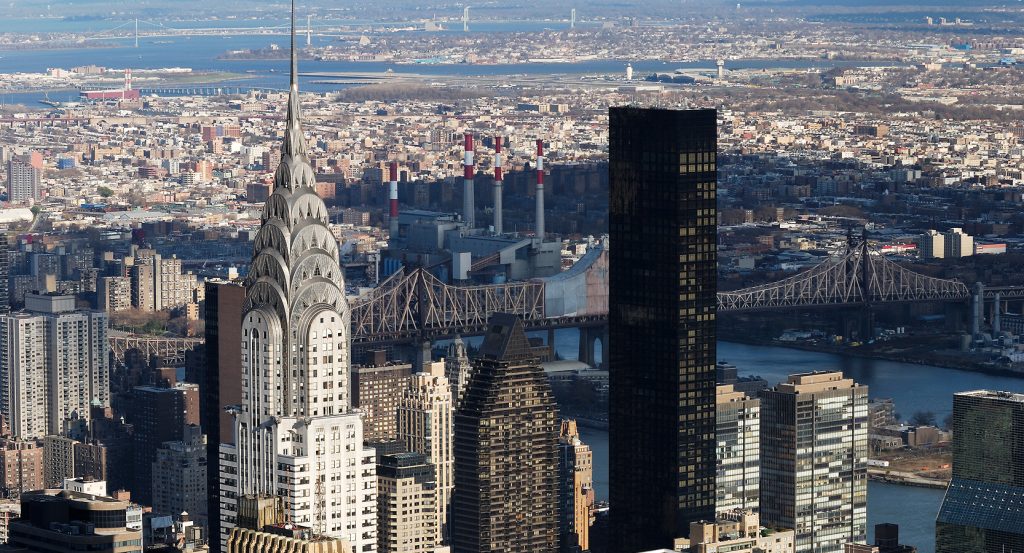
Why Queensboro Bridge matters.
Queensboro Bridge is a mighty cantilever crossing where Sutton Place's East River edge meets immense steelwork, five linked spans and an engineering form that binds Manhattan, Roosevelt Island and Queens.
Set above the East River near East 59th Street and just steps from Mount Vernon Hotel Museum & Garden, the bridge leaves Manhattan through a dense steel approach before crossing Roosevelt Island and reaching Long Island City. Rough-faced masonry piers carry enormous trussed cantilevers whose exposed diagonals, upper chords and steel towers remain legible across the full river crossing. Two stacked transportation levels thread through the structure, placing roadways, pedestrian movement and bicycle traffic inside a structure that rises and falls around the central island. Beaux-Arts masonry at the Manhattan anchorage adds stone arches, stair towers and architectural detailing beneath the industrial steel superstructure, giving the western approach a markedly different physical character from the river spans. The result is a layered crossing whose stone approaches, stacked decks, immense trusses and intermediate footing on Roosevelt Island make its engineering structure inseparable from the journey between Manhattan and Queens.
What defines Queensboro Bridge.
Queensboro Bridge is best known for carrying the cantilever principle to unprecedented scale when it opened in 1909, with a design shaped through competing proposals, engineering revisions and unusually demanding structural analysis. Proposals for an East River crossing through Blackwell's Island had circulated since the early nineteenth century, and John A. Roebling produced one unrealized concept in 1856 before the city eventually committed to a crossing near 59th Street. R. S. Buck, S. R. Probasco and J. Shea developed an initial multiple-span cantilever scheme, and foundation construction had begun by late 1901 when Gustav Lindenthal became New York City Commissioner of Bridges. Lindenthal proposed a substantially different structural concept without suspended spans between the cantilever arms and employed massive steel eyebars in the upper chords, prompting Mayor Seth Low to appoint an independent engineering panel to assess the competing schemes. The final solution combined Buck's deck cross-section with Lindenthal's continuous structural concept, requiring dead loads to act through pure cantilever action and live loads through continuous-bridge behavior. Henry Hornbostel supplied the architectural treatment, joining major bridge engineering with carefully composed masonry elements at the approaches. Collapse of the first Quebec Bridge during construction in 1907 triggered another intensive examination of the New York design, and engineers subsequently removed two of four planned upper-level rail lines to reduce structural load. At completion, the Manhattan-to-Blackwell's Island span measured 1,182 feet and the island-to-Queens span 984 feet, giving the bridge the two longest steel cantilever spans then built anywhere in the world. The 1,182-foot section remained North America's longest cantilever span until the Quebec Bridge opened in 1917 and the longest in the United States until 1930.
The completed crossing immediately altered the transportation geography of Queens through a capacity conceived for several modes at once. Its original configuration carried two elevated railway lines, two trolley lines, six carriage lanes and two pedestrian walkways across an overall structure measuring 3,724.5 feet between its principal ends. Approximately 75,000 tons of steel went into the bridge and approaches, and the original project cost $18 million, including $4.6 million devoted to acquiring land. Trolley service extended from the bridge into Queens after the 1909 opening, and the broader transportation investment accelerated development around Queens Plaza and Long Island City during the decades after Greater New York's 1898 consolidation. Rail functions gradually disappeared as transportation patterns changed: lower inner-roadway trolley tracks were removed during the 1930s, upper-level transit tracks disappeared during the 1950s and remaining lower outer-level trolley tracks gave way to road lanes. A reconstruction campaign beginning in April 1981 eventually renewed roadways, structural members, drainage, lighting and the Manhattan approach, with one $210 million phase alone rehabilitating the lower outer roadways between 1995 and 2001. The bridge entered its second century still carrying one of New York's principal East River routes, preserving the multimodal role that had driven its original conception even as the specific forms of transportation changed repeatedly around its steel frame.
How Queensboro Bridge fits.
Queensboro Bridge works as the anchor for an East River outing connecting aerial transportation, Isamu Noguchi's self-created museum and Mark di Suvero's conversion of an industrial waterfront into a center for large-scale sculpture.
Begin at Roosevelt Island Tramway, created during the island's 1970s residential redevelopment when completion of its subway station remained years away and the older bridge elevator required servicing. The aerial system opened in 1976 as an interim transportation solution between Roosevelt Island and East 60th Street, then endured as a permanent part of New York transportation after the subway finally reached the island in 1990. The original cabins remained in service until a major 2010 overhaul, and the system marked its 50th anniversary in 2026 after carrying more than 85 million riders across the East River. Continue to The Noguchi Museum, founded by Japanese American sculptor Isamu Noguchi and opened in May 1985 inside a repurposed 1920s industrial building in Long Island City. Noguchi had worked in the neighborhood since 1960 and personally established, designed and installed the museum, making it the first American museum created by a living artist specifically for presentation of that artist's own work. Two floors of galleries and an outdoor sculpture garden hold selections from the world's largest collection of Noguchi's work, extending across sculpture, drawings, models, dance sets and Akari light sculptures. The institution also preserves his complete archive and catalogue raisonné, making the building Noguchi created late in his career a continuing center for scholarship on his work. Conclude at Socrates Sculpture Park, where sculptor Mark di Suvero and neighborhood collaborators converted a waterfront dumping ground into an outdoor art site during 1986. Di Suvero had rehabilitated nearby warehouses for artist studios beginning in 1980, then turned toward the vacant parcel between his workspace and The Noguchi Museum; the Athena Foundation secured a five-year city lease in 1985 for one dollar per year. Artists and community members cleared rubble during the following spring and summer, and the inaugural exhibition opened September 28, 1986 with work by Vito Acconci, Rosemarie Castoro, Melvin Edwards, Richard Stankiewicz, Bill Tucker and di Suvero among fifteen participating artists. New York formally added the site to its public park system in 1998, securing the former industrial parcel for continuing production and presentation of large-scale public art. The progression moves from an aerial transit solution created during Roosevelt Island's redevelopment through Noguchi's artist-designed museum and culminates in di Suvero's community-built sculpture ground, linking transportation, artistic independence and waterfront reinvention across the East River.
Where your story begins.
Foresyte Travel reveals places that feel extraordinary long before you arrive.
Enjoy editorial crafted for luxury travelers.
Foresyte may earn a commission when you book.







































































































