
Why Rodeo Drive Walk of Style matters.
Rodeo Drive Walk of Style is a polished fashion memorial where Golden Triangle's luxury-retail character meets couture history, Hollywood costume design and a public tribute to the creative figures who elevated personal style into cultural influence.
Set along North Rodeo Drive near Dayton Way and extending across the district's principal shopping blocks, the Walk occupies sidewalks framed by palm trees, sculptural storefronts and some of Beverly Hills' most architecturally ambitious retail façades. Bronze plaques lie directly within the pavement, turning an ordinary walk along the street into a sequence of signatures and personal quotations from designers, photographers, editors and other honorees. Pedestrian movement drives the encounter as individual inscriptions emerge beneath the surrounding boutiques, placing the people who shaped international fashion within the commercial environment their work helped elevate. Robert Graham's towering Torso supplies the principal vertical counterpoint, translating the Walk's human-centered premise into sculpture at Rodeo Drive and Dayton Way. The result is a street-level memorial that embeds fashion history into the physical fabric of Beverly Hills, joining individual creative achievement with the district most closely associated with luxury retail in Southern California.
What defines Rodeo Drive Walk of Style.
Rodeo Drive Walk of Style is best known for translating the commemorative logic of a sidewalk honor into a program devoted specifically to fashion, design and entertainment, created in 2003 by the City of Beverly Hills and Rodeo Drive Committee. Fred Hayman, whose Giorgio Beverly Hills boutique helped propel Rodeo Drive toward international luxury prominence, participated in developing the concept and eventually received the award himself in 2011. Robert Graham created Torso as the program's symbol, carving the 14-foot sculpture from solid aluminum blocks and mounting it on a bronze pedestal at Rodeo Drive and Dayton Way; the work was dedicated on June 11, 2003 and miniature versions became the physical awards presented to inductees. Giorgio Armani became the inaugural recipient later that year, recognizing a designer whose relationship with Hollywood included Richard Gere's wardrobe for American Gigolo and a succession of Academy Awards appearances that helped alter red-carpet fashion. Tom Ford followed in 2004, and Herb Ritts and Mario Testino brought fashion photography into the program in 2005. Costume design entered prominently in 2006 through James Acheson, Milena Canonero and Edith Head, connecting the street's couture focus with practitioners whose work shaped characters and historical periods on screen. Salvatore Ferragamo, Gianni and Donatella Versace, James Galanos, Manolo Blahnik and Valentino Garavani subsequently extended the sequence across footwear, American design and major European fashion houses. The Walk developed as more than a roster of designers, using Graham's sculpture and sidewalk plaques to place several creative disciplines behind modern fashion into permanent public view.
Later inductions broadened the program from individual designers into fashion institutions, editorial leadership and screen-based creative work. Cartier and Princess Grace of Monaco received honors in October 2009, with Prince Albert II accepting the posthumous tribute to his mother and Pierre Rainero representing Cartier; the pairing marked the first recipient from a jewelry house alongside the first honoree in the celebrity-icon category. Iman and Missoni entered the Walk in 2011, followed in September 2012 by Diana Vreeland, whose decades at Harper's Bazaar and Vogue had made fashion editing itself part of the program's commemorative scope. Bulgari became the twentieth recipient that December, when Nicola Bulgari accepted the award and Beverly Hills Mayor William Brien proclaimed December 5 “Bulgari Day.” Catherine Martin became the twenty-first recipient and first Australian honoree in February 2014, receiving the award at Greystone Mansion during the same awards season in which her production and costume work for The Great Gatsby earned two Academy Award nominations. Cate Blanchett presented Martin's honor and Tobey Maguire delivered a toast, reinforcing the Walk's continuing connection between fashion and filmmaking. Burberry followed in 2015, extending a program that had grown from Armani's inaugural induction into a cross-disciplinary chronicle of designers, photographers, editors, jewelers, costume practitioners and fashion houses.
How Rodeo Drive Walk of Style fits.
Rodeo Drive Walk of Style works as the anchor for an afternoon through Beverly Hills, tracing how theatrical retail architecture, grand hospitality and an oil fortune gave the city physical settings equal to its twentieth-century association with wealth, fashion and Hollywood.
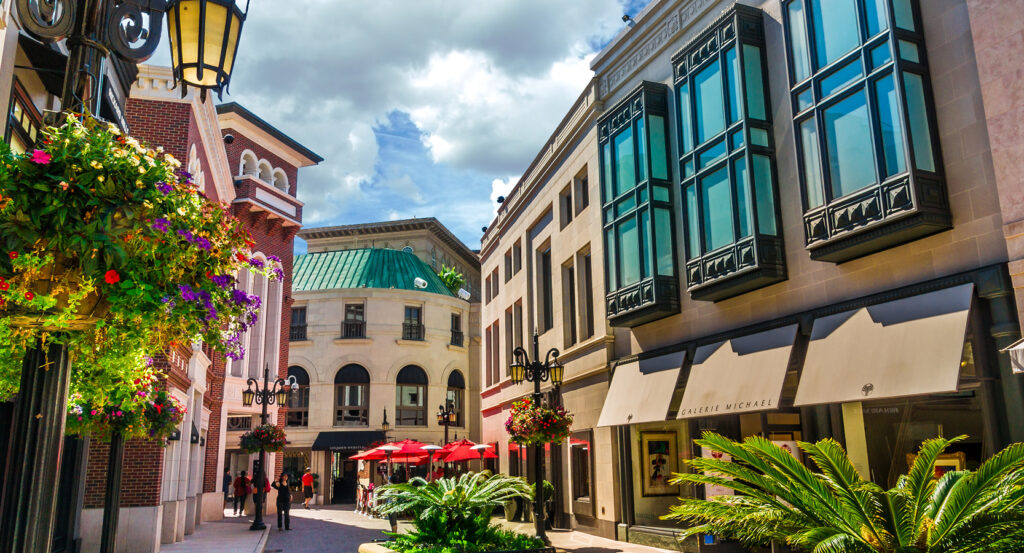
Begin at Two Rodeo Drive, the 1990 retail complex whose steep cobblestone pedestrian street rises through a split-level development conceived to multiply street-facing storefronts within an unusually constrained site. Developer Douglas Stitzel assembled an environment of classical façades, arched windows, pilasters, towers and descending stairs that architecture critic Aaron Betsky interpreted as a collage drawn from European and American urban imagery. Dior and Valentino ranked among the early tenants, and the interior promenade placed upper-level shops along what reads physically as another street, disguising the commercial engineering beneath an elaborate architectural composition. Its position opposite the southern end of Rodeo Drive turned the project into one of the district's most theatrical experiments in making luxury retail itself part of the streetscape. Continue to Beverly Wilshire, Beverly Hills, A Four Seasons Hotel, opened in January 1928 as the Beverly Wilshire Apartment Hotel on ground previously occupied by the Beverly Hills Speedway. Developer Walter G. McCarty commissioned Walker & Eisen for the original Italian Renaissance building, whose opening came when Beverly Hills still counted only 1,000 residents; later work by Welton Becket & Associates, Gruen Associates, Gensler and Richard Meier extended the property across successive architectural eras. The former speedway beneath the site had operated as a mile-and-a-quarter wooden oval and drew 70,000 spectators to its 1926 world championship race, giving the hotel's corner an earlier history rooted in mass entertainment before hospitality reshaped Wilshire Boulevard. Conclude at Greystone Mansion & Gardens: The Doheny Estate, where oil magnate Edward L. Doheny gave his son Ned 12.58 acres as a wedding gift in 1926 and construction began the following February on an estate designed by Gordon B. Kaufmann. P.J. Walker Company built the steel-reinforced concrete mansion with Indiana limestone facing and Welsh slate roofing, and landscape architect Paul G. Thiene developed grounds incorporating formal gardens, water features and extensive ancillary structures. The entire estate cost $3,166,578.12, with the mansion accounting for $1,238,378.76, before the Doheny family moved into the residence in September 1928. Beverly Hills acquired the property in 1965, dedicated it as a public park in 1971 and secured National Register recognition in 1976, turning one of the city's grandest private estates into publicly accessible civic property. The progression moves from an architectural illusion engineered around luxury storefronts through a grand hotel built over a former motor-racing performance into an oil heir's immense private estate converted to public use, tracing three distinct ways Beverly Hills translated wealth into enduring urban form.
Where your story begins.
Foresyte Travel reveals places that feel extraordinary long before you arrive.
Enjoy editorial crafted for luxury travelers.
Foresyte may earn a commission when you book.





































































































