
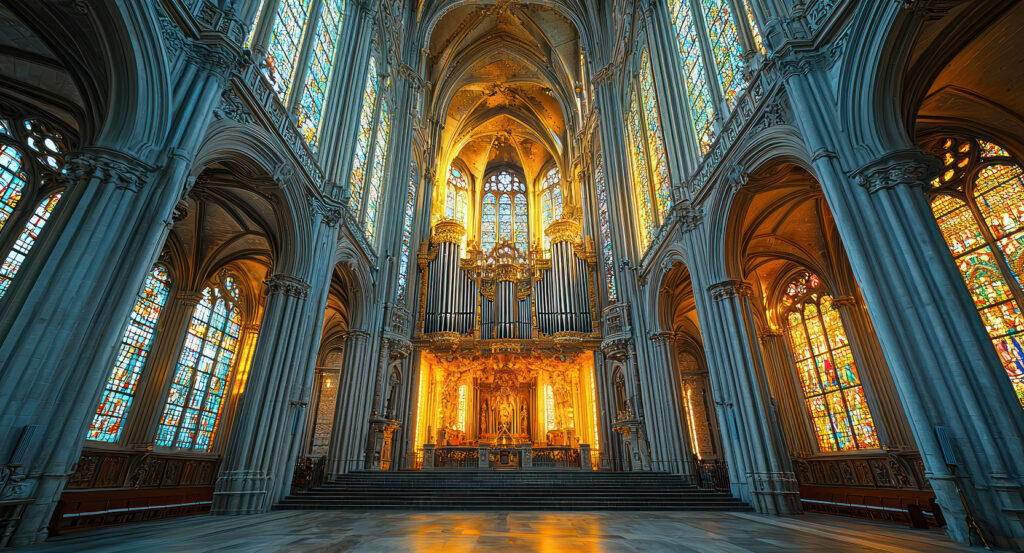
Why Saint Wenceslas Chapel matters.
The St. Wenceslas Chapel is the cathedral's beating heart, a chamber where stone turns to light and silence becomes holy.
Step through its narrow doorway, and the noise of the cathedral fades into stillness. The air feels different here, heavier, almost electric, as if centuries of prayer still linger between the walls. Every inch of the space glows: walls encrusted with semiprecious stones, amethyst, jasper, agate, and lapis, shimmering like the interior of a jeweled reliquary. Gold leaf frames painted frescoes that tell the story of St. Wenceslas's life and martyrdom; in the soft flicker of candlelight, they appear to move. The room is small, almost intimate, yet it radiates a presence larger than the cathedral itself. To stand within it is to feel history condense, a thousand years of Czech faith distilled into one sacred breath.
What defines Saint Wenceslas Chapel.
The chapel was completed in 1367 under the patronage of King Charles IV, designed by Peter Parler as the spiritual core of his new Gothic cathedral.
It honors St. Wenceslas, the 10th-century duke and martyr whose death inspired the birth of the Czech nation. His tomb lies embedded in the lower wall, surrounded by gilded iron grilles that guard the relics within. Above it, a fresco depicts his murder in Stará Boleslav, while others chronicle his miracles and sainthood. The semiprecious stones, 1,300 of them, were chosen to symbolize both earthly virtue and divine eternity, their arrangement following the medieval belief that color could embody moral truth. A small, locked door behind the altar leads to the chamber where the Bohemian Crown Jewels are kept, the royal insignia of kings and emperors, visible to the public only once every several years. Few visitors realize that the chapel's ceiling vaults form a hidden cross visible only from the upper gallery, aligning symbolically with the cathedral's main axis. The space has survived wars, fires, and political purges almost untouched, even occupying forces during the 20th century were said to step lightly here, aware of its gravity.
How Saint Wenceslas Chapel fits.
When you enter St. Vitus Cathedral, move through its grand nave first, then save the chapel for last, it's not an exhibit, it's a culmination.
Approach slowly; the light changes as you near the southern transept, shifting from the cathedral's cool blues to the chapel's warm gold. You can't enter beyond the iron gate, but stand close enough to feel the air thicken with incense and history. Take your time to study the walls, each stone catches light differently, revealing hidden hues as the sun shifts. Look for the fresco of St. Wenceslas's death above the tomb; the emotion in its brushwork transcends centuries. If you're visiting during one of the rare public displays of the Crown Jewels, arrive early, the line stretches deep into the courtyard, and the experience feels almost liturgical. Visit again at dusk, when the last light of day passes through the stained glass above, igniting the gold into fire. The St. Wenceslas Chapel isn't simply a monument, it's a reliquary of memory, the soul of a cathedral that has kept watch over Prague for a thousand years.
Where your story begins.
Foresyte Travel reveals places that feel extraordinary long before you arrive.
Enjoy editorial crafted for luxury travelers.
Foresyte may earn a commission when you book.





































































































