
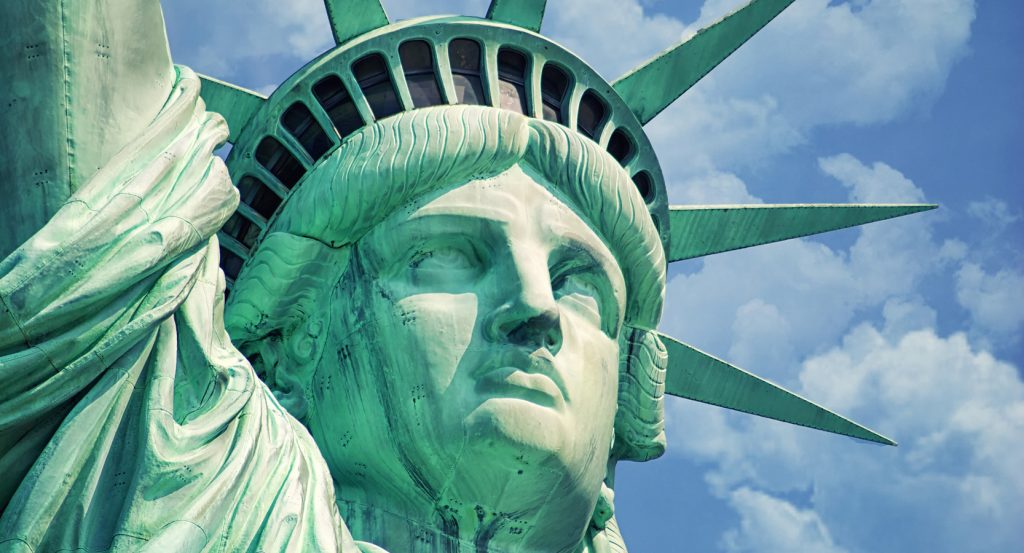
Why Statue of Liberty Museum matters.
Statue of Liberty Museum is a sculptural harbor museum where Liberty Island's civic symbolism meets contemporary architecture, planted roof terraces and panoramic views across New York Harbor.
Set within Liberty Island near its eastern waterfront and just steps from the island's flagpole plaza, the museum occupies a low, angular structure embedded into the landscape beyond the principal approach to the statue. FXCollaborative shaped the 26,000-square-foot building as an extension of the island's open ground, using an expansive green roof, native vegetation and broad exterior terraces to carry planted terrain upward across the architecture. Precast concrete panels manufactured in Pennsylvania and granite quarried in Connecticut give the exterior substantial masonry weight, with bird-friendly glazing opening selected elevations toward the statue, Manhattan and the surrounding harbor. Stormwater passes through the planted roof, rain garden and infiltration trenches, and salt- and wind-tolerant trees, shrubs and perennials respond directly to the exposed maritime conditions of the island. The result is a museum whose low profile, walkable roof, regional stonework, resilient planting and carefully oriented glass preserve the primacy of Liberty Island's outdoor landscape as the building rises beside one of New York Harbor's most recognizable structures.
What defines Statue of Liberty Museum.
Statue of Liberty Museum is best known for transferring the monument's historical interpretation into a dedicated building accessible to the millions of people arriving on Liberty Island, replacing the smaller exhibition formerly housed within the statue's pedestal. Security restrictions and physical constraints had limited pedestal access to 20 percent of island arrivals, leaving most people. The National Park Service and Statue of Liberty-Ellis Island Foundation developed the new institution as the most substantial project undertaken on Liberty Island since the statue's centennial restoration more than three decades earlier. Construction began in 2016, with FXCollaborative responsible for architecture, ESI Design responsible for the exhibition program and Phelps Construction Group responsible for construction. Diane von Furstenberg chaired the fundraising campaign, joining the Foundation's philanthropic effort to the federal stewardship of the national monument. The completed museum opened on May 16, 2019 following a dedication attended by National Park Service leadership, Foundation president Stephen Briganti and New York City Mayor Bill de Blasio, with performances by Broadway artists and the Manhattan Girls Chorus. Its opening expanded museum access across an island receiving millions of annual arrivals, moving historical interpretation from a restricted interior into a purpose-built institution available to the broader Liberty Island public.
Frédéric Auguste Bartholdi's original torch anchors a separate historical strand extending from the statue's nineteenth-century fabrication through a century of alterations and the 1980s centennial campaign. Bartholdi envisioned a solid copper flame gilded to catch daylight, yet the torch had already acquired two rows of illumination portholes by the statue's 1886 dedication, followed by an 18-inch glass belt and colored pyramidal skylight six years later. A 1916 alteration removed copper in 250 locations for amber cathedral glass, and a 1931 lighting installation cut two 16-inch openings into the balcony floor for projectors. Centennial restoration specialists concluded during the 1980s that corrosion, water intrusion and accumulated alterations had damaged the assembly beyond restoration, leading to its removal on July 4, 1984. A replacement based on Bartholdi's intended copper-and-gold configuration reached the statue in November 1985 and received formal dedication during the July 4, 1986 centennial celebration. Phelps Construction Group moved the surviving nineteenth-century assembly from the pedestal in November 2018 before its installation inside the museum's glass-walled Inspiration Gallery. The adjacent Engagement Gallery examines Bartholdi and the artisans who fabricated the statue, and ESI Design's Becoming Liberty digital installation assembles participant self-portraits into an evolving collective display. Bartholdi's altered torch now gives the museum a physical object spanning the statue's original construction, early electrical modification, centennial restoration and twenty-first-century interpretation.
How Statue of Liberty Museum fits.
Statue of Liberty Museum works as the anchor for a New York Harbor outing connecting nineteenth-century immigration, coastal defense and the Revolutionary-era political world of Lower Manhattan.
Begin at Ellis Island National Museum of Immigration, where the federal immigration station opened on January 1, 1892 and seventeen-year-old Annie Moore of County Cork became its first processed immigrant. Fire destroyed the original wooden complex in 1897, and architects Edward Lippincott Tilton and William Alciphron Boring subsequently designed the French Renaissance Revival main building that opened in 1900; the station ultimately processed 12 million immigrants before closing in 1954. Restoration returned the main building to public use as a museum in 1990, placing the Registry Room and surviving institutional spaces at the center of an extensive account of American migration. Continue to Castle Clinton National Monument, constructed as the Southwest Battery on rocks off Manhattan between 1808 and 1811 and armed with 28 cannons capable of firing 32-pound shot across the harbor. The fort never fired during the War of 1812, received the Castle Clinton name in 1817 and subsequently passed through entertainment use, immigration processing and a 45-year chapter as the New York Aquarium before preservation secured its survival during the twentieth century. Conclude at Fraunces Tavern Museum, inside the 1719 building Samuel Fraunces acquired in 1762 and operated during the political upheaval preceding American independence. A British cannonball struck the building during the 1775 exchange involving HMS Asia, George Washington selected its Long Room for his December 4, 1783 farewell to his officers, and federal offices for Foreign Affairs, War and Treasury occupied the property between 1785 and 1788. Alexander Hamilton and Aaron Burr attended a Society of the Cincinnati dinner there on July 4, 1804, days before their duel, extending the building's political associations into the early republic. The progression moves from Ellis Island's federal immigration complex through Castle Clinton's changing harbor roles into Fraunces Tavern's Revolutionary and early federal chapters, connecting migration, defense and national government across the harbor approach to Lower Manhattan.
Where your story begins.
Foresyte Travel reveals places that feel extraordinary long before you arrive.
Enjoy editorial crafted for luxury travelers.
Foresyte may earn a commission when you book.







































































































