
Why Philosophical Hall at Strahov Library matters.
The Philosophical Hall feels like stepping inside the mind of the Enlightenment, a space so vast and luminous it seems to expand thought itself.
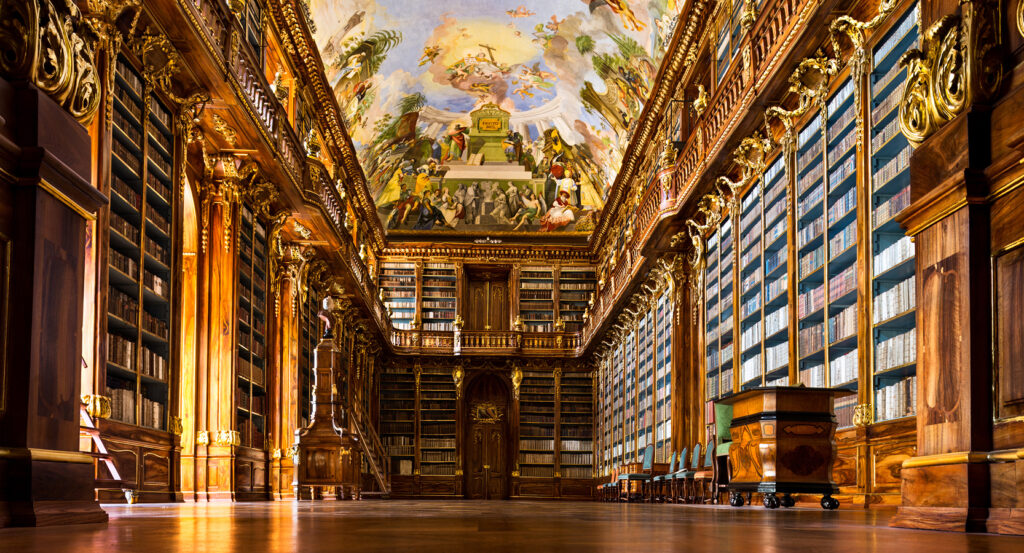
The moment you enter, time softens. The ceiling lifts high above you in a swirl of frescoed clouds, where angels and scholars mingle in an allegory of wisdom. Below, rows of books stretch endlessly, leather spines in russet, gold, and deep oxblood, each one a fragment of human understanding preserved against oblivion. The light here doesn't just illuminate; it reveals. As it spills through tall windows onto the parquet floor, the entire hall glows like a living scripture, intellect rendered divine. The Philosophical Hall is more than a library. It's a statement of faith in the power of knowledge, that the act of learning, itself, is sacred.
What defines Philosophical Hall.
Completed in 1794 under Abbot Václav Mayer, the Philosophical Hall was conceived as a temple to reason during an age when science and spirituality still walked hand in hand.
Its architecture, designed by Jan Ignác Palliardi, marks a clear shift from Baroque ornamentation toward Enlightenment idealism, symmetry, light, proportion. The fresco that crowns its barrel-vaulted ceiling was painted by Austrian artist Franz Anton Maulbertsch, who, in just six months, transformed 1,800 square meters of plaster into a visual symphony. Entitled The Enlightenment of Mankind, it depicts humanity's ascent from ignorance to wisdom, guided by Divine Revelation - Philosophy personified, torch in hand, casting light across the intellectual cosmos. Beneath this celestial masterpiece stand over 42,000 volumes, encompassing theology, philosophy, mathematics, and natural science. Many were brought here from the Premonstratensian abbey in Louka after its dissolution, making the Philosophical Hall one of Europe's great survivors of monastic knowledge. Few visitors realize that the hall conceals a narrow, spiral staircase hidden behind a section of shelving, once used by monks to move discreetly between levels during study hours. Even the towering globes and armillary spheres positioned along the central axis aren't mere decoration; they symbolize the unity of heaven and earth through human curiosity. Every inch of this hall was designed not just to store knowledge, but to glorify it.
How Philosophical Hall fits.
Visit in the afternoon, when sunlight filters through the western windows, igniting the fresco's golds and pinks until the entire ceiling seems to breathe.
Begin near the entrance, letting your eyes travel upward first, Maulbertsch's brushwork is so alive it feels like movement. Then, follow the curvature of the room, tracing the rhythm of the bookshelves until you reach the far balcony. Stand there and look back; the hall's design is meant to be viewed in both directions, each perspective framing the other like reflection and refraction. If you join a guided tour, pause when the docent stops speaking, silence here is its own language. Try to imagine the monks who once studied beneath this ceiling, their candles flickering against the fresco's glow. After the visit, step outside onto the monastery terrace and look over Prague, the city spread out like an illuminated manuscript. You'll realize that what you've just seen isn't merely architecture or art; it's conviction carved in symmetry, painted in light. The Philosophical Hall is where knowledge became holy, and where that holiness still shines.
Where your story begins.
Foresyte Travel reveals places that feel extraordinary long before you arrive.
Enjoy editorial crafted for luxury travelers.
Foresyte may earn a commission when you book.





































































































