
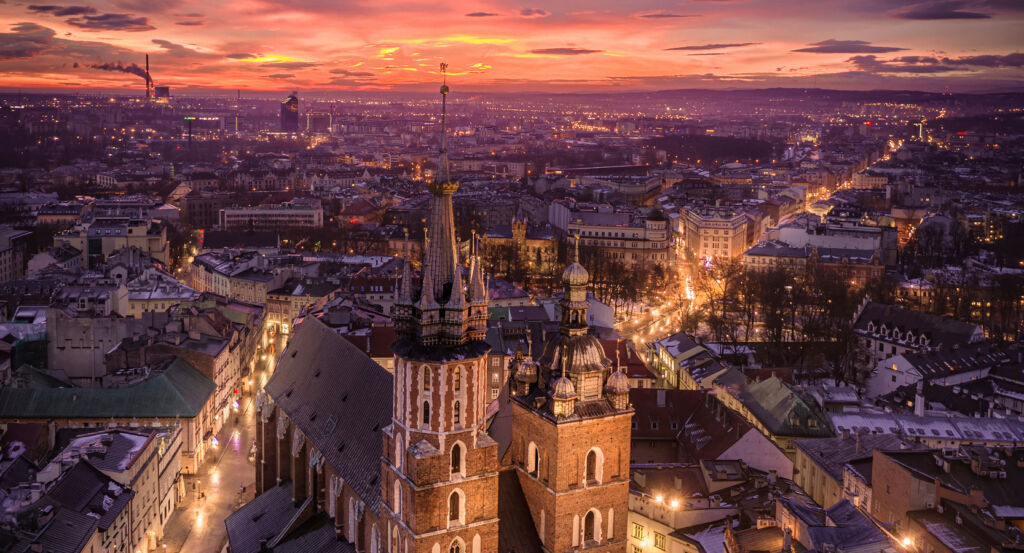
Why you should experience The Bonerowski Palace in Kraków, Poland.
The Bonerowski Palace is an extraordinarily rare Old Town residence where aristocratic heritage, architectural gravitas, and cultivated quiet converge into a stay that feels ceremonial, intimate, and inseparable from Kraków's historical soul.
Occupying a prime position directly on the Main Market Square, the palace sits at the absolute center of Kraków's civic and cultural life, yet once inside, the atmosphere shifts into something hushed, composed, and almost private. The building itself carries centuries of significance, a former royal residence, diplomatic venue, and noble home, and that lineage is felt not through overt decoration, but through proportion, material weight, and restraint. Entry feels like crossing a threshold in time. Stone staircases, historic ceilings, and preserved architectural details coexist with refined contemporary interventions that respect the structure. Public spaces feel more like grand salons than hotel lounges, arranged for lingering, observation, and quiet conversation. Windows open directly onto the Market Square, offering one of the most iconic urban views in Europe, yet the interior calm remains undisturbed. Guest rooms are deeply individual, shaped by the palace's historic bones. High ceilings, original architectural details, and carefully chosen furnishings create an atmosphere that feels residential and ceremonial at once. Beds are designed for deep, unbroken rest, lighting is layered and warm, and the rooms carry a sense of gravity that encourages stillness. Bathrooms balance historic context with modern comfort, offering generous space, intuitive layouts, and materials that feel substantial and enduring. Throughout the palace, the experience is defined by quiet authority. Nothing is rushed, nothing is overstated, and nothing feels generic. The Bonerowski Palace is ideal for travelers who want to inhabit Kraków's history.
What you should know about The Bonerowski Palace.
The Bonerowski Palace operates less like a conventional hotel and more like a preserved urban estate, and that distinction profoundly shapes how guests experience both the building and the city around it.
Rather than prioritizing volume or throughput, the palace emphasizes discretion and spatial dignity. Corridors are not merely functional; they follow the logic of a noble residence. Rooms are positioned to preserve privacy and acoustic calm, even though the city's most animated square lies just beyond the windows. Sound behaves differently here, exterior energy becomes distant and atmospheric rather than intrusive, while interior spaces absorb movement and conversation into a soft quiet that feels almost monastic during certain hours. This acoustic control, combined with the building's scale and materials, creates a sense of containment that is rare in such a central location. The palace's interiors are not themed or curated to perform history; they are history, supported by contemporary comfort. This authenticity affects how guests move. People slow down instinctively. Conversations soften. Time stretches. The service culture mirrors this restraint. Staff interactions are elegant, measured, and deeply respectful of privacy. Assistance is anticipatory rather than reactive, offered quietly and withdrawn just as seamlessly. There is an implicit understanding that guests are not here to be entertained, but to inhabit a meaningful space. Another understated strength of the palace is how it manages contrast. Stepping out into the Market Square, alive with sound, color, and motion, and then returning inside does not feel abrupt. The transition unfolds gradually through stairwells, corridors, and lighting shifts that allow the nervous system to recalibrate. Over multi-day stays, this balance becomes transformative. The square outside begins to feel familiar rather than overwhelming, and the palace becomes a place of orientation rather than escape. The Bonerowski Palace does not impose a narrative of luxury; it offers stewardship of place, allowing history, architecture, and rhythm to do the work.
How to fold The Bonerowski Palace into your trip.
The Bonerowski Palace works best when you allow it to become the gravitational center of your Kraków experience rather than simply a place to sleep.
Begin your mornings early, when the Market Square is still quiet and the city feels suspended between night and day. From the palace doors, step directly into the square, letting its scale and architecture reveal themselves. Return mid-morning for breakfast or a pause, using the palace as a natural reset point. From here, Kraków unfolds effortlessly. Wawel Castle, Kazimierz, Planty Park, museums, and galleries are all accessible on foot, allowing exploration to feel organic. Midday returns feel indulgent rather than necessary, a chance to sit by a window, reflect, or simply absorb the sense of place before heading out again. Afternoons can stretch long, knowing that your return will always feel ceremonial. Evenings are where the palace truly distinguishes itself. As the square fills with light and sound, dining nearby or attending performances feels heightened by proximity. Returning late at night, when the square empties and the city quiets, feels almost cinematic, a private re-entry into history. Over longer stays, the rhythm becomes deeply satisfying. Routes repeat, faces become familiar, and the city reveals itself through intimacy. Business travelers benefit from the palace's discretion and centrality. Leisure travelers gain something rarer: the feeling of living inside Kraków's most symbolic space. Anchoring your stay at The Bonerowski Palace allows Kraków to be experienced not as a destination to conquer, but as a place to dwell, layered, resonant, and alive with continuity. The palace does not compete with the city's story. It holds it, quietly and confidently, allowing you to step fully into it at your own pace.
Where your story begins.
Foresyte Travel reveals places that feel extraordinary long before you arrive.
Experience premium editorial crafted for luxury travelers.





































































































