
Why The Langham, Fifth Avenue matters.
The Langham, New York, 5th Avenue is a refined hotel where Midtown's architectural intensity meets Gwathmey Siegel's modernist tower, Langham's nineteenth-century hospitality lineage and permanent works by American artist Alex Katz.
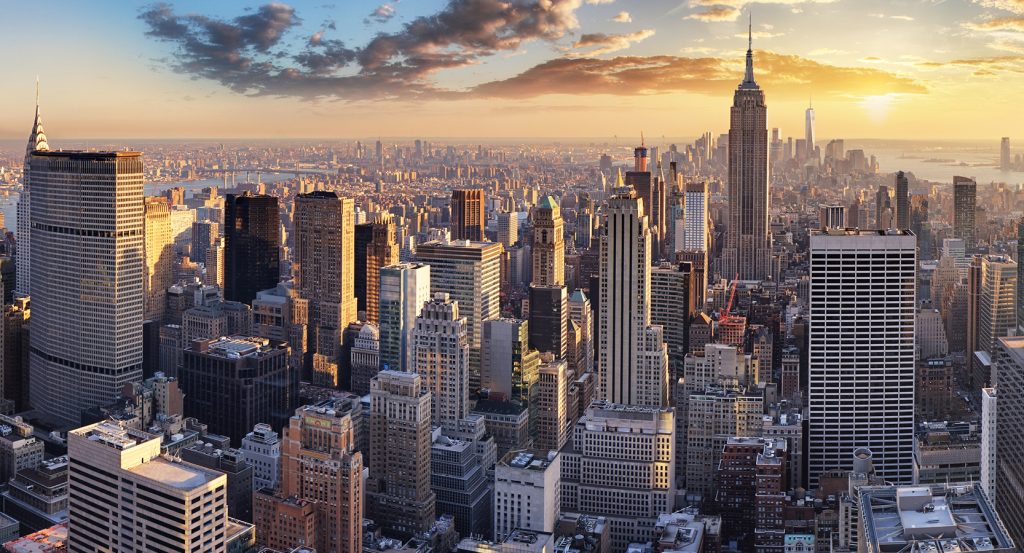
Set along 5th Avenue near West 36th Street and just steps from the Empire State Building, the hotel occupies a prominent Midtown corridor between Bryant Park's commercial district, the Garment District and the expansive towers extending north toward Rockefeller Center. Gwathmey Siegel & Associates Architects composed the slender tower with limestone, glass and metal, using setbacks and projecting volumes to break its vertical mass into strongly articulated sections. Double-height glazing and pale stone establish a restrained 5th Avenue base, with the hotel occupying the lower levels beneath private residences and maintaining its own arrival sequence from the avenue. Roche Bobois furnishings, Italian marble, dark wood and large-scale contemporary art carry the building's polished architectural language into interiors whose generous proportions distinguish the property within dense Midtown. The result is a hotel whose Gwathmey Siegel architecture, 5th Avenue position and substantial contemporary-art presence connect modern Manhattan design with one of international hospitality's oldest luxury names.
What defines The Langham.
The Langham, New York, 5th Avenue is best known for occupying the hotel component of 400 5th Avenue, the final Manhattan skyscraper designed by Charles Gwathmey before his death in 2009. Italian development company Bizzi & Partners pursued the tower with investment partners including Aronov Development and selected Gwathmey Siegel & Associates Architects for a project combining luxury hospitality with condominium residences. Charles Gwathmey and Robert Siegel developed the exterior around a limestone base and glass tower whose projecting bays and setbacks created a sculptural vertical profile on a constrained 5th Avenue site. DeSimone Consulting Engineers supplied structural engineering for the building, whose reinforced-concrete frame supported the differing spatial requirements of hotel functions below and private residences above. The Setai Fifth Avenue opened in November 2010 under management by Capella Hotel Group, establishing the original hospitality character within the completed tower. Hong Kong-based Great Eagle Holdings acquired the hotel component for $229 million in 2012, bringing the property into the corporate family behind Langham Hospitality Group. The hotel became Langham Place, 5th Avenue in May 2013, connecting the building with a hospitality lineage originating in London's Langham hotel, which opened in 1865. Langham subsequently simplified the Manhattan property's name to The Langham, New York, 5th Avenue, placing it directly within the company's principal luxury brand. The ownership transition transformed a recently completed independent luxury development into Langham Hospitality Group's flagship New York presence without altering Gwathmey Siegel's fundamental architectural composition. The property joins a twenty-first-century Manhattan tower by a major American modernist architect with an international hotel company whose brand history reaches to Victorian London.
Alex Katz gives The Langham, New York, 5th Avenue its most consequential artistic distinction through a permanent collection assembled specifically for the property. Katz emerged from postwar New York painting with flattened portraits, landscapes and sharply cropped compositions whose clarity separated his work from the dominant Abstract Expressionist movement surrounding his early career. The hotel acquired a substantial group of original Katz works valued in the millions of dollars, distributing paintings and prints through public areas and creating an unusual concentration of one living American artist within a Manhattan hotel. Eleven major paintings anchor the collection, joined by additional works on paper and prints that extend Katz's imagery across the property. Large portraits use the artist's characteristic simplified forms, saturated fields and cropped figures to create immediate visual encounters against the restrained stone, wood and neutral surfaces of the interiors. Katz's long relationship with New York gives the collection a direct geographic connection with the city in which he developed his career after studying at Cooper Union. Ai Fiori added another creative chapter when Michael White and Ahmass Fakahany's Altamarea Group opened the restaurant with the original hotel in 2010. White built the restaurant around the cuisines of the French and Italian Rivieras, and MICHELIN awarded Ai Fiori a star during its early years of operation. Meyer Davis designed the restaurant interior, adding another New York design practice to a building already shaped by Gwathmey Siegel and the hotel's art program. The Langham, New York, 5th Avenue developed a cultural character through the sustained presence of Katz's art and a restaurant conceived by prominent figures in New York dining, giving the Gwathmey Siegel tower creative authorship extending well beyond its exterior architecture.
How The Langham fits.
The Langham, New York, 5th Avenue works as an architectural anchor for an outing connecting Carrère and Hastings' expansive public library, Cass Gilbert's pioneering Gothic skyscraper and Stanford White's transformation of Madison Square through one of New York's defining private clubs.
Begin at Stephen A. Schwarzman Building, where Carrère and Hastings won the competition to design New York Public Library's principal building after the consolidation of the Astor, Lenox and Tilden collections. Construction began in 1902 on the former Croton Reservoir site, and the marble Beaux-Arts building opened on May 23, 1911 after one of the most ambitious civic construction campaigns of its era. Edward Clark Potter sculpted the marble lions flanking the 5th Avenue entrance, and the Rose Main Reading Room extends almost the full width of the building beneath an elaborately painted ceiling. Continue to New York Life Building, designed by Cass Gilbert for the insurance company on the former site of Madison Square Garden. Completed in 1928, the Gothic Revival skyscraper rises through a series of setbacks to a pyramidal roof covered in gilded tiles, giving the company headquarters a silhouette visible across the surrounding Midtown blocks. Gilbert used Indiana limestone at the base and organized the tower around the 1916 Zoning Resolution, turning mandated setbacks into an expansive composition for one of the nation's largest insurance companies. Conclude at The Players, founded in 1888 by actor Edwin Booth as a private club intended to bring actors into sustained contact with writers, artists, lawyers, financiers and other members of New York cultural life. Booth purchased an 1847 Gramercy Park townhouse and commissioned Stanford White to adapt and expand it for the new institution, with White creating a Great Hall, library and additional rooms while preserving the domestic character of the original house. Booth lived in an upper-floor apartment until his death there in 1893, leaving the building and much of its theatrical collection to the club he had created. The progression moves from Carrère and Hastings' expansive civic library through Gilbert's Gothic corporate skyscraper and culminates in White and Booth's union of architecture, theater and private-club culture, placing The Langham, New York, 5th Avenue within three distinct expressions of New York patronage and architectural ambition.
Where your story begins.
Foresyte Travel reveals places that feel extraordinary long before you arrive.
Enjoy editorial crafted for luxury travelers.
Foresyte may earn a commission when you book.







































































































