
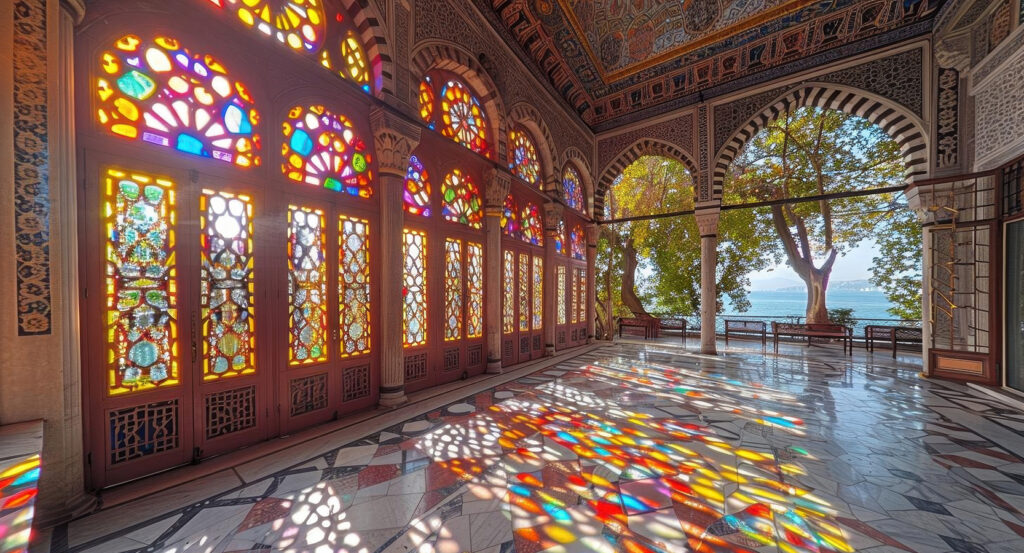
Why you should experience The Palace Gardens at Topkapi Palace in Istanbul, Türkiye.
The Palace Gardens at Topkapi Palace are the empire's most poetic secret, a vast green world where history breathes through roses and cypress.
Spread across the palace's terraces overlooking the Bosphorus, these gardens were once the Ottoman sultans' private sanctuaries, designed not for performance but for serenity. Here, the empire's rulers walked in silence among tulip beds and fountains, contemplating the rhythm of creation. The scent of jasmine drifts through marble courtyards, and the rustle of leaves feels like a conversation with centuries past. To wander these gardens today is to glimpse how the Ottomans understood beauty, not as dominance over nature, but as harmony with it. The views sweep from the Golden Horn to the Sea of Marmara, yet the power of the place lies in its stillness. This is the Ottoman soul laid bare, a balance of grandeur and grace.
What you should know about The Palace Gardens at Topkapi Palace.
The Palace Gardens were the empire's living philosophy, shaped by faith and geometry.
Commissioned by Sultan Mehmed II after his conquest of Constantinople in 1453, the gardens were laid out in a series of terraces corresponding to the palace's four courtyards, each one symbolizing a deeper passage toward order and divinity. Their design fused Persian paradise gardens, Byzantine horticultural traditions, and Islamic cosmology, where every plant and fountain carried symbolic meaning. Tulips, the empire's emblem of perfection, bloomed in geometric beds to represent eternity; water channels mirrored the Qur'anic image of paradise as “gardens beneath which rivers flow.” The Fourth Courtyard housed the most intimate gardens, adorned with kiosks like the Revan and Baghdad Pavilions, where sultans withdrew for reflection. The plantings changed with the seasons, roses for devotion, hyacinths for humility, pomegranates for abundance, tended by royal gardeners known as bostancis, who were both horticulturalists and palace guards. Beyond their beauty, the gardens played political roles: banquets, coronations, and diplomatic receptions unfolded among their shaded colonnades, blurring the line between governance and garden. Even the trees were chosen with intention, cypresses for eternity, plane trees for justice, pines for strength. The gardens were, in essence, a living metaphor for the sultan's rule: ordered, fertile, and divinely sustained.
How to fold The Palace Gardens at Topkapi Palace into your trip.
The Palace Gardens are best experienced as a gradual unfolding, not a destination, but a rhythm to move through.
Begin at the First Courtyard, where ancient plane trees mark the empire's outer boundary, and let your pace slow naturally as you move toward the inner terraces. In the Third Courtyard, pause by the ornamental pools where the sound of water softens the world, then continue to the Fourth Courtyard, where the pavilions open to sweeping Bosphorus views. Sit for a while near the Marble Terrace, watching sunlight shimmer on the water and imagining sultans doing the same centuries ago. The gardens are most breathtaking in spring, when the tulips bloom in waves of crimson and gold, a nod to the renowned Tulip Era of Ottoman elegance. Visit near sunset if you can, when the domes glow amber and the breeze from the strait carries the scent of the sea through the cypress. The Palace Gardens at Topkapi Palace are not just royal grounds, they are a meditation on time, faith, and the fragile beauty that outlasts empires.
Where your story begins.
Foresyte Travel reveals places that feel extraordinary long before you arrive.
Experience premium editorial crafted for luxury travelers.





































































































