
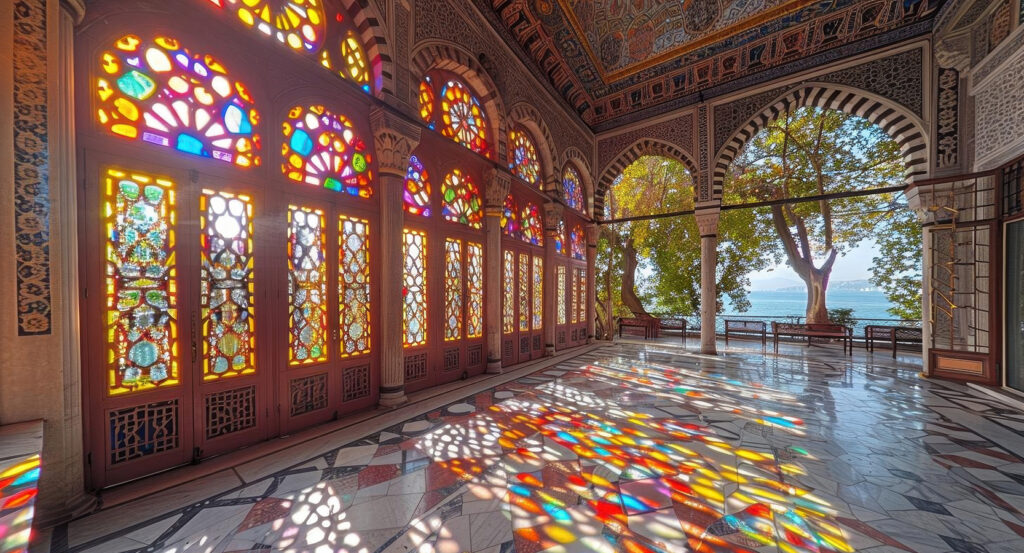
Why you should experience The Imperial Treasury at Topkapi Palace in Istanbul, Türkiye.
The Imperial Treasury at Topkapi Palace in Istanbul is where the Ottoman Empire's grandeur gleams brightest, a chamber of awe that turns power into artistry.
Stepping into The Imperial Treasury feels like entering the imagination of an empire at its zenith: gold-threaded banners, diamond-encrusted daggers, emerald-studded thrones, and jeweled armor that once shimmered under torchlight. The air itself feels heavy with legacy. Yet beyond the glitter, there's reverence, this is where craftsmanship met divinity. Every piece tells a story of conquest, devotion, or ceremony, a silent discussion between faith and fortune. The soft glow from glass cases mirrors what these halls once represented: not mere wealth, but the empire's vision of perfection, a world in balance, ordered and adorned by beauty.
What you should know about The Imperial Treasury at Topkapi Palace.
The Imperial Treasury was not simply a vault, it was the empire's sacred archive of glory.
Housed within the Conqueror's Pavilion (Fatih Köşkü), among the oldest surviving structures in Topkapi Palace, The Imperial Treasury was built by Sultan Mehmed II in the late 15th century as both royal residence and repository for the empire's most prized possessions. The building's four domes, connected by arches and framed with lead-coated tiles, were designed to symbolize the four corners of the world, a visual metaphor for Ottoman dominion. Among its treasures rests the renowned Topkapi Dagger, its hilt set with three colossal emeralds, and the Spoonmaker's Diamond, a 86-carat stone that catches every hint of light like frozen fire. These weren't mere ornaments; they were political tools, displayed during audiences to impress envoys and remind them of the sultan's unshakable might. The pavilion also houses relics gifted by foreign rulers, jeweled Qur'ans, Mughal daggers, Persian armors, each object a piece of diplomacy immortalized in gold. Few realize that the treasury's design follows the same proportions as the Prophet's Mosque in Medina, aligning opulence with sanctity. In Ottoman symbolism, the more ornate the object, the greater the divine favor it was thought to embody.
How to fold The Imperial Treasury at Topkapi Palace into your trip.
The Imperial Treasury rewards those who linger, not those who rush.
Enter from the Third Courtyard, where the path narrows and the hum of the palace softens into stillness. Let your eyes adjust to the dim, reflective light, each case gleaming like a memory half-remembered. Pause before the emerald-studded throne of Sultan Ahmed I, its stones chosen for the way they shift color under candlelight. Continue to the Dagger and Diamond, but don't stop there, look for the small, gilded Qur'an cases, the gold-threaded banners carried into battle, and the ceremonial turbans that crowned centuries of rule. If possible, visit during the late morning, when the sunlight outside filters through the domes and seems to awaken the gold within. The Imperial Treasury at Topkapi Palace isn't about the display of riches, it's about witnessing how faith and empire once shared the same pulse. Each reflection on the glass is a reminder: glory fades, but beauty endures.
Where your story begins.
Foresyte Travel reveals places that feel extraordinary long before you arrive.
Experience premium editorial crafted for luxury travelers.





































































































