
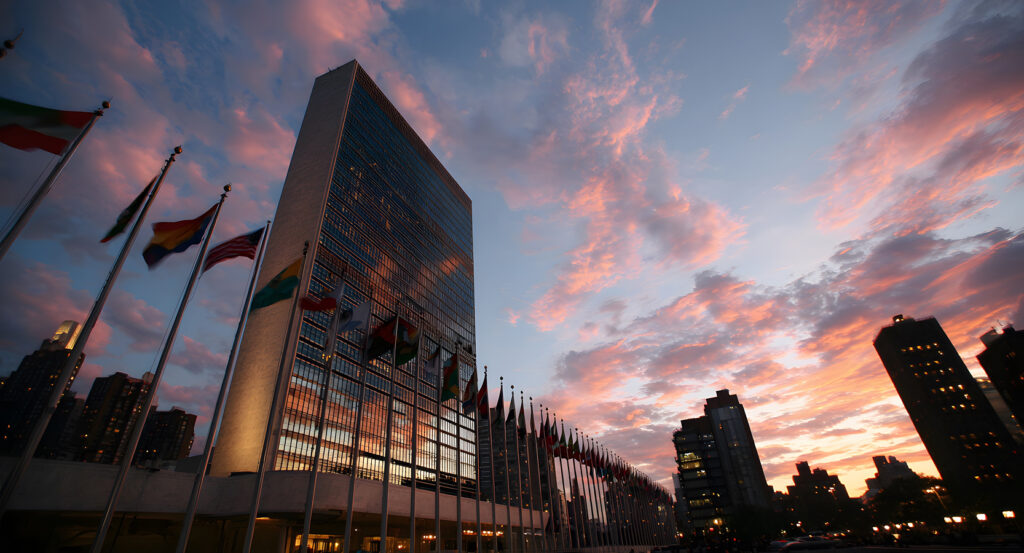
Why United Nations Headquarters matters.
United Nations Headquarters is among the world's most significant diplomatic landmarks where Turtle Bay's international diplomacy, modernist architecture, global governance, and cultural symbolism create one of New York City's most influential institutions.
Set along 1st Avenue between East 42nd and East 48th Streets beside the East River near Ralph Bunche Park and just steps from Dag Hammarskjöld Plaza, this internationally recognized campus combines landmark modernist architecture, expansive public art, diplomatic chambers, landscaped plazas, and iconic national flag displays within the permanent home of the United Nations. Sleek glass façades, expansive civic spaces, globally significant artworks, and sweeping waterfront views establish an atmosphere that reflects the organization's mission of international cooperation. Every building represents a commitment to diplomacy, peace, and discussion on a global scale. The result is a destination defined by architectural innovation, political significance, and one of the world's foremost centers of international affairs.
What defines United Nations Headquarters.
United Nations Headquarters is best known for serving as the permanent headquarters of the United Nations since 1952, providing the principal meeting place for one of the world's most important international organizations following its establishment in 1945 after the Second World War. The 18-acre campus occupies land purchased through an $8.5 million donation from John D. Rockefeller Jr., enabling construction of a purpose-built diplomatic complex overlooking the East River. An international team of architects led by Wallace K. Harrison developed the master plan in collaboration with some of the twentieth century's most influential designers, including Le Corbusier, Oscar Niemeyer, Sven Markelius, and others representing multiple member nations. The iconic 39-story Secretariat Building, completed in 1952, became one of the earliest and most influential examples of the International Style skyscraper, distinguished by its glass curtain wall that transformed modern office architecture worldwide. The campus also includes the General Assembly Hall, where representatives from all 193 United Nations Member States convene for annual sessions, alongside the Conference Building, Security Council Chamber, and numerous diplomatic facilities that host thousands of international meetings each year. Beyond its political significance, the headquarters preserves an internationally renowned public art collection featuring works donated by member states, including the Knotted Gun (Non-Violence) sculpture by Carl Fredrik Reuterswärd, the Isaiah Wall, and gifts representing cultures from around the world. Comprehensive renovations completed through the Capital Master Plan between 2008 and 2015 modernized the historic complex with advanced sustainability measures, seismic improvements, and contemporary building systems while preserving one of the world's most influential architectural landmarks.
The campus integrates International Style architecture, expansive civic spaces, landscaped gardens, ceremonial plazas, diplomatic interiors, and internationally significant public artworks into a cohesive environment dedicated to global cooperation. The Secretariat Building's elegant glass curtain wall, carefully proportioned public spaces, and restrained modernist detailing established new standards for postwar institutional architecture while reinforcing ideals of openness and international collaboration. Continuous preservation, security enhancements, sustainability initiatives, and diplomatic modernization ensure the headquarters remains fully equipped to support the evolving work of the United Nations. Every element demonstrates how architecture, diplomacy, engineering, and international cooperation combine to create one of the world's most important civic landmarks.
How United Nations Headquarters fits.
United Nations Headquarters works as the diplomatic centerpiece of an exploration through Midtown East.
Begin at Dag Hammarskjöld Plaza, where landscaped public spaces and monuments introduce the international character of the district before continuing to United Nations Headquarters. Continue to The Japan Society, whose exhibitions and cultural programming naturally expand the neighborhood's global perspective through international exchange. Conclude at Grand Central Terminal, where one of New York City's greatest architectural landmarks provides a memorable finale celebrating the remarkable relationship between diplomacy, transportation, and urban development that defines Midtown. The progression moves naturally from civic public space to the world's foremost diplomatic headquarters before concluding within one of New York's most celebrated landmarks, revealing why United Nations Headquarters remains among the world's most significant institutions.
Where your story begins.
Foresyte Travel reveals places that feel extraordinary long before you arrive.
Enjoy editorial crafted for luxury travelers.
Foresyte may earn a commission when you book.







































































































