
Why Waldorf Astoria New York matters.
Waldorf Astoria New York is a storied hotel where Midtown East's corporate grandeur meets Schultze & Weaver's soaring Art Deco architecture, preserving the Park Avenue palace that transformed American luxury hospitality through expansive public rooms, diplomatic history and extraordinary cultural reach.
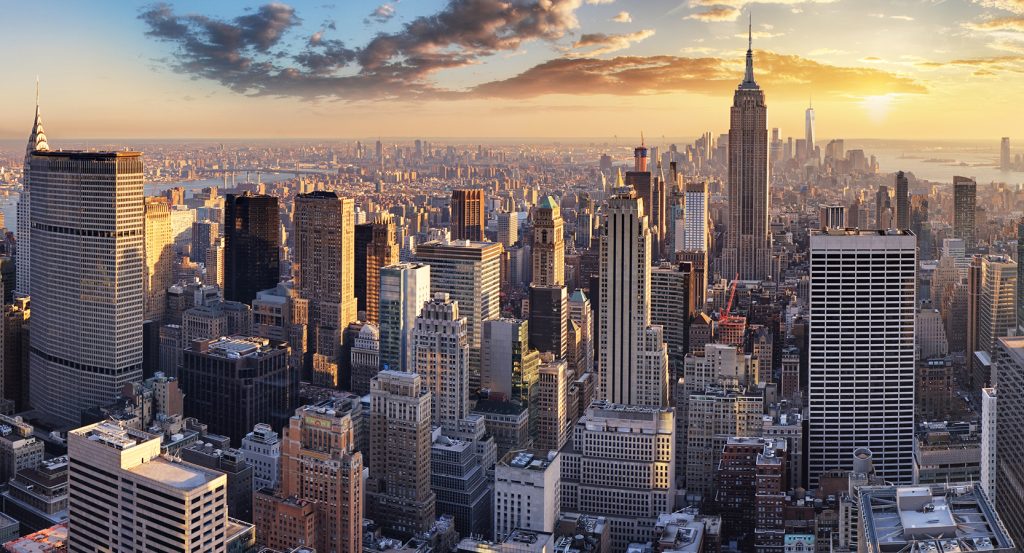
Set along Park Avenue near East 50th Street and just steps from St. Bartholomew's Church, the hotel occupies Midtown East's ceremonial core between Lexington Avenue's corporate corridor, Rockefeller Center's western precinct and the office towers extending north toward the East 50s. Schultze & Weaver composed the limestone and brick skyscraper through graduated setbacks, narrow vertical piers and twin copper-capped towers, giving the enormous structure an increasingly slender profile as it rises above Park Avenue. A block-long sequence of public interiors carries movement through marble floors, metalwork, murals and soaring ceremonial rooms, turning circulation through the building into an architectural event. The Park Avenue entrance establishes the principal axis through the restored lobby toward Peacock Alley, concentrating the building's immense scale into a sequence of interconnected spaces beneath the tower. The result is a hotel whose stepped skyline, expansive interiors and full-block presence give one of American hospitality's most consequential institutions an architectural scale equal to its cultural history.
What defines Waldorf Astoria New York.
Waldorf Astoria New York is best known for opening on Park Avenue in 1931 as the largest and tallest hotel in the world, transferring a famous hospitality name from its original Gilded Age home on 5th Avenue into a radically different Art Deco skyscraper. William Waldorf Astor had opened the original Waldorf Hotel in 1893 beside the mansion of his aunt Caroline Astor, and John Jacob Astor IV opened the neighboring Astoria four years later. The properties eventually joined through a 300-foot marble promenade called Peacock Alley, creating the Waldorf-Astoria whose name and social traditions survived demolition of the 5th Avenue complex for the Empire State Building. Hotelier Lucius Boomer carried the institution to Park Avenue, commissioning Schultze & Weaver to design the new skyscraper across the block bounded by Park Avenue, Lexington Avenue and East 49th and 50th streets. President Herbert Hoover addressed the October 1931 opening from Washington, marking the arrival of a hotel whose immense ballrooms, private suites and public salons became stages for political, diplomatic and cultural life. Cole Porter moved into the Waldorf Towers in 1934 and lived there until his death in 1964, composing at a Steinway piano that later returned to the hotel's lobby. Conrad Hilton acquired the property in 1949 after pursuing it for years, adding the hotel he called “The Greatest of Them All” to the company that would eventually turn Waldorf Astoria into an international luxury brand. New York City designated the exterior in 1993, protecting Schultze & Weaver's Art Deco composition as the surrounding Midtown skyline continued to change. Hilton agreed to sell the property to Anbang Insurance Group for $1.95 billion in 2014, and the transaction closed in February 2015 under a long-term Hilton management arrangement. The hotel closed in 2017 for a reconstruction that fundamentally reorganized the immense building while preserving its most significant ceremonial interiors. Waldorf Astoria New York reopened in July 2025, returning the Park Avenue institution to operation after eight years and beginning its most consequential architectural chapter since 1931.
Skidmore, Owings & Merrill directed the reconstruction 62,000 square feet of protected interiors, recovering Schultze & Weaver's original symmetry and architectural detailing across the lobbies, corridors, Grand Ballroom and adjoining ceremonial spaces. Pierre-Yves Rochon developed the hotel interiors with colors, furnishings and finishes derived from the original Art Deco palette, pairing new work with surviving marble, metalwork and decorative surfaces. Peacock Alley regained its central position along the principal circulation axis, with maple burl paneling reproduced to original specifications and aquatic-patterned carpeting extending beneath Rochon's contemporary furniture. Edward Emerson Simmons murals dating from the former 5th Avenue hotel were conserved along the Silver Corridor, carrying nineteenth-century artwork into the restored Park Avenue interior. The 1893 World's Fair Clock returned as a focal object in the lobby after conservation of its elaborate bronze structure, figurative decoration and clock faces. Spirit of Achievement, the sculptural figure created by Nina Saemundsson for the 1931 building, was restored above the principal entrance as part of the exterior campaign. Cole Porter's Steinway returned to public display, reconnecting the reconstructed hotel with one of its longest and most culturally consequential residents. The Grand Ballroom recovered decorative plasterwork, balconies, metal railings and its dramatic ceiling composition as the ceremonial room returned to gala use in September 2025. SOM converted 96 percent of the building beyond the protected interiors, reorganizing the enormous former hotel around substantially larger private accommodations and 372 residences designed by Jean-Louis Deniot. New York Landmarks Conservancy recognized the completed architectural work with a 2026 Lucy G. Moses Preservation Award, giving the reconstruction the organization's highest preservation honor. Waldorf Astoria New York joins Rochon's contemporary interiors with restored murals, sculpture, metalwork and ceremonial architecture to carry the physical record of the 1931 hotel into its second century.
How Waldorf Astoria New York fits.
Waldorf Astoria New York works as the anchor for an outing connecting a palatial Gilded Age residence converted into an arts institution, a cultural center created to deepen relations between Japan and the United States and an Art Deco tower conceived for an electrical manufacturing empire.
Begin at Villard Houses, commissioned during the 1880s by railroad financier Henry Villard and designed by McKim, Mead & White as six connected residences arranged around a courtyard facing Madison Avenue. Joseph M. Wells developed much of the Renaissance-inspired design under the firm, drawing from Roman palazzi to create one of New York's most sophisticated surviving residential ensembles from the period. Villard's financial collapse forced him from the property soon after completion, and later occupants included Whitelaw Reid, publisher of the New-York Tribune. The Municipal Art Society established its Urban Center there in 1980 after an extensive restoration, giving the former residences a major role in the city's preservation and planning culture. Continue to Japan Society, founded in 1907 during a period of expanding diplomatic and commercial relations between Japan and the United States. John D. Rockefeller III helped revive the organization after the Second World War and provided the site for its permanent headquarters near the East River. Junzo Yoshimura designed the 1971 building with a severe modernist façade, interior garden and architectural details derived from Japanese traditions, creating the first major New York structure designed by a leading Japanese architect. Exhibitions, performing arts, film and scholarly programs subsequently made the institution an important American center for sustained engagement with Japanese culture. Conclude at General Electric Building, completed in 1931 for the RCA Victor Corporation before General Electric absorbed RCA and inherited the tower. Cross & Cross designed the skyscraper with a Gothic-inflected Art Deco crown whose elaborate lightning-bolt ornament, radio-wave motifs and projecting tracery transformed electrical technology into architectural decoration. The building's orange brick shaft rises above a richly ornamented base before terminating in a crown conceived to glow dramatically against the nighttime skyline. Its completion during the same year as the Waldorf Astoria captures a moment when New York corporations and hotels were translating technological power, commercial ambition and modern design into expansive towers. The progression moves from Villard Houses' Gilded Age residential grandeur through Japan Society's postwar cultural diplomacy and culminates at General Electric Building, where Art Deco architecture transformed the imagery of electricity and radio into one of Midtown's most distinctive skyscraper crowns.
Where your story begins.
Foresyte Travel reveals places that feel extraordinary long before you arrive.
Enjoy editorial crafted for luxury travelers.
Foresyte may earn a commission when you book.







































































































