
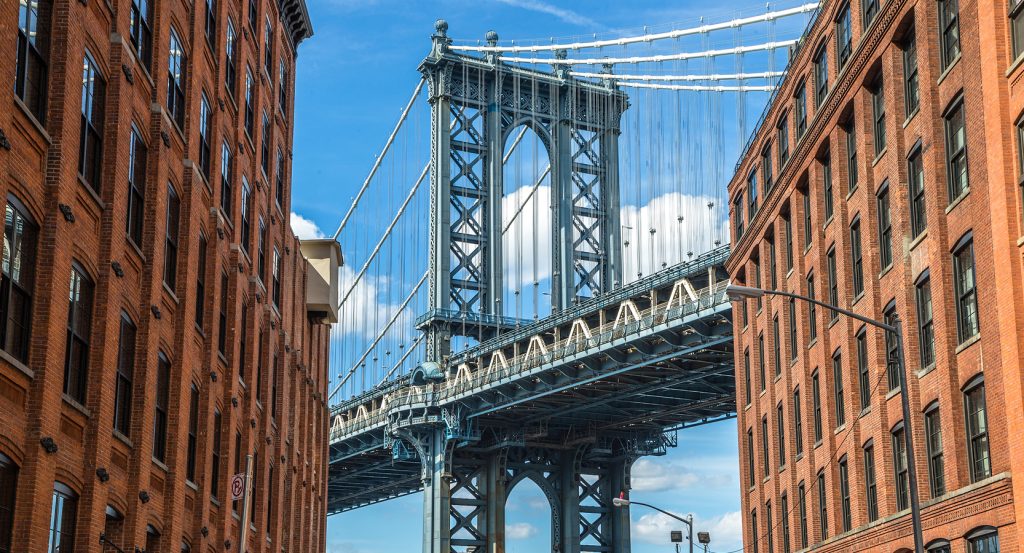
Why Williamsburg Street West matters.
Williamsburg Street West is a historic DUMBO corridor where maritime commerce, engineering ambition, and waterfront revival converge along one of Brooklyn's oldest surviving streets.
Running beneath the approaches to the Brooklyn Bridge between Fulton Ferry and the East River, this compact waterfront corridor connects restored warehouse buildings, cobblestone streets, historic ferry infrastructure, public gathering spaces, adaptive reuse projects, and striking harbor viewpoints that define Brooklyn's industrial waterfront. Massive brick warehouses, granite paving stones, bridge infrastructure, converted factory buildings, and sweeping Manhattan views create an atmosphere unlike anywhere else in the borough. Long before DUMBO became a global creative district, this corridor functioned as part of Brooklyn's busiest commercial shoreline, where ferries, warehouses, and maritime businesses powered the city's growth. The result is a street where Brooklyn's working waterfront survives beneath one of the world's most recognizable bridges.
What defines Williamsburg Street West.
Williamsburg Street West is best known for preserving the historic route that once connected the Fulton Ferry waterfront with the independent City of Williamsburg, carrying travelers and freight between two of nineteenth-century Brooklyn's most important commercial centers.
Before the consolidation of Brooklyn and the construction of the Williamsburg Bridge, this roadway formed part of the principal connection between the Fulton Ferry landing and Williamsburg, supporting commerce, manufacturing, and passenger movement across the rapidly growing borough. Although later redevelopment transformed the surrounding waterfront, Williamsburg Street West survived as one of the few physical reminders of Brooklyn's pre-bridge transportation network. Today, the street preserves a direct link to the era when ferries, not bridges, were the lifeblood of movement along the East River.
How Williamsburg Street West fits.
Williamsburg Street West works as an exploration of Brooklyn's historic waterfront and engineering landmarks.
Begin at Fulton Ferry Landing, where the corridor's defining relationship with maritime transportation and Brooklyn's earliest commercial growth immediately comes into focus. Continue beneath the Brooklyn Bridge, whose expansive engineering transformed the waterfront while leaving fragments of its earlier history intact. Finish at Empire Fulton Ferry Park, where panoramic views of Lower Manhattan reveal how industry, transportation, and public space continue to shape this remarkable stretch of the East River. Along the way you'll encounter restored warehouses, cobblestone streets, historic ferry infrastructure, waterfront parks, adaptive reuse projects, architectural landmarks, and unforgettable skyline views that reveal the layered history beneath modern DUMBO. The experience tells the story of how ferries, bridges, and waterfront commerce collectively built one of New York City's most important urban landscapes.
Where your story begins.
Foresyte Travel reveals places that feel extraordinary long before you arrive.
Enjoy editorial crafted for luxury travelers.
Foresyte may earn a commission when you book.







































































































