Why 10th Street matters.
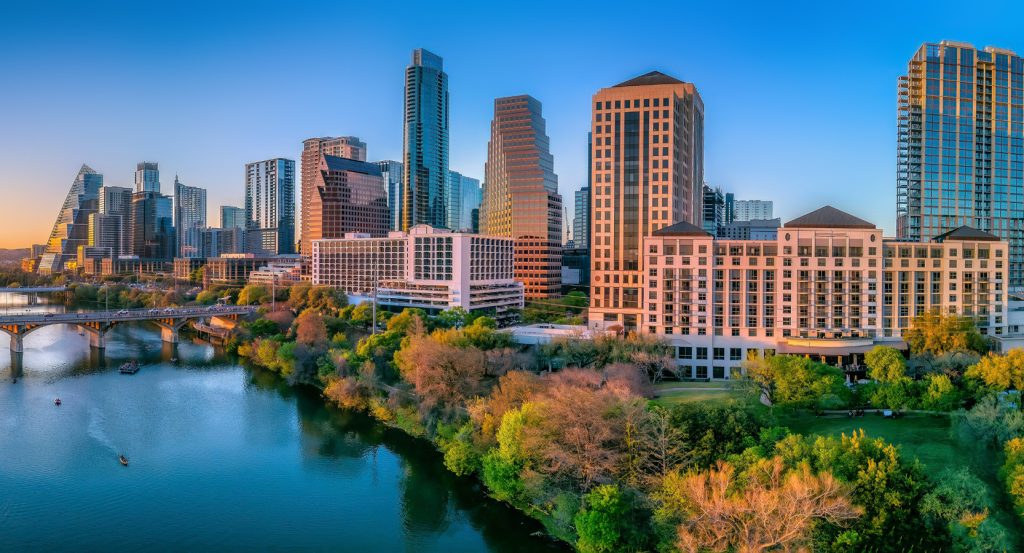
10th Street is a storied corridor where Downtown's civic heritage, cultural traditions, architectural diversity, and enduring capital-city character converge across one of the city's defining east-west streets.
Running through Downtown between Clarksville and Chestnut, the corridor links historic civic buildings, longstanding commercial blocks, churches, and cultural institutions that collectively reflect Austin's growth from a Republic-era capital into one of America's most distinctive cities. Historic masonry structures, public architecture, mature shade trees, and carefully preserved streetscapes create an urban landscape where generations of political, cultural, and community history remain visible. Continued reinvestment has strengthened the corridor while respecting the structure established during Austin's earliest decades. The result is an experience defined by historical depth, architectural richness, and one of Downtown's most compelling corridors.
What you should know 10th Street.
10th Street is best known for occupying one of the principal east-west alignments established by the 1839 Edwin Waller Plan, prepared by surveyor Edwin Waller under the direction of Republic of Texas President Mirabeau B. Lamar, forming part of the original structure that continues organizing Central Austin. Throughout the late nineteenth and twentieth centuries the corridor evolved into an important governmental, commercial, and residential thoroughfare as churches, professional organizations, neighborhood businesses, and civic institutions expanded alongside the city's growing population. Surrounding blocks preserve distinguished examples of Classical Revival, Victorian, Art Deco, and Mid-Century Modern architecture that document successive periods of civic investment and urban development across the capital city. The corridor occupies a significant place within the history of Central East Austin, where historically African American neighborhoods fostered churches, businesses, educational institutions, and civic organizations that profoundly influenced Austin's cultural, political, and economic development throughout the twentieth century. Collectively, the corridor's Republic-era planning, architectural diversity, civic evolution, community legacy, and cultural continuity establish 10th Street as one of Austin's defining historic corridors.
The Waller Creek and Shoal Creek watersheds influenced early urban expansion through limestone topography, native riparian vegetation, and historic drainage systems that guided nineteenth-century subdivision patterns across Central Austin. The Austin History Center and the Downtown Alliance continue supporting archival preservation, historical research, public programming, and stewardship initiatives that reinforce the district's architectural character and civic memory. Archaeological investigations throughout Central Austin have documented Indigenous cultural materials together with Republic of Texas and nineteenth-century occupation deposits that continue expanding scholarly understanding of long-term human settlement within the Upper Colorado River valley. Together, these environmental systems, cultural institutions, and archaeological discoveries demonstrate how 10th Street reflects a corridor where environmental history, civic stewardship, and cultural preservation remain closely interconnected.
How 10th Street fits.
10th Street works as an exploration of Austin's African American heritage, civic history, and early Republic legacy.
Begin at George Washington Carver Museum, Cultural and Genealogy Center, where exhibitions, archival collections, and community interpretation introduce the people, institutions, and traditions that shaped African American life in Austin. Continue to Austin History Center, where photographs, manuscripts, maps, and archival collections deepen the experience by documenting the city's political, architectural, and cultural evolution across generations. Conclude at French Legation State Historic Site, where the restored 1841 diplomatic residence provides the historical payoff by illustrating Austin's earliest years as the capital of the Republic of Texas. The progression moves naturally from community heritage to documented civic history before culminating in one of Austin's oldest surviving historic properties.
Where your story begins.
Foresyte Travel reveals places that feel extraordinary long before you arrive.
Enjoy editorial crafted for luxury travelers.
Foresyte may earn a commission when you book.