Why 7th Street matters.
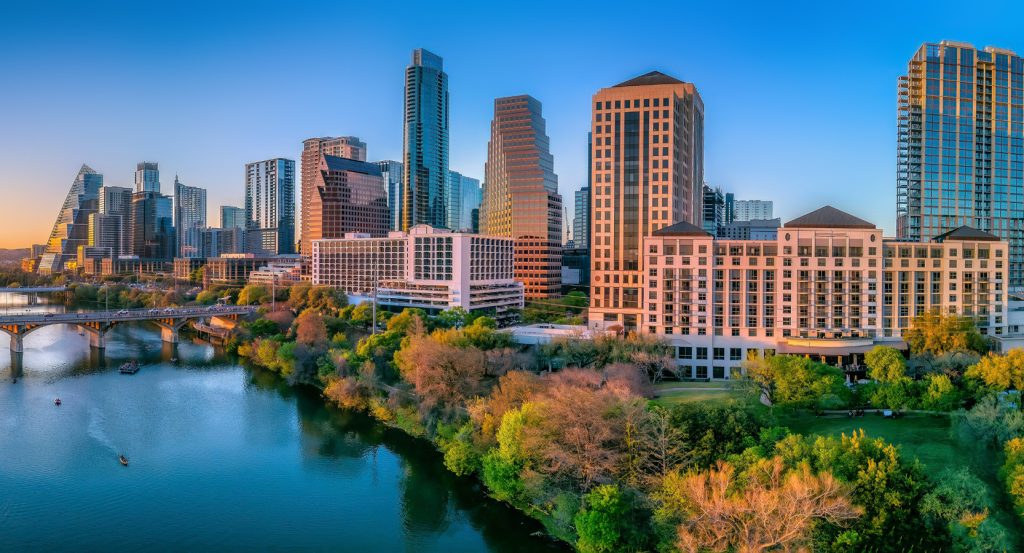
7th Street is a lively corridor where Downtown's commercial heritage, entertainment traditions, architectural character, and enduring capital-city character intersect across one of the city's oldest east-west streets.
Running through Downtown between West Downtown and Central East Austin, the corridor links historic commercial blocks, theaters, civic institutions, and cultural destinations that collectively demonstrate Austin's growth from a nineteenth-century frontier capital into a modern metropolitan center. Restored masonry buildings, early twentieth-century storefronts, contemporary towers, and shaded public spaces create an urban landscape where successive generations of development remain visible within a remarkably compact setting. Decades of preservation and investment have reinforced the corridor's historic character while accommodating Austin's continuing evolution. The result is an experience defined by architectural continuity, cultural richness, and one of Downtown's most enduring corridors.
What you should know 7th Street.
7th Street is best known for occupying a principal east-west alignment within the 1839 Edwin Waller Plan, prepared by surveyor Edwin Waller under the direction of Republic of Texas President Mirabeau B. Lamar, establishing the street structure that continues defining Downtown today. The corridor became an important commercial address during the late nineteenth and early twentieth centuries as masonry mercantile buildings, financial institutions, hotels, and professional offices reshaped the original frontier settlement into the governmental and business center of Texas. Adjacent blocks encompass contributing resources within the Sixth Street Historic District, listed on the National Register of Historic Places in 1975, preserving one of the state's finest collections of Victorian commercial architecture constructed primarily between the 1880s and 1910s. Nearby institutions including the Austin History Center, opened within the former Austin Public Library building completed in 1933, preserve extensive archival collections documenting the city's political, architectural, social, and cultural development. Collectively, the corridor's Republic-era planning, commercial expansion, National Register resources, and archival institutions establish 7th Street as one of Downtown's defining historic corridors.
The Shoal Creek watershed influenced Austin's earliest western development by shaping limestone crossings, settlement patterns, and the physical limits of nineteenth-century expansion beyond the original city grid. The Downtown Alliance, established in 1993, continues supporting preservation initiatives, public realm improvements, economic development, and historical interpretation that strengthen the district's long-term vitality. Archaeological investigations throughout Downtown have documented Indigenous cultural materials alongside Republic of Texas and nineteenth-century commercial deposits that continue expanding scholarly understanding of human occupation within the Colorado River valley. Together, these environmental systems, civic organizations, and archaeological discoveries demonstrate how 7th Street reflects a corridor where urban planning, environmental history, and cultural preservation remain closely connected.
How 7th Street fits.
7th Street works as an exploration of Austin's commercial heritage, architectural history, and cultural institutions.
Begin at Austin History Center, where original photographs, manuscripts, maps, and archival collections introduce the people and events that shaped the city's development from the Republic era onward. Continue to Museum of the Weird, where classic sideshow traditions, popular culture exhibits, and decades of Austin folklore reveal an unconventional chapter of the city's cultural identity. Conclude at The Driskill, where Romanesque Revival architecture, late nineteenth-century craftsmanship, and generations of Texas political and civic history provide the historical payoff through one of Austin's finest surviving nineteenth-century architectural achievements. The progression moves naturally from documentary history to local cultural traditions before culminating in one of Austin's most distinguished historic hotels.
Where your story begins.
Foresyte Travel reveals places that feel extraordinary long before you arrive.
Enjoy editorial crafted for luxury travelers.
Foresyte may earn a commission when you book.