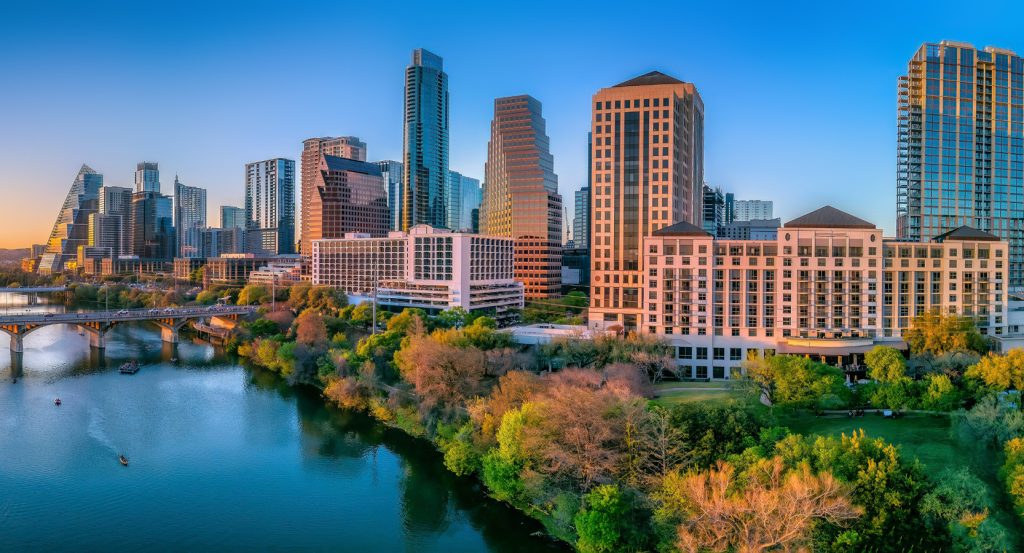
Why you should experience 8th Street in Austin, Texas.
8th Street is a spirited corridor where Downtown's civic heritage, architectural legacy, cultural institutions, and enduring capital-city character converge across one of the city's most distinguished east-west streets.
Running through Downtown between West Downtown and Central East Austin, the corridor connects historic commercial blocks, government buildings, museums, theaters, and public plazas that collectively reflect nearly two centuries of Austin's evolution as the capital of Texas. Restored nineteenth-century architecture, grand civic buildings, contemporary towers, and shaded streetscapes create an urban landscape where successive eras of development remain visible within a compact downtown setting. Generations of preservation and reinvestment have strengthened the corridor while maintaining its importance within Austin's civic and cultural life. The result is an experience defined by historical depth, architectural distinction, and one of Downtown's defining corridors.
What you should know about 8th Street.
8th Street is best known for traversing the original 1839 Edwin Waller Plan, commissioned by Republic of Texas President Mirabeau B. Lamar after surveyor Edwin Waller established the rectilinear street grid that continues defining Downtown nearly two centuries later. The corridor forms part of one of Texas' most significant governmental and architectural districts, anchored by the Texas State Capitol, completed in 1888 under architect Elijah E. Myers, whose 302.64-foot Renaissance Revival design remains taller than the United States Capitol and was designated a National Historic Landmark in 1986. Nearby institutions including the Paramount Theatre, opened in 1915 as one of Texas' oldest continuously operating theaters, the O. Henry Museum, preserving the former home of writer William Sydney Porter, and the Texas State Library and Archives Commission, established in 1909, reinforce the corridor's importance as a center for government, literature, performing arts, and historical preservation. Surrounding blocks encompass numerous properties listed on the National Register of Historic Places, preserving Victorian commercial buildings alongside Beaux-Arts, Classical Revival, Art Deco, International Style, and contemporary architecture that collectively document Austin's transformation from a frontier capital into a major metropolitan center. Collectively, the corridor's Republic-era planning, National Historic Landmark architecture, literary heritage, performing arts legacy, and historic preservation establish 8th Street as one of Downtown's defining historic corridors.
The nearby Shoal Creek watershed shaped the western edge of Austin's original settlement by influencing early street alignments, limestone crossings, and patterns of nineteenth-century urban expansion beyond the Waller Plan. The Downtown Alliance, established in 1993, continues supporting preservation, streetscape enhancements, economic development, and public programming that reinforce the district's civic vitality and historic character. Archaeological investigations throughout Downtown have documented Republic of Texas, nineteenth-century commercial, and earlier Indigenous cultural deposits that continue expanding scholarly understanding of human occupation along the Colorado River valley. Together, these environmental systems, civic organizations, and archaeological discoveries demonstrate how 8th Street reflects a corridor where urban planning, environmental history, and cultural preservation remain deeply interconnected.
How to fold 8th Street into your trip.
8th Street works as an exploration of Austin's architectural heritage, performing arts, and civic history.
Begin at Texas State Capitol, where grand Renaissance Revival architecture, landscaped grounds, and the seat of Texas government introduce the political foundations that have defined Austin since the Republic era. Continue to Paramount Theatre, where ornate early twentieth-century architecture and a century of live performances reveal one of Texas' most enduring performing arts traditions. Conclude at Bullock Texas State History Museum, where extensive collections, immersive exhibitions, and rare historical artifacts provide the historical payoff by placing Downtown's civic and cultural evolution within the broader story of Texas. The progression moves naturally from state government to architectural and performing arts heritage before culminating in the state's premier museum devoted to Texas history.
Where your story begins.
Foresyte Travel reveals places that feel extraordinary long before you arrive.
Experience premium editorial crafted for luxury travelers.