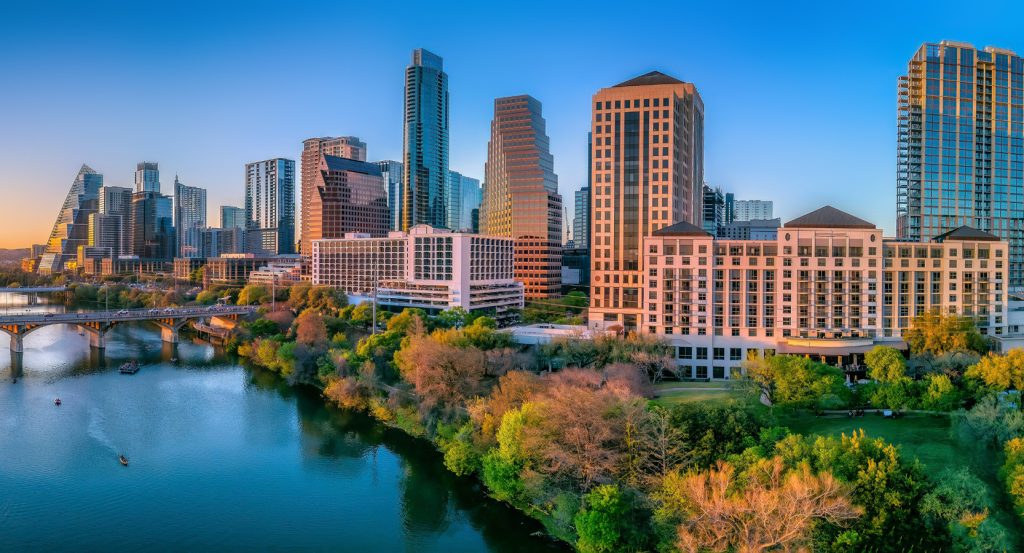
Why you should experience San Gabriel Street in Austin, Texas.
San Gabriel Street is an energetic corridor where West Campus' academic tradition, architectural evolution, neighborhood vitality, and cultural character create one of Central Austin's most recognizable streets.
Running through West Campus between Downtown and North University, the corridor connects the University of Texas, established residential blocks, academic institutions, neighborhood businesses, and public gathering spaces that reflect more than a century of educational and urban development. Each successive stretch reveals historic apartment buildings, contemporary residential towers, mature live oaks, shaded sidewalks, and locally owned cafés that reinforce the street's unmistakable identity. The defining moment arrives as San Gabriel Street demonstrates how higher education, architectural reinvestment, and neighborhood life continue shaping one of Central Austin's defining corridors. The result is an experience defined by academic energy, architectural diversity, and one of West Campus' most rewarding streets.
What you should know about San Gabriel Street.
San Gabriel Street is best known for traversing West Campus, the district that expanded rapidly following the founding of the University of Texas at Austin in 1883, as residential subdivisions, boarding houses, fraternity and sorority residences, apartment buildings, and neighborhood businesses emerged to accommodate a growing university population throughout the late nineteenth and twentieth centuries. The corridor borders the West Campus Neighborhood, where early Craftsman houses, Classical Revival residences, Mid-Century apartment buildings, and contemporary mixed residential developments collectively document successive eras of student-oriented growth while preserving elements of the area's historic streetscape. Nearby institutional anchors include the Harry Ransom Center, established in 1957, whose collections exceed 42 million literary manuscripts, 1 million rare books, and 5 million photographs, making it among the world's foremost humanities research libraries. The corridor also provides convenient access to Pease Park, Austin's oldest public park, established in 1875 through a land donation by Governor Elisha M. Pease, preserving 84 acres along Shoal Creek within walking distance of the university district. Native live oak, cedar elm, Texas red oak, Mexican sycamore, mountain laurel, yaupon holly, and riparian vegetation continue defining the corridor's landscape while reflecting its relationship with the Shoal Creek watershed. Collectively, the corridor's academic origins, architectural evolution, research institutions, parkland, and environmental setting establish San Gabriel Street as one of West Campus' defining corridors.
Adjacent to the corridor, the Neill-Cochran House Museum, completed in 1856 and designed by Abner Cook, preserves one of Austin's oldest surviving residences while interpreting nearly two centuries of local architectural and social history. Nearby, the Texas Memorial Museum, opened in 1939 on the University of Texas campus, continues advancing research and public education through extensive collections documenting Texas geology, paleontology, archaeology, and biodiversity. The nearby Shoal Creek Conservancy, founded in 2013, has coordinated habitat restoration, flood resilience initiatives, and public trail improvements that strengthen the ecological health of the creek corridor bordering West Campus. Together, these historic landmarks, scientific institutions, and environmental organizations demonstrate how San Gabriel Street reflects a corridor where education, preservation, and stewardship continue reinforcing one another.
How to fold San Gabriel Street into your trip.
San Gabriel Street works as an exploration of Austin's academic heritage, cultural institutions, and historic landscapes.
Begin at Harry Ransom Center, where globally significant literary archives, rare books, and photography collections establish the scholarly character surrounding San Gabriel Street while introducing one of the world's premier humanities research institutions. Continue to Pease Park, where restored creek landscapes, shaded trails, and historic parkland deepen the experience before guiding the journey toward its historical conclusion. Conclude at Neill-Cochran House Museum, where preserved Greek Revival architecture, period furnishings, and nearly two centuries of documented history provide the historical payoff by illuminating Austin's earliest decades. The progression moves naturally from world-renowned scholarship to historic public landscapes before culminating in one of the city's oldest surviving homes.
Where your story begins.
Foresyte Travel reveals places that feel extraordinary long before you arrive.
Experience premium editorial crafted for luxury travelers.