
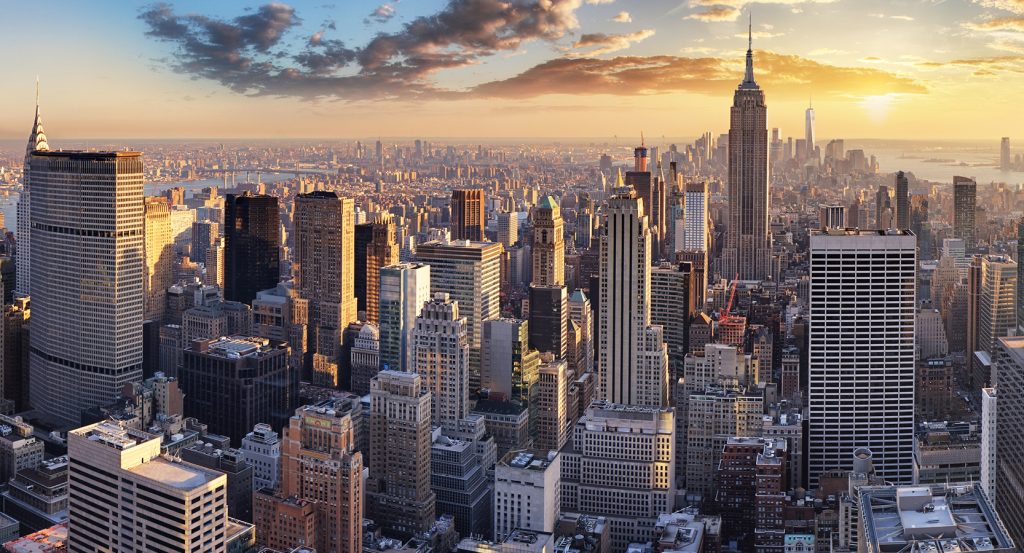
Why you should experience Aman New York in New York, NY.
Aman New York is a meditative luxury hotel where Midtown's Gilded Age architecture, 5th Avenue refinement, artistic pedigree and culture of discretion converge within an urban sanctuary suspended above one of Manhattan's most animated intersections.
Set along 5th Avenue near West 57th Street and just steps from Central Park, the hotel occupies the upper levels of the Crown Building, the 1921 Warren & Wetmore tower whose architects also shaped Grand Central Terminal and the Helmsley Building. Jean-Michel Gathy of Denniston reimagined the century-old structure through a restrained style of oak, stone, bronze and Japanese-inflected craftsmanship, placing working fireplaces throughout the suites and using operable screens to divide sleeping, bathing and living spaces. Gathy extended that serenity into the Garden Terrace, where reflecting pools, fire pits and landscaped planting surround outdoor dining beneath a retractable glass roof high above 5th Avenue. The result is a hotel where Warren & Wetmore's vertical architecture and Gathy's disciplined material language create an enveloping sense of calm at the geographical center of Manhattan intensity.
What you should know about Aman New York.
Aman New York is best known for opening on August 2, 2022 as an 83-suite hotel accompanied by 22 private homes, becoming Aman's second urban property after Aman Tokyo and bringing a portfolio that had reached 34 properties into one of the world's most competitive luxury-hospitality markets. The 22 Aman Residences represented the company's first urban branded residences, occupying the upper reaches of the 410-foot Crown Building above the hotel accommodations and incorporating individually configured homes, several with private terraces and swimming pools. The property simultaneously introduced Aman Club to New York, extending the company beyond conventional hotel operations through a private membership community integrated with dining, wellness and cultural programming inside the building. Together, the 83-suite inventory, 22-home residential collection, Aman Club and position as the brand's second city hotel made the opening a consequential expansion of a hospitality philosophy previously associated primarily with secluded resort settings.
Aman Spa New York develops that urban concept across more than 25,000 square feet and three floors, centering the wellness program on a 20-meter, or 65-foot, heated indoor swimming pool alongside two private Spa Houses dedicated respectively to a Russian-style banya and Moroccan hammam traditions. The wider program incorporates a cryotherapy chamber, infrared body rolls, reformer Pilates, yoga and movement spaces, a window-lined fitness center, separate sauna and steam facilities, a cold-plunge terrace and a Contrast Therapy Suite combining infrared sauna, red-light therapy, cold plunge and steam shower. Deep below 5th Avenue, The Jazz Club creates an entirely different cultural register through a subterranean performance room whose early creative direction was shaped by trumpeter Brian Newman, a musician with longstanding connections to Lady Gaga who subsequently served as musical director of Bruno Mars's Pinky Ring at Bellagio. The spa's three-floor concentration of thermal traditions and performance science, paired with a dedicated underground music venue, extends Aman New York into wellness and live culture with the same degree of specialization applied to its accommodation program.
How to fold Aman New York into your trip.
Aman New York works as the anchor for an afternoon tracing modern art, concert culture and Gilded Age collecting through the institutions surrounding 5th Avenue and West 57th Street.
Begin at Museum of Modern Art, whose founding trustees Abby Aldrich Rockefeller, Lillie P. Bliss and Mary Quinn Sullivan established the institution in 1929, initially opening six rooms in the Heckscher Building before developing a collection that would fundamentally expand the institutional definition of modern art across painting, sculpture, photography, architecture, design and film. Continue to Carnegie Hall, where Andrew Carnegie financed a concert complex designed by cellist and architect William Burnet Tuthill, opening on May 5, 1891 with a program featuring Pyotr Ilyich Tchaikovsky before violinist Isaac Stern spearheaded the campaign that prevented its demolition and led New York City to purchase the building in 1960. Conclude at The Frick Collection, formed around industrialist Henry Clay Frick's holdings of European painting, sculpture and decorative arts and installed within the Carrère and Hastings-designed Fifth Avenue residence completed in 1914, which became a public museum following Frick's death and opened to visitors in 1935. The progression moves from Rockefeller, Bliss and Sullivan's rebellious conception of a modern museum through Carnegie and Tuthill's temple to musical performance into Frick's intensely personal collection of European art, revealing the traditions of patronage, collecting and cultural authorship surrounding Aman New York.
Where your story begins.
Foresyte Travel reveals places that feel extraordinary long before you arrive.
Experience premium editorial crafted for luxury travelers.







































































































