Why Bryant Park Carousel matters.
Bryant Park Carousel is an intimate amusement ride where Midtown's French-classical park character meets hand-finished carousel craft, cabaret music and a compact menagerie beneath mature London plane trees.
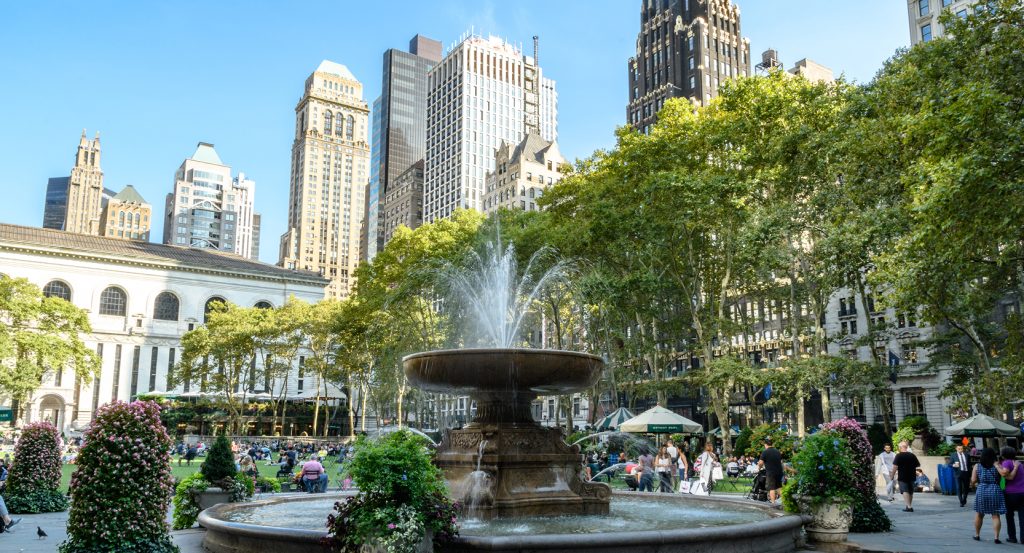
Set along Bryant Park's 40th Street allée near 5th Avenue and just steps from the William Cullen Bryant Memorial, the carousel occupies the park's southern edge beneath a dense canopy of London plane trees beside the central lawn. Fourteen animal figures circle beneath a decorative canopy, with horses joined by a rabbit, deer, cat and frog in a menagerie modeled on traditional European and American carousel creatures. French cabaret music accompanies the rotating platform, reinforcing a design conceived specifically for the formal garden character surrounding it. Painted rounding boards draw their ornament from the baroque-style torchères lining 40th Street, tying the small structure visually to architectural details already embedded across the park. The result is a deliberately site-specific carousel whose animal figures, ornamental canopy, French music and relationship with the allée extend Bryant Park's classical design into a working piece of amusement craft.
What defines Bryant Park Carousel.
Bryant Park Carousel is best known for extending the French-classical character of Bryant Park through a custom carousel designed by Marvin Sylvor and fabricated by his Brooklyn-based Fabricon Carousel Company. Bryant Park Corporation pursued the addition after the park had emerged from the extensive rehabilitation that reopened it in 1992, seeking a family-oriented attraction suited to the formal landscape along 40th Street. Sylvor had founded Fabricon in the 1980s and developed an international business producing individually designed carousels, with more than 70 examples completed across destinations extending from Chicago to Hong Kong, Singapore, São Paulo and Saudi Arabia by 2002. Fabricon spent six months building the Bryant Park commission in Brooklyn, creating an original design modeled directly on the surrounding park. The finished ride accommodated 18 riders and paired its custom decorative program with French songs including “La Vie en Rose.”  Bryant Park Corporation installed the carousel in June 2002, adding a permanent amusement structure to a site whose formal plan had previously centered on lawn, allées, terraces and planting. One figure carries an unusually local commemoration: the lead horse, Granny's Folly, received its name for an NYPD mounted horse killed in the line of duty. The complete menagerie comprises ten horses and four other animals, giving Sylvor's commission a specific cast of figures created for this Midtown setting.
The carousel belongs to a much longer sequence of deliberate interventions that produced the park surrounding it. An Architects' Emergency Committee competition during the Depression selected Queens architect Lusby Simpson's classical proposal, which drew inspiration from Paris's Jardin du Luxembourg and centered the grounds on a lawn, formal paths, stone balustrades and rows of London plane trees. Parks Commissioner Robert Moses advanced the project in 1934 with consulting architect Aymar Embury II and landscape architect Gilmore D. Clarke, and the reconstructed grounds opened that September. Decades of deterioration eventually led Daniel A. Biederman and New York Public Library chairman Andrew Heiskell to found Bryant Park Restoration Corporation in 1980 with support from the Rockefeller Brothers Fund. Early management changes produced a 92 percent reduction in crime and doubled annual attendance across seven years before a comprehensive physical rehabilitation began. The park closed in 1988 for four years of work that increased visibility from surrounding streets, removed isolating hedges, restored restrooms, added restaurant pavilions and concession kiosks and placed 2,000 movable bistro chairs throughout the grounds. Sociologist William H. Whyte had championed movable chairs as a way to give park users control over where and how they sat, and his thinking became closely associated with Bryant Park's revival. The 1992 reopening created the public setting into which Sylvor's carousel arrived a decade later, making the ride a small but deliberate extension of a park rebuilt through successive generations of landscape design and public-space management.
How Bryant Park Carousel fits.
Bryant Park Carousel works as the anchor for a Midtown outing connecting a great public research library, an extraordinary private rare-book collection and the railroad terminal that helped shift New York's metropolitan center northward.
Begin at New York Public Library - Stephen A. Schwarzman Building, created after John Bigelow devised the 1895 consolidation of the Astor and Lenox libraries with the Tilden Trust into The New York Public Library. First director John Shaw Billings sketched the organizing plan for an immense reading room above seven floors of stacks, and Carrère & Hastings won the architectural competition in 1897. 500 workers spent two years dismantling the Croton Reservoir before the cornerstone was laid in 1902; construction ultimately consumed $9 million, and 75 miles of shelving had been installed by 1910. More than one million books occupied the building when President William Howard Taft presided over its May 23, 1911 dedication, and tens of thousands entered when the doors opened the following morning. Continue to The Morgan Library & Museum, where financier Pierpont Morgan commissioned Charles Follen McKim in 1902 to create a private library beside his Madison Avenue residence for collections of manuscripts, early printed books, drawings and prints. McKim completed the Italian Renaissance-style building in 1906, integrating architecture, sculpture and painting across three principal rooms. Belle da Costa Greene began working for Morgan in 1905, built the rare-book and manuscript collection, became the institution's first director when J. P. Morgan Jr. converted it into a public institution in 1924 and remained director until 1948. Her acquisitions included major William Caxton works, and her quarter-century as director added 138 illuminated manuscripts, 596 incunabula and more than 17,000 reference works to the institution. Conclude at Grand Central Terminal, which opened at 12:01 a.m. on February 2, 1913 after an immense rebuilding campaign replaced an earlier railroad complex with a terminal engineered for electric trains and constructed around a two-level track system. More than 150,000 people entered on opening day, and development above the buried rail approaches subsequently helped produce Terminal City, with the Biltmore Hotel, Yale Club, Hotel Commodore, Graybar Building and a succession of skyscrapers rising around the station during the following decades. The terminal later survived major redevelopment threats, and its preservation became inseparable from the legal battle that affirmed New York City's power to protect historically important architecture. The progression moves from Carrère & Hastings's public institution through McKim and Greene's extraordinary union of architecture and collecting and culminates at the railroad terminal whose construction reshaped Midtown itself, connecting books, patronage and transportation across the blocks surrounding Bryant Park.
Where your story begins.
Foresyte Travel reveals places that feel extraordinary long before you arrive.
Enjoy editorial crafted for luxury travelers.
Foresyte may earn a commission when you book.