
Why New York Public Library - Stephen A. Schwarzman Building matters.
New York Public Library - Stephen A. Schwarzman Building is a commanding Beaux-Arts library where Midtown's intellectual culture meets Vermont marble architecture, vast research collections and ceremonial public rooms conceived for free access to knowledge.
Set along 5th Avenue between West 40th and West 42nd streets near Avenue of the Americas and just steps from One Vanderbilt, the building occupies an entire two-block site with Bryant Park extending immediately behind its western elevation. Carrère & Hastings organized the exterior around a broad marble terrace, deeply recessed arched openings, Corinthian columns and a central entrance approached between Edward Clark Potter's paired Tennessee-marble lions. Astor Hall carries the architectural scale indoors through white marble arches and expansive staircases, establishing a ceremonial route from 5th Avenue toward the research rooms above. McGraw Rotunda deepens that interior sequence with Edward Laning's painted cycle devoted to the history of the written word, placing figurative art within one of the principal circulation spaces. The result is a library whose extended 5th Avenue frontage, sculptural entrance, marble halls and richly appointed interiors give public scholarship an architectural presence commensurate with the scale of its collections.
What defines New York Public Library - Stephen A. Schwarzman Building.
New York Public Library - Stephen A. Schwarzman Building is best known for housing the principal research library created after the Astor Library, Lenox Library and Tilden Trust united on May 23, 1895 to form The New York Public Library. Samuel J. Tilden had left $2.4 million toward a free library and reading room, John Jacob Astor had funded the reference library that opened in 1849, and James Lenox had assembled a rare-book collection containing the first Gutenberg Bible brought to the New World. Attorney and Tilden trustee John Bigelow devised the consolidation as the Astor and Lenox institutions confronted shrinking endowments and expanding holdings during the 1890s. The city selected the Croton Reservoir site on 5th Avenue for the new central building, requiring 500 workers to spend two years dismantling the massive reservoir before construction advanced. First director John Shaw Billings sketched an organizing plan in 1897 that placed an enormous reading room above seven levels of book stacks, making rapid retrieval from the collections a fundamental architectural concern. Carrère & Hastings won the architectural competition that November after John Merven Carrère and Thomas Hastings had studied at the École des Beaux-Arts in Paris and worked in the offices of McKim, Mead & White. A 7.5-ton cornerstone containing photographs, newspapers, correspondence and agreements between the city and Library was laid on November 10, 1902. Seventy-five miles of shelving had been installed by 1910, and more than one million books occupied the building before its dedication on May 23, 1911. President William Howard Taft presided over the ceremony with Governor John Alden Dix and Mayor William J. Gaynor, and tens of thousands entered when the $9 million library opened to the public the following morning.
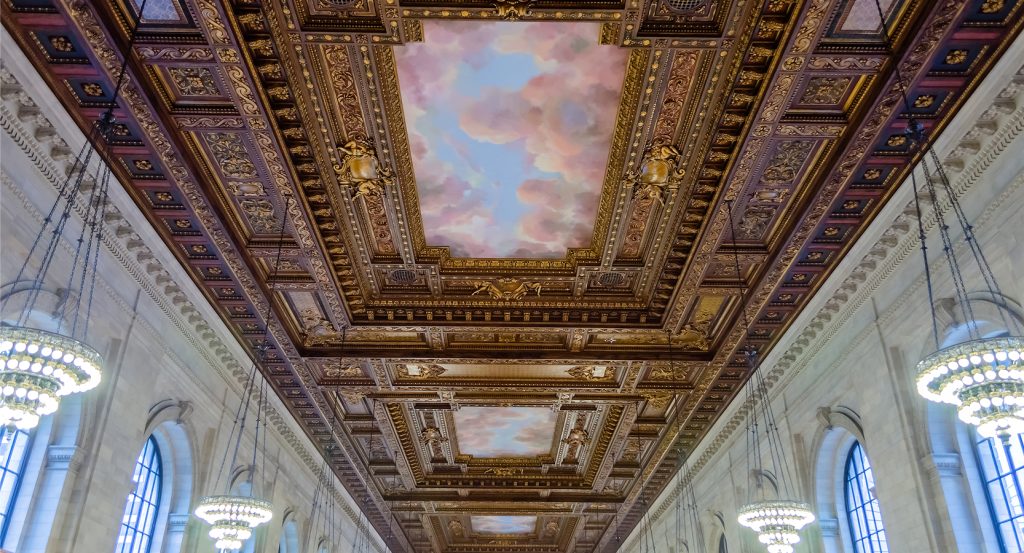
The Rose Main Reading Room forms another consequential chapter in the building's history, extending 297 feet across the third floor beneath 52-foot ceilings painted with expansive skies. Forty-two oak tables occupy the room, and the restored configuration provides 624 reader seats within an interior nearly two city blocks long. Sandra Priest Rose and Frederick Phineas Rose financed a major restoration completed in 1998, after which the room received the names of their children Deborah, Jonathan F. P., Samuel Priest and Adam R. Rose. A plaster rosette fell from the ceiling overnight in May 2014, closing the room and adjacent Bill Blass Public Catalog Room for more than two years as engineers examined the structure and crews reinforced 900 ornamental ceiling elements with steel cable. EverGreene Architectural Arts recreated and restored the James Wall Finn sky murals before both rooms reopened on October 5, 2016. Below Bryant Park, another expansion had begun in 1988 with excavation for a 120,000-square-foot storage extension 30 feet underground, connected to the original building through a 120-foot tunnel and opened in 1991 at a cost of $24 million. A second subterranean level completed decades later became part of the Milstein Research Stacks, giving the building capacity for more than four million research volumes beneath the park. A $2.6 million delivery system installed during the same modernization uses 24 individual cars traveling across 360 feet of track to move requested books between storage and the reading rooms. These successive projects preserved the great reading room above as the Library simultaneously expanded the concealed infrastructure required to sustain research at an immense scale.
How New York Public Library - Stephen A. Schwarzman Building fits.
New York Public Library - Stephen A. Schwarzman Building works as the anchor for a Midtown outing connecting a financier's private collection, the reinvention of regional rail travel and the architectural ambitions of the machine age.
Begin at The Morgan Library & Museum, whose architectural nucleus originated when Pierpont Morgan commissioned Charles Follen McKim in 1902 to design a private library beside his Madison Avenue residence for a rapidly expanding collection. Morgan died in 1913, and his son Jack transformed the library into a public institution in 1924 in fulfillment of his father's desire that the collection benefit the American people. Benjamin Wistar Morris designed a second marble structure completed in 1928, and Renzo Piano Building Workshop began another architectural chapter in 2001 by unifying the surviving historic buildings through glass and painted-steel additions that opened in 2006. Continue to Grand Central Terminal, opened at 12:01 a.m. on February 2, 1913 after New York required railroads to abandon steam operation following deadly accidents and mounting problems with smoke, soot and congestion. The replacement terminal separated commuter and intercity rail operations across different levels, connected its concourses with ramps and helped drive a new wave of construction around Midtown. More than 150,000 people entered on opening day, and later decades brought decline, preservation battles and an extensive renewal completed with a 1998 rededication. Grand Central Madison added Long Island Rail Road service in 2023 through new tunnels and platforms descending as much as 180 feet below street level. Conclude at Chrysler Building, the 1928-1930 Art Deco skyscraper William Van Alen designed for automobile executive Walter P. Chrysler after Chrysler assumed control of a speculative tower project begun by developer William H. Reynolds. Chrysler financed the building personally, and Van Alen translated automobile imagery into stainless-steel eagles, radiator-cap forms and machine-age ornament across the upper stories. The completed 1,046-foot tower briefly held the title of world's tallest building, with its stepped stainless-steel crown and concealed spire giving Walter Chrysler a personal architectural symbol independent of corporate financing. The progression moves from McKim's private library transformed into a public institution through Grand Central's reconstruction of regional transportation and culminates in Van Alen's machine-age skyscraper, tracing three major architectural responses to New York's early twentieth-century ascent.
Where your story begins.
Foresyte Travel reveals places that feel extraordinary long before you arrive.
Enjoy editorial crafted for luxury travelers.
Foresyte may earn a commission when you book.







































































































