Why you should experience Canal Streetcar Line in New Orleans, Louisiana.
Canal Streetcar Line is a historic transit corridor where the Central Business District's transportation heritage, architectural grandeur, commercial vitality, and centuries of urban life define one of New Orleans' most enduring public thoroughfares.
Running along Canal Street between the Mississippi River and the city's historic cemeteries and just steps from Canal Place, this celebrated streetcar corridor combines meticulously restored historic streetcars, grand civic architecture, grand department stores, theaters, hotels, and one of America's most recognizable urban boulevards into an unforgettable journey through New Orleans. Rolling beneath towering oaks and past generations of commercial landmarks, the line preserves a living transportation tradition that continues shaping the rhythm of everyday city life. The result is an experience defined by historical continuity, engineering heritage, and exceptional urban character.
What you should know about Canal Streetcar Line.
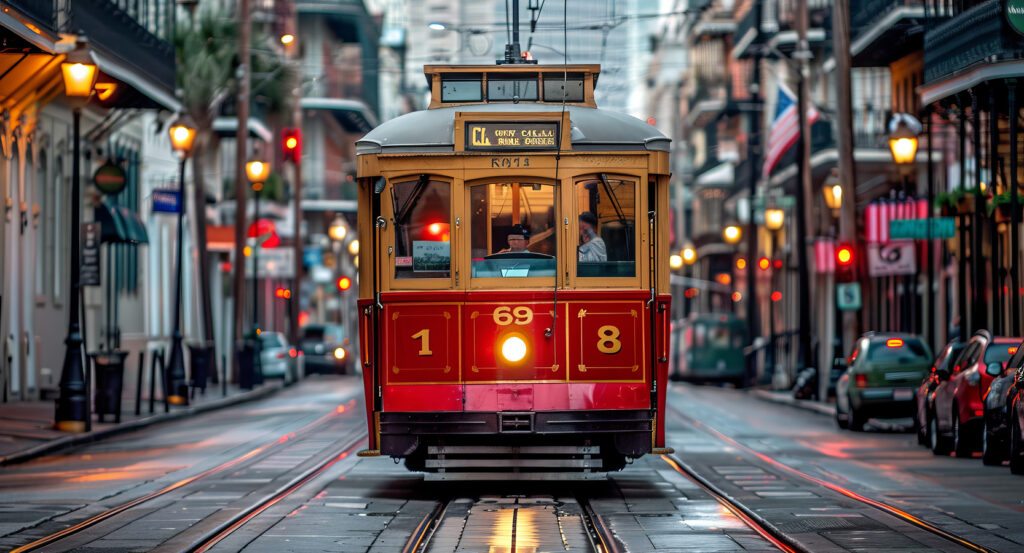
Canal Streetcar Line is best known for operating along one of America's oldest continuously active street railway corridors, tracing its origins to 1861 when horse-drawn streetcars first began serving Canal Street before successive generations of mule cars, electric streetcars, and modern heritage vehicles transformed the route into the backbone of New Orleans' public transportation network. Canal Street itself was established in the early nineteenth century as an ambitious but never-completed canal intended to separate the original French Quarter from the expanding American sector of the city, ultimately becoming New Orleans' grand civic boulevard. The streetcar line entered service on January 8, 1861, initially using horse-drawn cars before electrification arrived in 1893, reflecting the city's rapid embrace of emerging transportation technologies. For decades the line served as the commercial spine of New Orleans, carrying shoppers, commuters, and visitors past flagship department stores, luxury hotels, theaters, financial institutions, and civic landmarks that established Canal Street as the retail capital of the Gulf South. After service ended in 1964 amid nationwide streetcar abandonments, preservation advocates successfully campaigned for its return, culminating in the line's historic reopening in 2004 following an $161 million reconstruction that restored rail infrastructure, overhead power systems, streetscapes, and heritage operations. Today the route extends 5.5 miles (8.9 kilometers) from the Mississippi River to City Park and the historic cemeteries, branching into the Canal-City Park and Canal-Cemeteries services operated by the New Orleans Regional Transit Authority. The fleet includes meticulously crafted Perley Thomas, style heritage streetcars, built to reflect the appearance of the city's iconic early twentieth-century rolling stock while incorporating modern accessibility features, air-conditioning, and contemporary engineering systems beneath historically accurate exteriors. The line also plays a vital role in New Orleans' resilience planning, with substantial reconstruction following Hurricane Katrina restoring one of the city's most important transportation corridors while reinforcing its significance as both functioning infrastructure and living cultural heritage.
The engineering experience unfolds through embedded steel rail, overhead catenary systems, carefully restored heritage vehicles, broad neutral grounds, and one of America's finest surviving examples of integrated street railway urbanism. Historic streetscape restoration, preservation-sensitive infrastructure improvements, and continuous transit operations demonstrate how nineteenth-century transportation corridors can successfully serve twenty-first-century cities. Every journey along the Canal Streetcar Line reveals nearly two centuries of urban evolution, illustrating how transportation, commerce, architecture, and civic planning combined to create one of the most influential streetcar corridors in the United States.
How to fold Canal Streetcar Line into your trip.
Canal Streetcar Line works as part of an exploration through New Orleans' celebrated civic and cultural landmarks.
Begin at Canal Place, where upscale shopping and Mississippi River views introduce Canal Street before boarding the Canal Streetcar Line. Continue to City Park, whose expansive landscapes, museums, and centuries-old live oaks showcase one of America's great urban parks. Conclude at St. Louis Cemetery No. 3, where remarkable funerary architecture provides a memorable finale celebrating New Orleans' distinctive cultural heritage. The progression moves naturally from the historic commercial heart of the city to its celebrated public landscapes before concluding among one of its most significant historic cemeteries, revealing why the Canal Streetcar Line remains one of New Orleans' defining civic experiences.
Where your story begins.
Foresyte Travel reveals places that feel extraordinary long before you arrive.
Experience premium editorial crafted for luxury travelers.