Why Chartres Street matters.
Chartres Street is a historic French Quarter corridor where French Quarter's colonial architecture, religious heritage, centuries of commerce, and remarkable preservation create one of New Orleans' most historically significant streets.
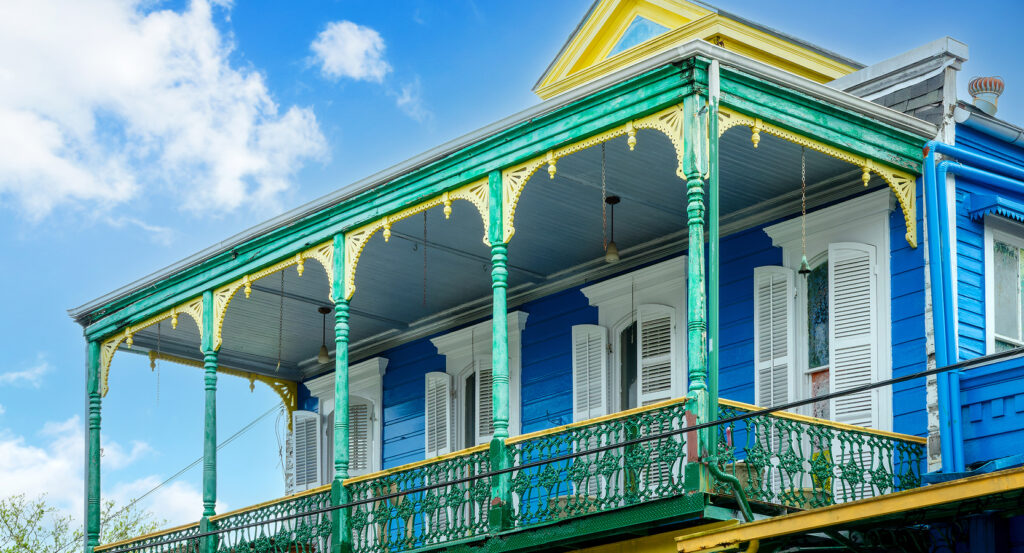
Running through French Quarter between Canal Street and Esplanade Avenue, this elegant thoroughfare passes some of the city's oldest surviving buildings, celebrated museums, historic residences, renowned restaurants, and sacred landmarks while preserving an extraordinary streetscape shaped by French, Spanish, and Creole influences. Quiet residential blocks, centuries-old masonry, wrought-iron balconies, and beautifully restored courtyards create an atmosphere that reveals the French Quarter at its most authentic. Every block uncovers another chapter in nearly three centuries of New Orleans history. The result is an experience defined by architectural excellence, cultural heritage, and one of America's most significant historic streets.
What defines Chartres Street.
Chartres Street is best known for preserving the French Quarter's greatest concentration of surviving colonial-era landmarks, tracing one of the original streets laid out following the founding of New Orleans in 1718 while connecting many of the city's oldest and most historically significant buildings. Named after Louis, Duke of Chartres, later Philippe II, Duke of Orléans, the corridor became one of colonial New Orleans' principal civic and religious streets, with much of its present architectural character emerging after the devastating Great New Orleans Fire of 1788 and the 1794 fire, when Spanish rebuilding regulations transformed the district through masonry construction and fire-resistant design. The street contains an exceptional concentration of nationally significant landmarks including the Old Ursuline Convent, completed in 1753 and widely recognized as the oldest surviving building in the Mississippi Valley, alongside St. Louis Cathedral, The Cabildo, The Presbytère, Napoleon House, New Orleans Pharmacy Museum, Beauregard-Keyes House, and the Historic New Orleans Collection's Williams Research Center. These institutions collectively document the city's religious, political, architectural, medical, and cultural evolution across more than three centuries. Protected within the Vieux Carré Historic District, designated a National Historic Landmark in 1965, Chartres Street remains one of the finest surviving examples of colonial urban planning in North America, where rigorous preservation standards administered by the Vieux Carré Commission, established in 1936, continue safeguarding its extraordinary architectural integrity. Together, unparalleled historic preservation, exceptional colonial architecture, enduring cultural institutions, and nearly three centuries of uninterrupted urban history establish Chartres Street as one of America's greatest historic corridors.
The corridor continues demonstrating how careful preservation can sustain a living historic neighborhood where civic institutions, residences, museums, restaurants, and places of worship coexist within one of the nation's most intact colonial streetscapes. Exceptional architectural continuity, nationally significant historic landmarks, centuries of cultural activity, and enduring community stewardship reinforce Chartres Street's standing among the world's finest preserved historic streets.
How Chartres Street fits.
Chartres Street works as a leisurely exploration through the historic heart of the French Quarter.
Begin at St. Louis Cathedral, where New Orleans' most recognizable religious monument introduces the extraordinary heritage surrounding Chartres Street before strolling its historic blocks. Continue to Old Ursuline Convent, where the oldest surviving building in the Mississippi Valley offers remarkable insight into colonial Louisiana. Conclude at Napoleon House, where one of the French Quarter's most celebrated historic buildings provides a memorable finale celebrating the remarkable architectural and cultural traditions that define Chartres Street. The progression moves naturally from the city's spiritual center to its oldest surviving colonial structure before concluding within one of New Orleans' most storied historic buildings, revealing why Chartres Street remains one of the French Quarter's defining corridors.
Where your story begins.
Foresyte Travel reveals places that feel extraordinary long before you arrive.
Enjoy editorial crafted for luxury travelers.
Foresyte may earn a commission when you book.