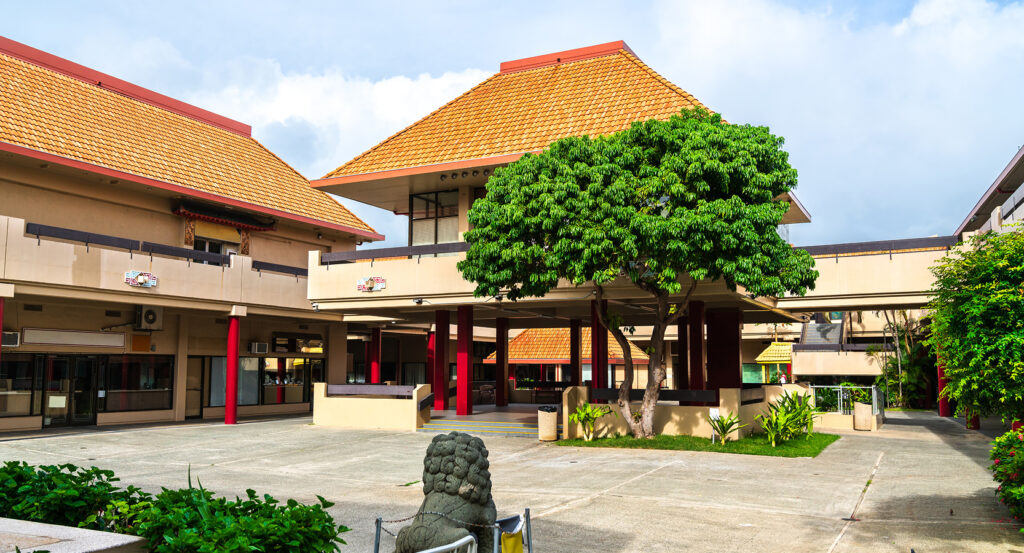
Why Oahu Market matters.
Oahu Market is the soul of Honolulu's Chinatown, a place where the island's multicultural heartbeat comes alive in a flurry of voices, colors, and scents.
Step through its open-air entrance, and you're transported to another era, one that predates glossy supermarkets and tourist façades. The air hums with the rhythm of daily life: the crack of cleavers against wooden blocks, the chatter of aunties haggling over prices, the scent of fresh cilantro mingling with roasted pork and salt-dried fish. This is where Honolulu's residents, not just visitors, come to shop for the ingredients that sustain family recipes passed down for generations. At first glance, the market feels chaotic, but look closer and you'll find harmony in its details: the carefully stacked guavas, the gleaming cuts of ahi tuna, the neon-red roast ducks hanging from hooks, the golden pineapples piled beside crates of Thai basil and lemongrass. Oahu Market is raw, real, and alive, a physical story of Hawaii's immigrant legacy told one stall at a time.
What defines Oahu Market.
Oahu Market has stood at the center of Chinatown since 1904, making it one of Honolulu's oldest continuously operating marketplaces.
It was founded by Lum Yip Kee, a Chinese immigrant and entrepreneur who saw an opportunity to unite dozens of independent vendors under one roof. His vision created a community hub, not just for commerce, but for connection, serving Chinese, Japanese, Filipino, and Hawaiian families throughout the 20th century. When much of Chinatown was rebuilt after the devastating 1900 fire, Oahu Market became a cornerstone of renewal, offering stability amid rapid change. Its design remains remarkably simple: a long hall lined with stalls and open bays that allow crosswinds to carry the scent of the sea through the market. Over the decades, it has survived pandemics, economic shifts, and waves of modernization that transformed the surrounding district, yet its heart remains unchanged. You can still see original architectural features like the cast-iron columns and century-old signage that once advertised imported goods from Guangdong and Okinawa. Beyond its historic charm, the market also plays an essential role in preserving Hawaii's food culture, from the preparation of laulau and poke to the continued sale of fresh herbs used in Chinese medicine. Generations of families have run the same stalls for decades, each one a living link in the story of Honolulu's Chinatown.
How Oahu Market fits.
To truly experience Oahu Market, come early, ideally before 9 a.m., when the air is cool, the fish is freshest, and the morning rush paints the aisles with movement and sound.
Begin by exploring the produce section, where tables overflow with tropical fruits you won't find anywhere else: spiky soursop, sugar apples, longan, and bunches of apple bananas so sweet they taste like candy. Move toward the butcher and seafood counters, where you can watch skilled vendors fillet reef fish with practiced precision or prepare roast meats glistening under the morning light. Don't be shy, strike up conversations; locals are usually happy to share recipes or cooking tips handed down through generations. If you're looking for lunch, wander a few steps outside the market to one of the nearby noodle shops or bakeries on King Street, where you can enjoy char siu bao or a steaming bowl of saimin made from ingredients sold just steps away. For photographers and culture seekers, Oahu Market is also a visual delight, its aged signage, hanging lanterns, and rows of exotic produce offer countless moments of authenticity rarely found in the modern city. Visiting here isn't about sightseeing; it's about participation, becoming part of the living rhythm that has sustained Honolulu's Chinatown for over a century. Oahu Market isn't just a place to shop, it's where Hawaii's diverse cultures meet, mix, and keep each other's stories alive.
Where your story begins.
Foresyte Travel reveals places that feel extraordinary long before you arrive.
Enjoy editorial crafted for luxury travelers.
Foresyte may earn a commission when you book.