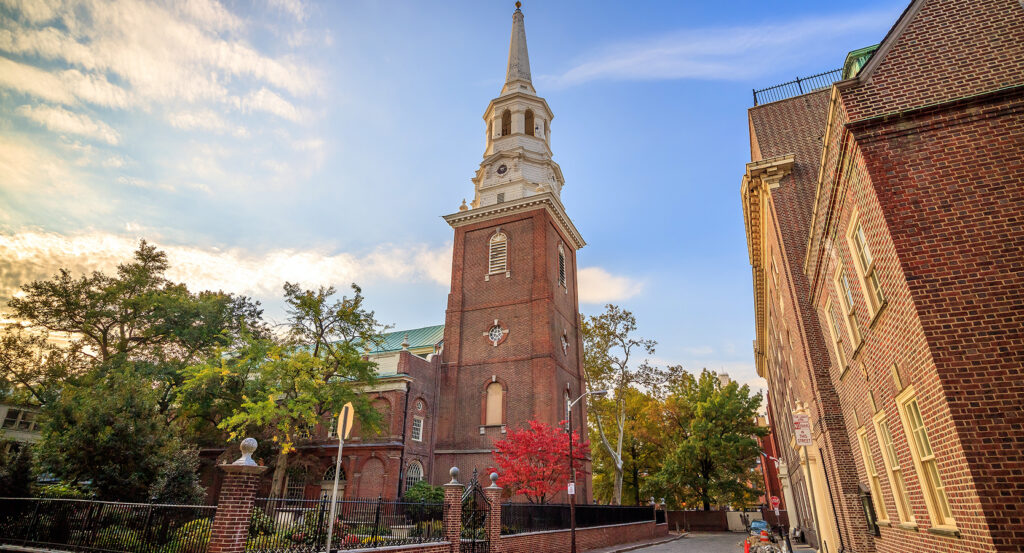
Why Christ Church matters.
Christ Church is the spiritual heartbeat of early America, where faith, revolution, and resilience intertwined beneath a canopy of candlelight and conviction.
Rising from the cobblestoned streets of Philadelphia's Old City, the church exudes a kind of timeless grace that feels both sacred and familiar. Its Georgian steeple, once the tallest structure in the colonies, pierces the skyline like a compass needle pointing toward history itself. Step inside, and the air carries a weight beyond centuries: the faint scent of polished wood and wax mingles with the soft echo of footsteps across worn pews. Sunlight filters through arched windows, striking the brass chandeliers that once shimmered above worshippers like Benjamin Franklin, George Washington, and Betsy Ross. Every creak in the floorboards feels like the whisper of the past, a reminder that this sanctuary witnessed the birth of a nation. Built between 1727 and 1754, Christ Church remains one of the earliest and most elegant examples of colonial architecture, with its symmetry and simplicity reflecting a time when beauty was born from restraint. But beyond its design, what truly endures is its spirit, a quiet, steadfast belief in liberty and community. Sitting in one of its wooden pews, it's impossible not to feel the magnitude of what once unfolded here: sermons that stirred the conscience, prayers that shaped the republic, and voices that refused to be silenced.
What defines Christ Church.
For all its renown, Christ Church's deeper stories remain hidden in its rafters, pews, and gravestones, fragments of faith that shaped not just a congregation but a country.
Founded in 1695 by members of the Church of England, it began as a modest mission in a city still finding its footing. Over time, it grew into one of the most influential parishes in colonial America. The church's steeple, added in 1754, wasn't just an architectural flourish; it served as a beacon for ships sailing up the Delaware River, a literal and spiritual guide for those seeking the promise of Philadelphia. During the Revolutionary era, its clergy and parishioners found themselves caught in the tension between loyalty to the Crown and the call for independence. Reverend William White, Christ Church's rector at the time, skillfully navigated that divide, serving as Chaplain to the Continental Congress and later becoming the first Presiding Bishop of the Episcopal Church after the revolution. Many don't realize that the church's communion silver, still used today, was gifted by Queen Anne herself, a gleaming relic of an empire that would soon lose its colonies. The pews tell their own stories: Washington's seat still bears the marks of use, while Franklin's lies only a few feet away, both testaments to the convergence of intellect and faith that defined the era. Outside, the churchyard holds generations of history, including the graves of signers of the Declaration of Independence and other early luminaries. Yet Christ Church never fossilized into nostalgia, it evolved. The congregation continued to grow and serve through every major turning point in the nation's story, from abolition to civil rights, maintaining its role as a gathering place for reflection, resilience, and renewal.
How Christ Church fits.
To experience Christ Church fully, move through it slowly, as you would through a living story, not a relic.
Start by approaching it from 2nd Street, where the church's red brick façade and towering white steeple seem to rise organically from the old cityscape. Pause before you enter; the quiet hum of the neighborhood fades as the bells toll, a sound that's rung over Philadelphia for nearly three centuries. Inside, take a seat in the pews and look upward, the craftsmanship of the wooden galleries and the symmetry of the arches reveal how beauty once served faith, not vanity. You can join a guided tour led by docents who weave together tales of architecture, revolution, and everyday life with the kind of warmth that makes history feel human again. Don't miss the chance to stand in Washington's pew or glance up at the original chandelier, both reminders that the men and women who gathered here were not mythical founders but real people grappling with impossible questions. Afterward, wander through the adjacent burial ground, where the names carved into the stones seem to whisper across time. If you visit on a Sunday, you can still attend a service, a surreal experience in which 18th-century ritual meets modern spirit, the hymns echoing through a space that once echoed with the ideals of freedom itself. When you step back outside, take a moment beneath the shade of the churchyard trees. The world feels louder now, but the peace lingers, that sense that you've stood in a place where courage once met conviction. Christ Church isn't just another historical site; it's a mirror held up to the American soul. It reminds you that faith, whether spiritual, civic, or personal, is built not on perfection, but persistence. Beneath its spire, the echoes of revolution and grace still intertwine, whispering that liberty, like belief, must be tended across generations.
Where your story begins.
Foresyte Travel reveals places that feel extraordinary long before you arrive.
Enjoy editorial crafted for luxury travelers.
Foresyte may earn a commission when you book.