
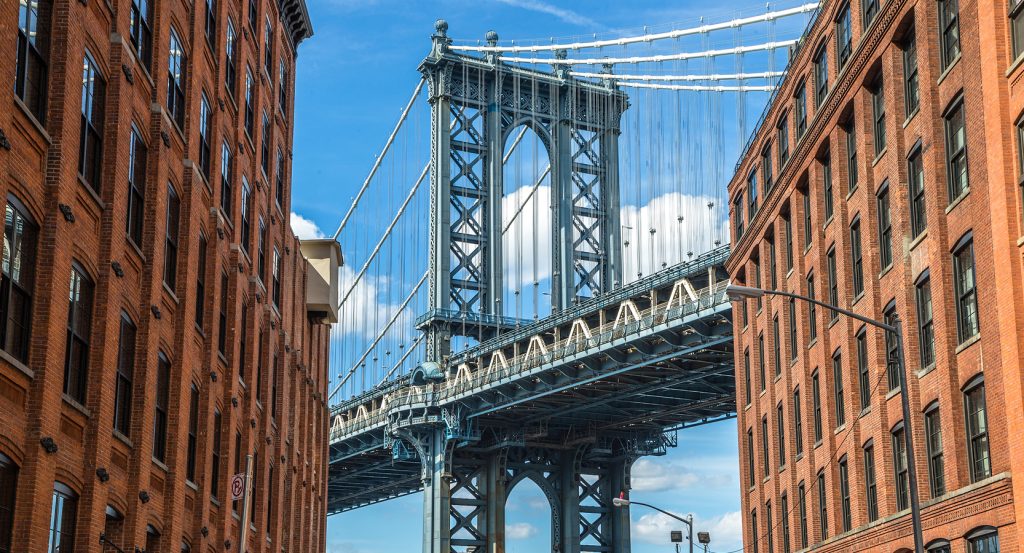
Why you should experience Dock Street in New York, NY.
Dock Street is a historic DUMBO corridor where maritime commerce, industrial architecture, and waterfront revival converge along one of Brooklyn's most historically significant streets.
Running through DUMBO between Brooklyn Heights and Vinegar Hill, this historic corridor connects restored warehouse buildings, landmark waterfront parks, neighborhood businesses, creative offices, cobblestone streets, and architecturally significant industrial structures that collectively showcase Brooklyn's remarkable transformation. Monumental nineteenth-century brick warehouses, adaptive reuse lofts, scenic public plazas, converted manufacturing buildings, and dramatic views of the Manhattan Bridge create an urban landscape where centuries of shipping, commerce, and innovation continue to intersect. Dock Street developed as a vital component of Brooklyn's East River port, serving warehouses, ferries, merchants, and shipping companies whose activities helped establish the borough as one of the nation's busiest commercial waterfronts. The result is a corridor defined by maritime heritage, architectural distinction, and contemporary creative energy.
What you should know about Dock Street.
Dock Street is best known for being home to Empire Stores, completed beginning in 1869 as one of the largest coffee warehouse complexes in the United States.
Constructed to store coffee, sugar, and other imported goods arriving through the Port of New York, the interconnected warehouses became an essential link in Brooklyn's thriving maritime economy during the late nineteenth century. Their immense scale and robust Civil War-era brick construction reflected the extraordinary volume of international trade flowing through the East River waterfront while supporting generations of merchants, dockworkers, and shipping companies. The meticulously restored complex now serves as an internationally recognized example of adaptive reuse, preserving its industrial character while housing cultural attractions, restaurants, offices, and public gathering spaces overlooking the harbor. Today, Empire Stores remains one of DUMBO's defining landmarks and a lasting symbol of Brooklyn's waterfront renaissance.
How to fold Dock Street into your trip.
Dock Street is best experienced as an exploration of DUMBO's industrial heritage, waterfront parks, and architectural landmarks.
Begin at Empire Stores, where one of Brooklyn's most celebrated adaptive reuse projects immediately establishes the street's defining industrial legacy. Continue toward Brooklyn Bridge Park, whose restored piers, landscaped waterfronts, and spectacular Manhattan skyline views reveal the remarkable transformation of Brooklyn's working shoreline. From there, make your way to Jane's Carousel, where the beautifully restored 1922 carousel provides a memorable conclusion beneath the Brooklyn Bridge while showcasing one of the neighborhood's most beloved public spaces. Along the route, you'll encounter cobblestone streets, architecturally significant warehouse buildings, neighborhood cafés, independent boutiques, welcoming waterfront plazas, and unforgettable East River vistas that reveal the corridor's exceptional depth. The progression moves naturally from landmark warehouse complex to world-renowned waterfront park to historic carousel pavilion, demonstrating how Dock Street connects maritime commerce, architectural preservation, and contemporary public life within one of Brooklyn's most extraordinary neighborhoods. Dock Street remains one of the borough's most rewarding streets, preserving a distinctive balance between historical significance, industrial beauty, and waterfront vitality.
Where your story begins.
Foresyte Travel reveals places that feel extraordinary long before you arrive.
Experience premium editorial crafted for luxury travelers.







































































































