Why Four Seasons Hotel New Orleans matters.
Four Seasons Hotel New Orleans is a modernist hotel where the Central Business District's riverfront commerce meets a restored trade tower, Louisiana cooking and a crystal-lit social room at the foot of Canal Street.
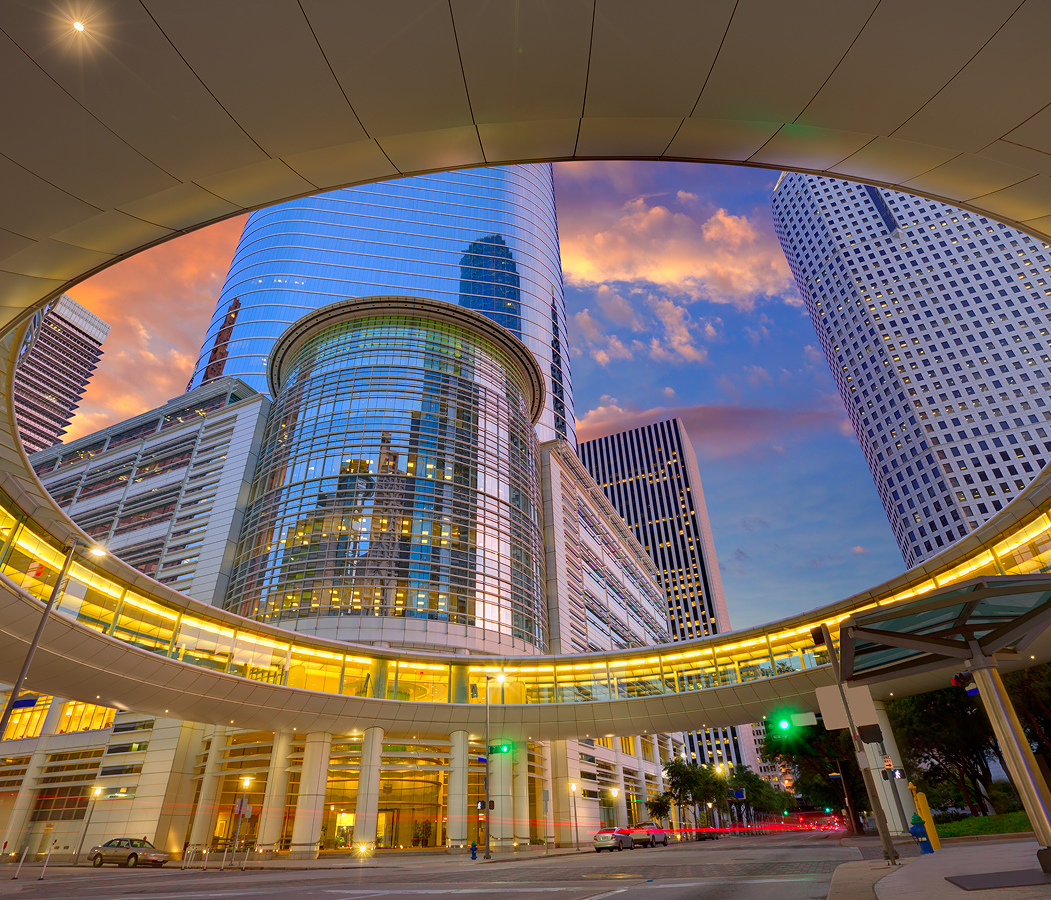
Set along Canal Street near Convention Center Boulevard and just steps from Canal Street Ferry Terminal, the hotel occupies the Central Business District's riverward edge, facing the Mississippi between Spanish Plaza to the south and the French Quarter extending north beyond Canal. The tower rises above a curved street-level addition, giving its original vertical silhouette a broader base that opens toward the waterfront and the pedestrian spaces surrounding the river landing. Chandelier Bar turns arrival into a social encounter beneath 15,000 hand-strung Bohemian crystals, with oak screens dividing the lobby into smaller settings for conversation and drinks. Inside the tower, broad windows bring the working river into view, placing passing vessels and the bend of the Mississippi within the hotel's daily visual life. The result is a property whose preserved skyline presence, river exposure and carefully scaled social interiors give the former commercial tower a substantial new role in the city's hospitality.
What defines Four Seasons Hotel New Orleans.
Four Seasons Hotel New Orleans is best known for converting Edward Durell Stone's international trade tower into a hotel through a restoration that retained the building's defining modernist form. Completed in 1967, the International House and International Trade Mart was dedicated in 1968 during the city's 250th anniversary celebrations and took the World Trade Center name that year. Stone organized its four projecting sections around the cardinal directions, making the tower's compass orientation an architectural reference to New Orleans' position in global commerce. The building stood as the city's tallest from 1967 to 1969 and entered the National Register of Historic Places in 2014. By the time of its conversion, the tower had spent years largely vacant following Hurricane Katrina, leaving a prominent part of the skyline with a diminished public role. Developers Carpenter & Company and Woodward Interests commissioned CambridgeSeven to lead the redevelopment, translating the former office building into a hotel and private residences. The original louvered façade required particular attention: its panels had helped define the commercial building, yet restricted the expansive views sought for its new use. CambridgeSeven restored panels for the lower levels, preserving a recognizable part of Stone's exterior within the conversion. Bill Rooney Studio created the hotel interiors, adding a separate design commission to the restored architecture. The hotel opened in August 2021 after a three-year transformation representing an investment exceeding $500 million. The Louisiana Landmarks Society recognized the redevelopment with a 2022 Award for Excellence in Historic Preservation, acknowledging a project that returned a nationally recognized building to sustained use.
Donald Link's Chemin à la Mer gives the hotel a culinary history grounded in Louisiana family cooking and the chef's development of New Orleans restaurants. Link began cooking professionally at fifteen, drawing early influences from his grandparents' Cajun and Southern food. His flagship Herbsaint earned him the James Beard Foundation's Best Chef: South award in 2007, and his 2009 cookbook Real Cajun: Rustic Home Cooking from Donald Link's Louisiana brought that regional cooking into print. Chemin à la Mer extended his work into Four Seasons, initially developing a menu centered on Gulf seafood, oysters and carefully selected steaks. A substantial change arrived on September 23, 2026, when the restaurant moved to the hotel's first floor and became a Louisiana brasserie, with Brody LeBlanc leading the kitchen as executive restaurant chef. The revised menu retained Link's Creole gumbo, duck confit and pan-roasted drum, preserving dishes that connected the restaurant's earlier cooking with its new direction. Shrimp étouffée and crab-and-artichoke gratin developed the Louisiana emphasis, accompanied by moules frites and lapin au moutarde from the French brasserie repertoire. Vanilla-bean crème brûlée, chocolate mousse and flambéed crêpes Suzette carried the same French influence through dessert. Link's conception of leisurely lunches drew directly on meals he had enjoyed in Paris, making the relocation a shift in the restaurant's social purpose as well as its cuisine.
How Four Seasons Hotel New Orleans fits.
Four Seasons Hotel New Orleans fits a daytime walk through the Warehouse Arts District, connecting institutions built by an artists' collective, a private collector and historians determined to preserve veterans' testimony.
Begin at Contemporary Arts Center New Orleans, which grew from the multidisciplinary artists' organizing of 1976 and formally began in 1977. The center established its home in a former Katz & Besthoff warehouse, giving experimental visual art and performance a permanent setting within a district beginning its cultural transformation. Renovation in 1990 prepared the building for an expanded role, and the Besthoff family's donation of the property in 1999 secured the institution's long-term home. The sequence from artists' initiative to a donated building explains how the center developed the physical and institutional footing for exhibitions, theater and dance under one roof. Continue across Camp Street to Ogden Museum of Southern Art, whose public collection began with Roger Houston Ogden's founding donation of more than six hundred works. Stephen Goldring Hall opened in 2003, with its dedication on August 23 giving the collection a permanent public setting. Barron and Toups designed the museum complex, which incorporated the Patrick F. Taylor Library and its adjoining educational wing into a larger home for Southern art. The museum's growth transformed one collector's commitment into an institution addressing the region through painting, photography and other media, extending the first stop's artist-led activity into the preservation of a substantial regional collection. Conclude a short walk away at The National WWII Museum, which opened on June 6, 2000 as The National D-Day Museum after Stephen Ambrose and Gordon H. Nick” Mueller developed a plan around Ambrose's collection of veterans' oral histories. Their founding purpose connected firsthand testimony with objects capable of explaining the Normandy invasion, bringing personal recollections into a public institution. Andrew Higgins's New Orleans company supplied the local wartime connection: Higgins Industries produced more than 20,000 military boats, including landing craft that supported Allied amphibious operations. The museum subsequently expanded beyond D-Day to address the wider American wartime experience, giving the outing its broadest treatment of individual lives, collective effort and historical consequence. The progression moves from artists securing a place for new work through a collector establishing a public home for Southern art and culminates in historians transforming veterans' testimony into national remembrance, revealing how private commitments became enduring cultural institutions within one New Orleans district.
Where your story begins.
Foresyte Travel reveals places that feel extraordinary long before you arrive.
Enjoy editorial crafted for luxury travelers.
Foresyte may earn a commission when you book.