Why Fulton Street matters.
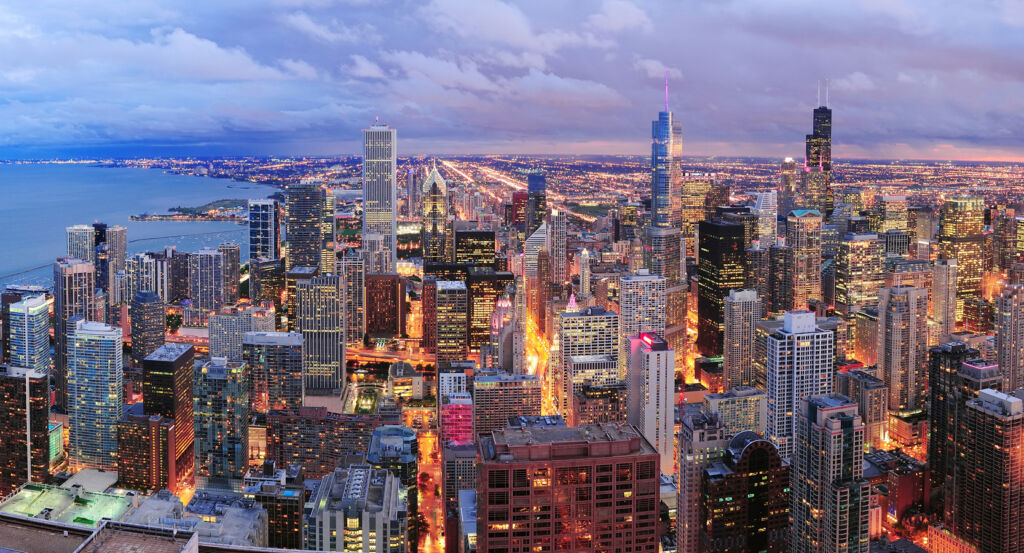
Fulton Street is an enterprising corridor where the West Loop's industrial heritage, wholesale commerce, architectural reinvention, and Chicago's entrepreneurial spirit continue shaping one of the city's most influential urban streets.
Running through the West Loop between the Chicago River and the United Center district, Fulton Street connects historic warehouse blocks, food industry buildings, technology offices, hospitality destinations, corporate headquarters, and preserved industrial architecture that collectively reflect more than 170 years of commercial evolution. The corridor reveals how railroad expansion, food distribution, manufacturing, and adaptive rehabilitation transformed an industrial marketplace into one of the nation's foremost centers of innovation and investment. Heavy-timber loft buildings, brick masonry warehouses, and thoughtfully restored commercial structures continue defining the streetscape while preserving the district's unmistakable industrial identity. The result is a corridor distinguished by commercial continuity, architectural preservation, and one of Chicago's most dynamic economic transformations.
What defines Fulton Street.
Fulton Street is best known for serving as the historic spine of Chicago's Fulton Market District, whose origins trace to the city's nineteenth-century wholesale produce, poultry, meat, dairy, and food distribution economy following construction of nearby railroad freight infrastructure and expansion west of the Chicago River after the Great Chicago Fire of 1871. Development between the 1870s and the 1930s introduced one of the nation's largest concentrations of heavy-timber loft buildings, brick warehouses, cold-storage facilities, produce houses, meatpacking businesses, food processors, and freight depots that established the corridor's enduring industrial identity. Establishment of the Randolph Street Market, successive investment by the Chicago & North Western Railway, Chicago Junction Railway, and extensive freight sidings connected Fulton Street directly with national agricultural supply chains serving wholesalers throughout the Midwest. Designation of the Fulton-Randolph Market Historic District on the National Register of Historic Places documented one of the country's most intact industrial food distribution districts, while landmark preservation initiatives retained scores of nineteenth- and early twentieth-century commercial buildings during extensive redevelopment. Twenty-first-century investment introduced headquarters for McDonald's Corporation, Google, Glassdoor, Mondelēz International, and numerous technology, hospitality, life science, and venture capital firms, transforming the corridor into one of the Midwest's most significant centers of adaptive commercial reinvestment.
Formation of the Fulton Market Innovation District established coordinated economic development, infrastructure modernization, streetscape improvements, workforce initiatives, business recruitment, and public investment supporting long-term neighborhood growth. Architect Alfred S. Alschuler designed numerous warehouses and industrial commissions throughout the West Loop, while architects Holabird & Roche, Graham, Anderson, Probst & White, and other leading Chicago firms contributed durable commercial buildings that continue defining the surrounding warehouse district. Adoption of the Fulton Market Innovation District Plan, implementation of successive City of Chicago zoning reforms, expansion of protected historic resources, continuing investment by the Chicago Department of Planning and Development, and nationally recognized adaptive reuse projects collectively transformed obsolete industrial facilities into offices, hotels, research laboratories, restaurants, and residential developments while preserving one of America's richest collections of food-industry architecture. Together, the Fulton Market Innovation District, National Register designation, Chicago Department of Planning and Development, Alfred S. Alschuler, Holabird & Roche, Graham, Anderson, Probst & White, Chicago & North Western Railway, Chicago Junction Railway, post-fire reconstruction, and decades of preservation demonstrate how transportation infrastructure, industrial enterprise, architectural excellence, planning policy, and sustained private investment established Fulton Street among Chicago's most historically significant commercial corridors.
How Fulton Street fits.
Fulton Street works as an exploration of Chicago's industrial heritage, architectural preservation, and contemporary innovation.
Begin at Fulton Market, where historic warehouse architecture and the district's enduring food commerce legacy introduce the commercial foundations that shaped Fulton Street before naturally expanding into the surrounding neighborhood. Continue to McDonald's Global Headquarters, where one of the world's largest corporate relocations demonstrates the corridor's remarkable transformation from wholesale industry into a globally recognized center of business and innovation before guiding the experience toward its conclusion. Conclude at Time Out Market Chicago, where dozens of local culinary concepts celebrate the district's continuing relationship with food, entrepreneurship, and adaptive reuse, providing a fitting finale to the corridor's long commercial evolution. The progression moves naturally from nineteenth-century wholesale commerce to global corporate investment before concluding with the culinary traditions that continue defining Fulton Street today.
Where your story begins.
Foresyte Travel reveals places that feel extraordinary long before you arrive.
Enjoy editorial crafted for luxury travelers.
Foresyte may earn a commission when you book.