
Why Galatoire's matters.
Galatoire's is a storied Creole dining institution where French Quarter's vivacious social culture meets the culinary inheritance of southern France, a century of New Orleans family traditions and the celebrated Friday lunches that have made its Bourbon Street dining room an enduring center of civic life.
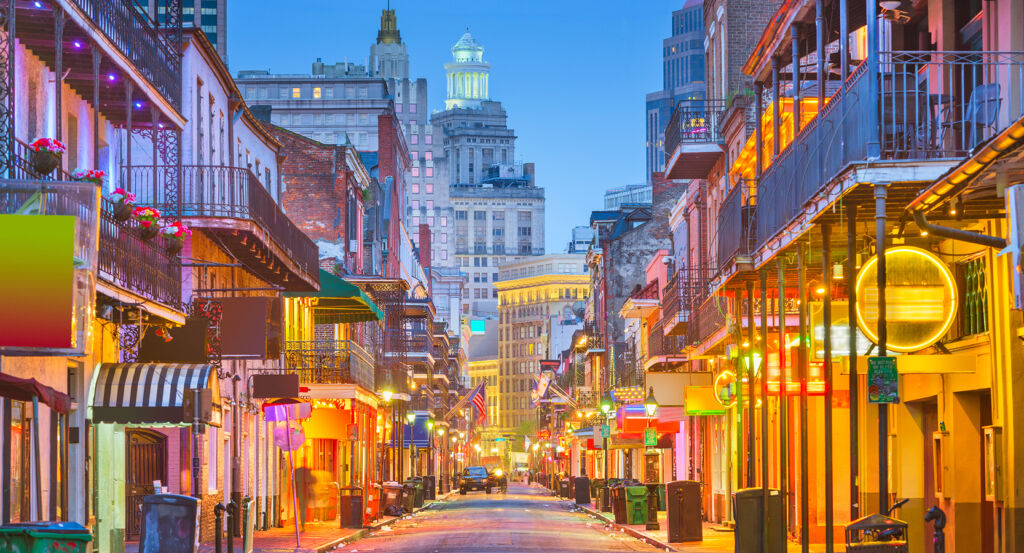
Set along Bourbon Street near Iberville Street and a short walk from Canal Street, the restaurant occupies the French Quarter's commercial threshold, where historic Creole buildings, traditional restaurants and entertainment establishments extend north toward the neighborhood's deeper residential and cultural blocks. Its white stucco façade, tall shuttered windows and restrained architectural ornamentation preserve the character of a nineteenth-century townhouse amid Bourbon Street's dense commercial frontage. The celebrated ground-floor dining room combines mirrored walls, ceiling fans, closely arranged tables and distinctive decorative finishes in a setting that has accommodated generations of New Orleans families. Upper-level dining rooms introduce a more intimate arrangement, with windows overlooking the surrounding historic streets and architectural details that preserve the building's domestic origins. The result is a restaurant whose historic interiors and animated dining room establish an unmistakable physical expression of New Orleans's enduring grand restaurant tradition.
What defines Galatoire's.
Galatoire's is best known for preserving the French Creole cooking of founder Jean Galatoire and developing one of New Orleans's most distinctive social institutions around the ritual of Friday lunch. Born in Pardies, a village near Pau in southwestern France, Galatoire brought the culinary customs of his homeland to America during the nineteenth century, establishing businesses in Birmingham and Chicago before settling in New Orleans. His early commercial ventures included a bar near the Louisville & Nashville Railroad terminal at the foot of Canal Street, where the growing port city's commercial activity provided an introduction to its hospitality economy. Galatoire subsequently developed a relationship with Victor Bero, proprietor of Victor's Restaurant, and acquired the established Bourbon Street business in 1905. The restaurant occupied a townhouse constructed 1830, giving the new enterprise a setting whose intimate scale and traditional arrangement suited the familial dining customs Galatoire had brought from France. Jean's wife, Gabrielle Marchal Galatoire, participated in the family's American journey, and three nephews, Justin, Leon and Gabriel Galatoire, eventually joined the business as apprentices and successors. Jean purchased the restaurant building in 1911 for $25,000, securing the property's future within the family as the establishment's reputation grew among New Orleans residents. His nephews acquired the business for $40,000 in 1919, continuing the cooking traditions and social customs that had distinguished their uncle's enterprise. Successive generations developed a system of professional service in which longstanding waiters cultivated relationships with individual families, transforming regular tables and recurring celebrations into important elements of the restaurant's cultural inheritance. Tennessee Williams, Harpo Marx and Mick Jagger joined the succession of prominent figures associated with the dining room, whose appeal reached beyond the city's established social circles. The restaurant's commitment to its original first-floor setting shaped a major architectural decision in 1998, when an extensive renovation restored the second floor to dining use after decades of closure following World War II. Melvin Rodrigue, who joined the organization as chief operating officer in 1997, helped direct that expansion and subsequently became a central figure in the restaurant's modern leadership. The James Beard Foundation recognized Galatoire's with its Outstanding Restaurant Award in 2005, placing the historic New Orleans institution among the nation's most distinguished dining establishments. A consequential ownership transition followed in 2009, when Jean Galatoire's descendants entered a partnership with Louisiana businessmen Todd Trosclair and John Georges, establishing a new ownership structure that retained family participation. Further expansion came through the acquisition of an adjacent Bourbon Street property in 2012, followed by the development of Galatoire's 33 Bar & Steak and additional private dining spaces. Galerie de Galatoire opened on Royal Street in 2021, extending the institution's hospitality traditions into another historic French Quarter setting. The restaurant's evolution connects an immigrant founder's culinary inheritance with five generations of family stewardship, national recognition and carefully managed expansion across one of America's most consequential restaurant districts.
Jean Galatoire's culinary inheritance continues through a dining tradition built around classical French sauces, Gulf seafood and the distinctive rhythm of an extended New Orleans lunch. The restaurant's celebrated Friday gathering begins with the anticipation of securing a table in the original dining room, where a longstanding first-come, first-served custom has made the queue an integral part of the institution's social character. Established patrons maintain relationships with particular servers, creating an unusually personal continuity between the kitchen, dining room and families whose celebrations have unfolded there for generations. The meal develops through a sequence of seafood preparations and traditional accompaniments that reveal the technical foundations of French Creole cooking, particularly the careful balance of acidity, richness and seasoning. Remoulade brings the sharpness of mustard and aromatic ingredients into conversation with the natural sweetness of Gulf shrimp, establishing a characteristic blend of freshness and intensity. Meunière preparations develop a different dimension through browned butter, lemon and the delicate treatment of fish, expressing the restaurant's commitment to classical technique through ingredients central to Louisiana's coastal economy. The kitchen's approach to sauces extends across preparations involving crab, oysters and other regional seafood, preserving the culinary style that has distinguished Galatoire's across successive generations. Service follows the leisurely cadence of the dining room, allowing conversations to move between neighboring tables as familiar faces greet one another and the social occasion gradually expands beyond the meal itself. The restaurant's customary dress expectations contribute to the sense of occasion, reinforcing a tradition in which personal presentation and formal hospitality remain connected. Galatoire's most consequential expression of that culture comes through the Friday lunches preceding Christmas and Mardi Gras, when the demand for coveted tables has developed into a substantial charitable undertaking. Annual auctions beginning in 2006 transformed the opportunity to reserve those tables into fundraising for New Orleans nonprofit organizations, linking a longstanding social ritual with the city's broader civic life. The Galatoire Foundation's 2026 Christmas and Mardi Gras auction series generated $635,000, including $447,300 raised through bidding for tables at the Friday preceding Mardi Gras. The highest bid reached $36,000 for a twelve-person table, illustrating the extraordinary cultural value attached to participation in the restaurant's most celebrated gathering. Galatoire's distinctive achievement lies in the continuity between classical cooking, personal service and communal ritual, giving a traditional French Creole meal an enduring place in the social calendar of New Orleans.
How Galatoire's fits.
Galatoire's works as the anchor for an outing connecting the French Quarter's musical heritage with the theatrical architecture and performance institutions that transformed Downtown New Orleans into a center of American entertainment.
Begin at New Orleans Musical Legends Park, the Bourbon Street courtyard devoted to musicians whose careers helped establish the city's international reputation for jazz and popular music. The park commemorates figures including Al Hirt, Pete Fountain and Fats Domino, connecting three distinct expressions of Louisiana's musical inheritance through public sculpture. Hirt became internationally celebrated for his trumpet playing, bringing the exuberance of New Orleans jazz into mainstream American entertainment through recordings and television appearances. Fountain developed a similarly recognizable musical character through his clarinet performances, including a longstanding association with The Lawrence Welk Show and the city's traditional jazz scene. Domino carried New Orleans rhythm and blues into the formative years of rock and roll, with recordings such as “The Fat Man” and “Blueberry Hill” helping establish the city's importance in twentieth-century popular music. Continue to Saenger Theatre, the grand Canal Street performance venue designed by New Orleans architect Emile Weil and opened in 1927 as the flagship of the Saenger Amusement Company. Constructed at a cost of $2.5 million, the theater originally accommodated 4,000 spectators and combined silent motion pictures with elaborate stage presentations. Weil conceived its auditorium as an Italian Baroque courtyard beneath an artificial night sky, using strategically positioned lights and mechanical effects to reproduce constellations, moving clouds and changing daylight. The introduction of talking pictures transformed the theater's entertainment program, and a 1964 subdivision created an additional auditorium within the original architectural composition. Hurricane Katrina inflicted extensive damage in 2005, prompting a major restoration that culminated in the theater's reopening in 2013. The $52 million project revived its decorative interiors and expanded its technical capabilities, returning an expansive example of atmospheric theater design to the city's performance landscape. Conclude at Orpheum Theater, the Beaux-Arts performance hall designed by G. Albert Lansburgh and constructed in 1918 during the expansion of American vaudeville entertainment. The building subsequently accommodated silent films, talking pictures, concerts and civic celebrations, reflecting the changing forms of performance that shaped Downtown New Orleans during the twentieth century. Threatened with demolition in 1983, the theater was acquired by the New Orleans Philharmonic Symphony Orchestra and restored through an $3 million renovation, establishing a new role for the building in the city's orchestral life. The orchestra's dissolution in 1991 interrupted that chapter, and Hurricane Katrina brought another extended period of closure after severe flooding damaged the property. Roland and Mary von Kurnatowski joined developer Eric George in acquiring the theater in 2014, undertaking a restoration that returned the building to public use in August 2015. The renewed venue became an important performance home for the Louisiana Philharmonic Orchestra, connecting its historic architectural setting with the continuation of professional orchestral music in New Orleans. The progression moves from the musicians who carried New Orleans jazz and rhythm and blues into national popular culture through the architectural performance of the Saenger Theatre and culminates in the Orpheum Theater's transformation from vaudeville house to orchestral institution, revealing the remarkable breadth of the city's performing arts inheritance.
Where your story begins.
Foresyte Travel reveals places that feel extraordinary long before you arrive.
Enjoy editorial crafted for luxury travelers.
Foresyte may earn a commission when you book.














































































































