
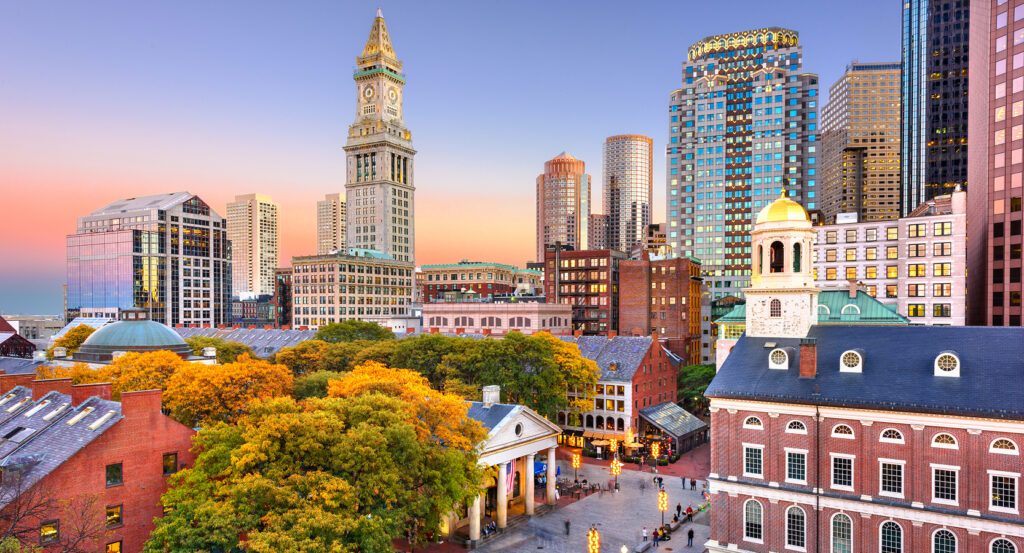
Why you should experience The Great Hall at Faneuil Hall in Boston, Massachusetts.
The Great Hall at Faneuil Hall is a historic assembly chamber where Downtown's Revolutionary legacy, democratic ideals, civic debate, and architectural heritage create one of America's most influential public spaces.
Located on the second floor of Faneuil Hall along Faneuil Hall Square near Congress Street and just steps from Quincy Market, this beautifully preserved chamber welcomes visitors beneath soaring timber trusses, polished hardwood floors, historic portraits, and the iconic gilded grasshopper weather vane that has watched over Boston for centuries. Sunlit windows, patriotic symbolism, and centuries of civic memory create an atmosphere where the nation's democratic traditions remain vividly present. Every visit reveals another chapter in the story of American self-government. The result is an experience defined by constitutional history, architectural preservation, and one of the United States' most significant civic interiors.
What you should know about The Great Hall at Faneuil Hall.
The Great Hall at Faneuil Hall is best known for serving as the principal public meeting chamber where Samuel Adams, James Otis Jr., John Hancock, and other Patriot leaders organized resistance to British rule during the years preceding the American Revolution, earning Faneuil Hall its enduring title as the “Cradle of Liberty.” Originally completed in 1742 through the philanthropy of merchant Peter Faneuil, the building's second-floor assembly chamber became Boston's foremost venue for public debate, political meetings, and civic gatherings. Following a devastating fire in 1761, the hall was rebuilt and later substantially enlarged by architect Charles Bulfinch between 1805 and 1806, creating the impressive Great Hall visitors experience today. Throughout the nineteenth century, the chamber hosted speeches by many of America's most influential figures, including Daniel Webster, Frederick Douglass, Susan B. Anthony, William Lloyd Garrison, and Theodore Roosevelt, while serving as a forum for abolition, women's suffrage, labor rights, and civil liberties. The hall's collection of grand portraits, historic furnishings, and preserved architectural details reflects nearly three centuries of civic leadership, making it among the nation's most important surviving public assembly spaces and a central stop along Boston's Freedom Trail.
Beyond its Revolutionary significance, the Great Hall continues demonstrating how public architecture can strengthen civic participation across generations. Its preserved eighteenth- and nineteenth-century interior provides an authentic setting for educational programs, ceremonial events, and public interpretation while reminding visitors that democracy has always depended upon open debate and public engagement. Revolutionary history, constitutional ideals, civic architecture, historic preservation, and democratic tradition combine to create one of America's most influential public interiors.
How to fold The Great Hall at Faneuil Hall into your trip.
The Great Hall at Faneuil Hall works as the historic centerpiece of an exploration through Downtown.
Begin at Quincy Market, where Boston's historic marketplace introduces the extraordinary surroundings of The Great Hall at Faneuil Hall. Continue to the Samuel Adams Statue, whose commanding presence reinforces the Revolutionary legacy that shaped the chamber's history. Conclude at the Old State House, where one of the nation's oldest public buildings provides a memorable finale celebrating the relationship between civic debate, political leadership, and American independence that defines Boston's Freedom Trail. The progression moves naturally from historic marketplace to revolutionary assembly hall before concluding through one of the country's defining colonial landmarks, revealing why the Great Hall remains one of Boston's essential historical experiences.
Where your story begins.
Foresyte Travel reveals places that feel extraordinary long before you arrive.
Experience premium editorial crafted for luxury travelers.







































































































