
Why High Line Art matters.
High Line Art is an ambitious public-art program where Chelsea's contemporary-art culture meets site-specific commissions, large-scale sculpture and temporary works distributed across an elevated former freight railway.
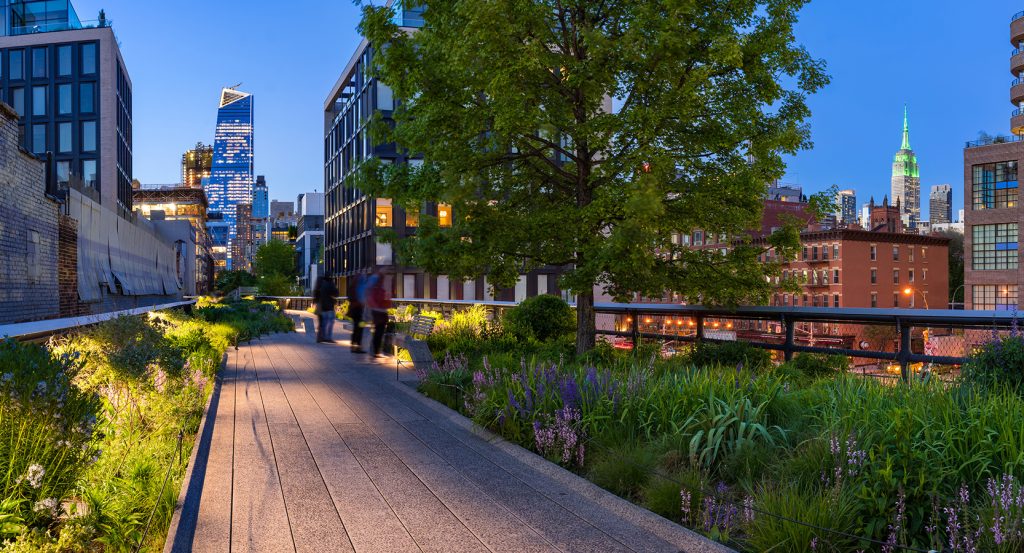
Set along the High Line between Gansevoort Street and West 34th Street near 10th Avenue and just steps from Chelsea Market, the program occupies park passages, overlooks, former rail structures and purpose-built exhibition areas across the West Side. Sculptures appear amid planting beds and retained tracks, murals and large-format images engage neighboring architecture, and moving-image projects use dedicated screens within the park, making the physical fabric of the railway part of the encounter with individual works. Performance projects extend that approach through stairways, plazas and circulation areas, allowing choreography, music and live art to inhabit spaces originally designed around freight movement and later remade for pedestrians. The Spur at West 30th Street expands the program into a broad gathering area built around the High Line Plinth, a dedicated platform for successive large-scale commissions positioned above 10th Avenue. The result is a dispersed outdoor art program whose sculptures, performances, moving images and temporary interventions draw their physical character from an elevated industrial structure embedded within one of Manhattan's principal contemporary-art districts.
What defines High Line Art.
High Line Art is best known for commissioning temporary and site-specific contemporary works throughout the High Line since the park's first section opened in 2009. Spencer Finch supplied the inaugural commission through The River That Flows Both Ways, produced with Creative Time and installed in the Chelsea Market Passage that June. Finch traveled the Hudson for 700 minutes during a single day, photographing the water once each minute before translating those observations into 700 individual panes of colored glass fitted into the passage's existing window bays. The program rapidly expanded across sculpture, sound, performance, photography and architectural intervention, commissioning Kim Beck, Francis Cape, Valerie Hegarty, Richard Galpin, Demetrius Oliver, Lisa Sigal, Paul Ramirez Jonas, Joel Sternfeld, Julianne Swartz, Sarah Sze and Stephen Vitiello during its early years. The International Association of Art Critics awarded the program first place for Best Show in a Public Space in 2009, giving the newly launched initiative an early critical distinction. Cecilia Alemani became director and chief curator in 2011 and developed an extensive commissioning program involving El Anatsui, John Baldessari, Phyllida Barlow, Carol Bove, Sheila Hicks, Rashid Johnson, Barbara Kruger, Faith Ringgold, Ed Ruscha, Nari Ward and Adrián Villar Rojas. Alemani expanded the curatorial scope through group exhibitions, recurring performance commissions and a daily video series, placing temporary art across numerous formats without converting the elevated railway into a conventional gallery.
The High Line Plinth opened another major chapter in 2019 by creating a permanent site devoted solely to successive large-scale commissions at the Spur. Simone Leigh inaugurated the series with Brick House, a 16-foot bronze bust combining a Black female figure with architectural forms associated with West Africa and the American South. The work belonged to Leigh's Anatomy of Architecture series and incorporated references extending from Batammaliba construction in Togo to Mousgoum dwellings in Chad and Cameroon. Sam Durant followed with Untitled (Drone) in 2021, and Pamela Rosenkranz installed Old Tree in 2023 before Iván Argote's Dinosaur arrived in 2024. Tuan Andrew Nguyen's The Light That Shines Through the Universe became the fifth Plinth commission in 2026, continuing a sequence in which works remain above 10th Avenue for extended individual runs before yielding the platform to another artist. Selection has itself developed into a public curatorial process: proposals for the seventh and eighth commissions entered consideration in 2026, with dozens of international artists participating before a planned shortlist and public maquette exhibition in 2027. The Plinth gives High Line Art a recurring architectural focal point for expansive sculpture while the wider program continues to distribute commissions throughout the park.
How High Line Art fits.
High Line Art works as the anchor for a Chelsea outing connecting an institution that helped establish the neighborhood's contemporary-art concentration, a museum devoted to American art and a permanent Hudson River commission rooted in the vanished industrial waterfront.
Begin at Dia Chelsea, whose presence on West 22nd Street reaches to Dia Art Foundation's purchase of 548 West 22nd Street in 1981 for storing and exhibiting a collection that already included substantial work by Andy Warhol, John Chamberlain, Donald Judd, Dan Flavin and Cy Twombly. Dia Center for the Arts operated there from 1986 to 2004, presenting projects by Robert Gober, Jenny Holzer, Pierre Huyghe, Robert Irwin, On Kawara, Jorge Pardo, Robert Ryman, Fred Sandback, Jessica Stockholder, Diana Thater and Lawrence Weiner during Chelsea's emergence as an international gallery district. Architecture Research Office later unified three contiguous Dia properties into a 32,500-square-foot complex with 20,000 square feet of street-level exhibition and programming areas, reopening in 2021 after a two-year construction campaign. Joseph Beuys's 7000 Eichen (7000 Oaks) extends outside as paired basalt columns and trees, connecting the institution's galleries with West 22nd Street. Continue to Whitney Museum of American Art, founded by Gertrude Vanderbilt Whitney in 1930 after her earlier support for living American artists and directed initially by Juliana Force. Whitney created the Biennial in 1932, beginning the longest-running recurring exhibition devoted to recent developments in American art. Renzo Piano Building Workshop designed the museum's present Gansevoort Street home, which opened May 1, 2015 with 50,000 square feet of indoor galleries and 13,000 square feet of outdoor exhibition terraces. Its 18,000-square-foot special-exhibition gallery was designed without interior columns, and Piano stepped the upper stories toward the High Line while placing the museum between the elevated railway and Hudson River. Conclude at Day's End, David Hammons's permanent Hudson River sculpture commissioned by the Whitney after the artist sent the museum a small drawing in 2014 proposing a work tied to the vanished Pier 52 shed. Hammons based the commission on Gordon Matta-Clark's 1975 Day's End, for which Matta-Clark cut immense openings into the abandoned pier building and altered the relationship among its industrial shell, sunlight and river. Hammons reconstructed the absent architecture as a spare steel outline extending 325 feet long, 65 feet wide and 52 feet high over the Hudson at the precise location of the former structure, with Guy Nordenson and Associates resolving the engineering required for its permanent installation. The Whitney opened Hammons's commission in 2021, joining two artists across nearly half a century through the physical dimensions of a waterfront building that no longer survives. The progression moves from Dia's sustained role in Chelsea's contemporary-art development through the Whitney's institutional history and Renzo Piano building and culminates in Hammons's reconstruction of Matta-Clark's vanished industrial site, connecting galleries, museum collecting and site-specific public art across the High Line corridor.
Where your story begins.
Foresyte Travel reveals places that feel extraordinary long before you arrive.
Enjoy editorial crafted for luxury travelers.
Foresyte may earn a commission when you book.







































































































