
Why The Spur matters.
The Spur is an elevated garden plaza where Hudson Yards' architectural scale meets the surviving eastern branch of the High Line through woodland planting, preserved rail infrastructure and a purpose-built platform for major contemporary sculpture.
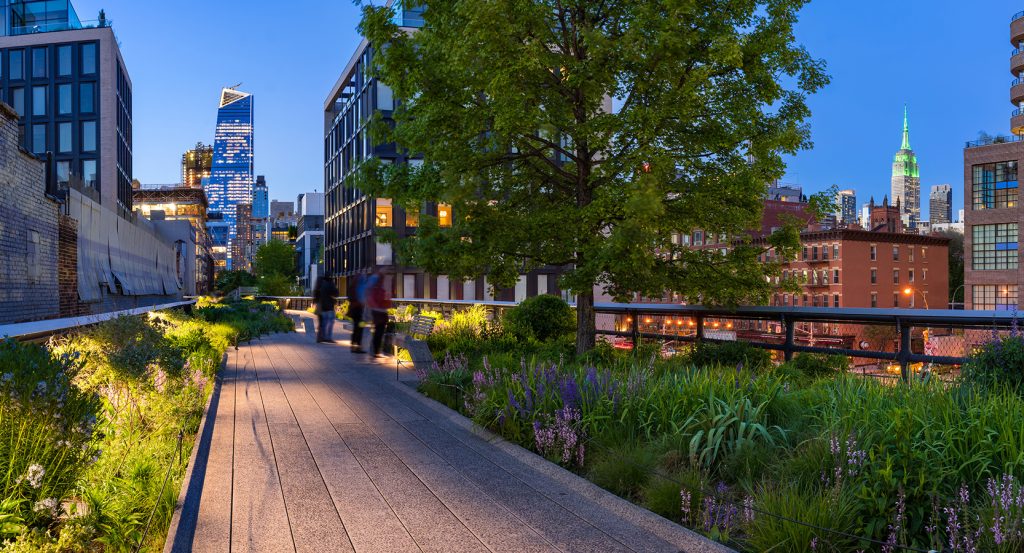
Set along West 30th Street near 10th Avenue and just steps from the High Line's West 30th Street access point, the plaza occupies the easternmost remnant of the original elevated freight structure, projecting above the avenue before terminating beside the former Morgan postal complex. The branch expands beyond the High Line's familiar linear proportions into a broad clearing, with planted thresholds, stepped timber seating and outward-facing balconies creating one of the park's largest gathering areas. Passage beneath 10 Hudson Yards places the route between massive structural piers before woodland planting opens toward the elevated plaza, producing an abrupt shift from compressed overhead architecture to open sky. Preserved railroad tracks cross the paved surface as planting beds and seating retain the industrial geometry beneath a landscape conceived by James Corner Field Operations, Diller Scofidio + Renfro and Piet Oudolf. The result is a High Line terminus whose freight-era structure, woodland approach and elevated clearing turn a former postal rail branch into one of Hudson Yards' most distinctive public spaces.
What defines The Spur.
The Spur is best known for surviving as the final branch of the original High Line after its future became contested during redevelopment of Manhattan's West Side, preserving infrastructure created for the New York Central Railroad's direct connection to the Morgan postal complex. The branch originated within the West Side Improvement, the vast railroad project that removed freight trains from street level and placed the West Side Line on an elevated viaduct during the 1930s. Mail traffic held major economic importance for the railroad, and the dedicated double-track branch crossed 10th Avenue before entering the Morgan Parcel Post building between West 29th and West 30th Streets. New York Central anticipated 8,000 mail cars moving through the connection annually in 1934, giving the short branch a specialized industrial purpose distinct from the warehouses and factories served elsewhere along the elevated line. The structure survived the later abandonment of freight service, yet preservation of the main High Line did not initially guarantee preservation of this eastern arm. Friends of the High Line mounted its “Save the Spur” campaign in 2008 as redevelopment plans around the rail yards placed the branch's future in doubt. Community advocacy and city support kept the structure in place, and planning for the third High Line section divided construction into phases that reserved the Tenth Avenue Spur for later work. Kohn Pedersen Fox subsequently designed 10 Hudson Yards around the surviving railway, using enormous stone-clad columns to carry the tower above the elevated route and allowing the branch to pass directly through the building toward 10th Avenue. Construction of the 52-story tower began in December 2012, making the preserved railway part of the structural and architectural conditions confronting the first building erected at Hudson Yards. The Spur opened on June 5, 2019, ten years after the High Line's first public section, completing the conversion of the original elevated railway through a fragment whose survival had required a separate preservation campaign and direct accommodation within the surrounding redevelopment.
The High Line Plinth gave the rescued branch a second consequential chapter by dedicating its eastern clearing to a rotating sequence of large-scale contemporary commissions, a program created specifically for artworks conceived at substantial civic scale. Simone Leigh inaugurated the series in 2019 with Brick House, a 16-foot-tall bronze sculpture combining the human body with architectural forms and centering a Black female figure above 10th Avenue. Sam Durant followed in 2021 with Untitled (drone), a fiberglass Predator drone mounted 25 feet above the park on a steel pole that allowed the sculpture to turn with the wind, placing an object associated with remote warfare and surveillance over a heavily traveled Manhattan avenue. Pamela Rosenkranz shifted the series toward biological form in 2023 through Old Tree, a 25-foot pink-and-red sculpture whose 145 foam-coated steel branches referenced both arboreal structure and the branching vessels of the human body. Iván Argote's Dinosaur arrived in October 2024 as a colossal hand-painted aluminum pigeon, elevating one of New York's most familiar street birds above pedestrians and traffic in a deliberate reversal of conventional commemorative sculpture. Tuan Andrew Nguyen succeeded Argote in 2026 with The Light That Shines Through the Universe, extending the Plinth sequence through a work connected to the cultural history of the Bamiyan Buddhas and accompanied by a High Line and Rubin partnership devoted to lectures and meditation. Leigh, Durant, Rosenkranz, Argote and Nguyen have turned the former mail branch into a changing platform for sculpture addressing architecture, military power, biological form, urban commemoration and cultural memory, giving The Spur an artistic history that continues to accumulate long after the railway's physical preservation was secured.
How The Spur fits.
The Spur works as the anchor for an afternoon connecting three Hudson Yards institutions through landscape construction, large-scale public architecture and a culinary project shaped by three major figures in modern Spanish gastronomy.
Begin at Bella Abzug Park, the linear green space developed by Michael Van Valkenburgh Associates as part of the broader transformation of the Far West Side and coordinated with the extension of the 7 subway line. The park stretches north from West 33rd Street through a sequence of lawns, fountains, seating areas and planted blocks, with substantial portions constructed on structural decking above MTA and Amtrak infrastructure. Michael Van Valkenburgh Associates began work on the project in 2010, collaborating with Toshiko Mori Architect, James Carpenter Design Associates, LERA, Langan Engineering and specialists spanning soil science, fountains, lighting and wind engineering. The park later received the name of New York attorney, congresswoman and women's-rights leader Bella Abzug, connecting a newly built landscape with one of the city's consequential twentieth-century political figures. Continue to Jacob K. Javits Convention Center, where James Ingo Freed of Pei Cobb Freed & Partners rejected the closed-box convention-center model through an immense glass-and-steel composition built around a 1,000-foot public concourse and 15-story Crystal Palace. Freed, who had studied at Illinois Institute of Technology and worked for Mies van der Rohe before joining I. M. Pei & Associates in 1956, developed the building with a structural team that included Weidlinger Associates and Salmon Associates. The original complex incorporated 684,000 square feet of exhibition space, a 63,000-square-foot lobby, a galleria, river pavilion and one-acre plaza, with its exposed structural geometry receiving architectural and engineering honors during the 1980s. Conclude at Mercado Little Spain, the 35,000-square-foot Spanish food hall created by José Andrés with Ferran Adrià and Albert Adrià, reuniting three chefs whose professional histories reach back to elBulli. Andrés conceived the project after first arriving in the United States through New York in 1990, making the Hudson Yards undertaking his first New York venture decades later and the Adrià brothers' first American project. The three collaborators built the project around Spanish market culture, with Capella Garcia Arquitectura developing the architectural scheme and the program extending across restaurants, bars and specialized counters. Ferran Adrià brought the intellectual legacy of elBulli, and Albert Adrià brought two decades of pastry and creative work at the same restaurant before developing his own Barcelona projects, placing Mercado Little Spain within a professional lineage that had already altered contemporary gastronomy across Europe and the United States. The progression moves from Michael Van Valkenburgh Associates' infrastructure-bound park through James Ingo Freed's immense convention architecture into the Andrés and Adrià collaboration, tracing three distinct forms of authorship that accompanied Hudson Yards' emergence as a new district on Manhattan's Far West Side.
Where your story begins.
Foresyte Travel reveals places that feel extraordinary long before you arrive.
Enjoy editorial crafted for luxury travelers.
Foresyte may earn a commission when you book.







































































































