
Why Whitney Museum of American Art matters.
Whitney Museum of American Art is a defining contemporary museum where the Meatpacking District's industrial character meets Renzo Piano's asymmetrical architecture, expansive American art galleries and outdoor exhibition terraces descending toward the Hudson River.
Set along Gansevoort Street near Washington Street and just steps from West Street, the museum occupies the western edge of the Meatpacking District where former warehouse blocks open toward the Hudson waterfront. Pale blue-gray steel panels, broad expanses of glass and an irregular eight-story profile establish an industrial architectural character, with the building's mass concentrated toward the river and lighter terraces stepping down along its eastern side. The principal encounter unfolds through large, flexible galleries connected vertically by interior circulation and an exterior staircase inspired by New York fire escapes, allowing art spaces to extend into open air across the upper floors. Floor-to-ceiling glazing and east-facing terraces introduce a distinct secondary mechanism by repeatedly bringing Manhattan architecture and changing daylight into the experience of the collection. The result is a museum where industrial form, flexible galleries, exterior circulation and the surrounding city give American art an architectural setting inseparable from Downtown Manhattan.
What defines Whitney Museum of American Art.
Whitney Museum of American Art is best known for Gertrude Vanderbilt Whitney's sustained commitment to living American artists and the institution that emerged after the Metropolitan Museum of Art declined her proposed gift of more than 500 works. Whitney, herself a sculptor, began purchasing and exhibiting work by American artists during the early twentieth century and established the Whitney Studio in Greenwich Village in 1914 for artists receiving limited support from established academies. The Whitney Studio Club followed in 1918, expanding that effort through exhibitions, professional support and an artistic community whose participants included figures later central to American modernism. By 1929 Whitney had assembled more than 500 works and offered the collection with an endowment to the Metropolitan Museum of Art. Its rejection prompted creation of an independent museum devoted to American art, founded in 1930 under first director Juliana Force and opened on West 8th Street in November 1931. The founding collection had grown to 600 works by opening and included Peggy Bacon, George Bellows, Stuart Davis, Charles Demuth, Mabel Dwight, Edward Hopper, Yasuo Kuniyoshi, Reginald Marsh and John Sloan. Whitney introduced the invitational exhibition that developed into the Whitney Biennial in 1932, beginning the longest-running exhibition series devoted to surveying recent American art. The institution moved to West 54th Street in 1954 and entered a major architectural chapter in 1966 with Marcel Breuer and Hamilton Smith's granite-clad Madison Avenue building, whose inverted stepped profile became closely associated with the museum for nearly five decades.
The permanent collection developed from Whitney's founding holdings into more than 27,000 works by more than 4,100 artists, giving the museum extraordinary depth across twentieth- and twenty-first-century American art. Its chronology begins with Ashcan School painting and extends through modernism, Social Realism, Precisionism, Abstract Expressionism, Pop art, Minimalism, Postminimalism and contemporary practice, with more than eighty percent of the holdings consisting of works on paper. Alexander Calder, Jasper Johns, Agnes Martin, Georgia O'Keeffe, Claes Oldenburg, Ed Ruscha, Cindy Sherman, Lorna Simpson and David Wojnarowicz are among artists represented through sustained holdings spanning different phases of their careers. Edward Hopper occupies an especially deep position: his first solo exhibition took place at the Whitney Studio Club in 1920, decades before the museum became the recipient of the Edward and Josephine Hopper holdings following their deaths in 1967 and 1968. That bequest encompassed 3,000 objects and became the largest single gift of artwork in Whitney history, establishing the institution as the world's largest repository of Hopper artwork and archival holdings. The Biennial supplies another mechanism for expanding and reassessing this collection, shifting from exhibitions organized by medium during the 1930s through annual presentations beginning in 1937 to the all-media biennial format established in 1973. More than 3,600 artists have participated across the Biennials and Annuals, joining the collection and recurring survey within a continuous institutional examination of American art as it develops.
How Whitney Museum of American Art fits.
Whitney Museum of American Art works as the anchor for an afternoon tracing industrial infrastructure, artist housing and sculptural waterfront landscape through three major projects extending north from the Meatpacking District into the West Village.
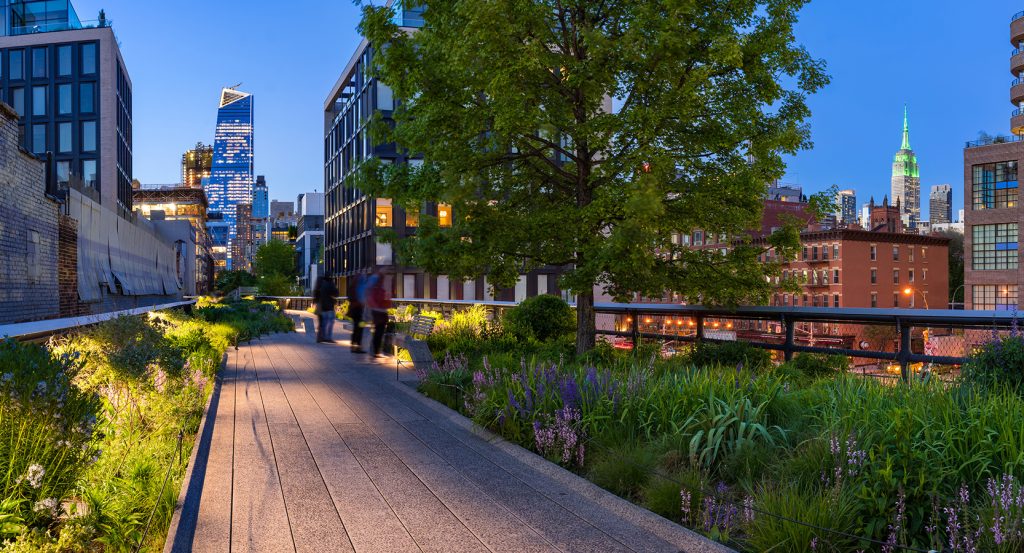
Begin at The High Line, whose steel infrastructure opened to freight traffic in 1934 as part of the West Side Improvement project and carried meat, dairy and produce directly through Manhattan's industrial west side before its final train transported three carloads of frozen turkeys in 1980. Joshua David and Robert Hammond founded Friends of the High Line in 1999 amid demolition pressure, and James Corner Field Operations, Diller Scofidio + Renfro and planting designer Piet Oudolf subsequently developed a public landscape inspired by the vegetation that had colonized the abandoned tracks; the first section opened from Gansevoort Street to West 20th Street in June 2009, retaining rails within planting beds as remnants of the freight structure. Continue to Westbeth Artists Housing, where a complex originating with Western Electric in 1868 became a major Bell Laboratories research center after 1898 and hosted work associated with the condenser microphone, early television broadcasting, talking motion pictures and binary computing. Bell Labs departed in 1966, and J. M. Kaplan Foundation support helped convert the industrial complex into 383 live-work residences under developer Dixon Bain and architect Richard Meier; Westbeth opened in 1970 as an early American example of large-scale industrial adaptive reuse specifically organized around permanent housing and studios for artists. Conclude at Little Island, where Barry Diller and Hudson River Park Trust began rethinking storm-damaged Pier 54 in 2013 before Heatherwick Studio and Signe Nielsen's MNLA developed a 2.4-acre park lifted above the Hudson. Arup engineered 132 precast concrete pots whose varied elevations create hills, overlooks and performance spaces, with piles extending to bedrock beneath the river and a Cairo pentagon geometry generating the irregular structural field; the landscape incorporates hundreds of plant varieties alongside a 700-seat open-air amphitheater and opened on 21 May 2021. The progression moves from industrial railway infrastructure reclaimed through landscape architecture through Richard Meier's conversion of Bell Laboratories into artist housing and into Heatherwick Studio and MNLA's topographic park above the Hudson, revealing how successive generations transformed Manhattan's working waterfront through art, architecture and public space.
Where your story begins.
Foresyte Travel reveals places that feel extraordinary long before you arrive.
Enjoy editorial crafted for luxury travelers.
Foresyte may earn a commission when you book.







































































































