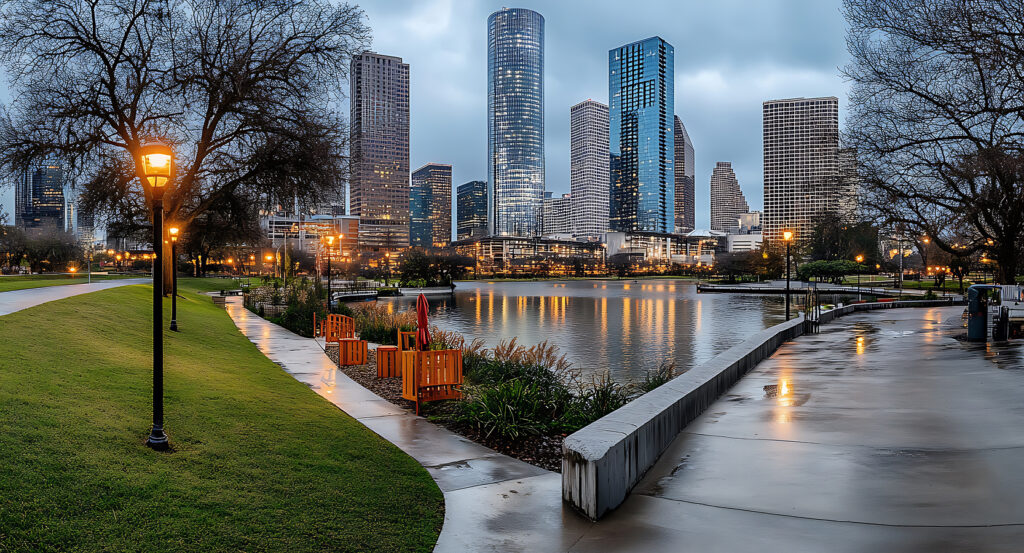
Why Houston City Hall matters.
Houston City Hall is a distinguished Art Deco civic landmark where Downtown's governmental legacy, architectural ambition, and civic character have shaped the heart of the nation's fourth-largest city.
Set along Bagby Street near McKinney Street and just steps from Hermann Square, this landmark anchors Houston's Civic Center District, where expansive public architecture, landscaped gathering spaces, and generations of municipal leadership define one of downtown's most recognizable civic landscapes. Towering limestone façades, elegant geometric detailing, bronze ornamentation, and expansive public terraces create an atmosphere that reflects both the optimism of the New Deal era and Houston's emergence as a modern metropolis. Since opening in 1939, the building has remained the symbolic center of city government while serving as the backdrop for civic celebrations, public demonstrations, and historic moments that continue to shape Houston's identity. The result is a landmark defined by architectural distinction, public service, and enduring civic pride.
What defines Houston City Hall.
Houston City Hall is best known for opening in 1939 as a $1.67 million Works Progress Administration-era civic landmark designed by Joseph Finger, becoming one of Houston's finest surviving examples of Art Deco architecture and one of the city's first fully air-conditioned office buildings.
Constructed during the final years of the Great Depression, the building embodied Houston's confidence in its future while demonstrating how New Deal investment could produce civic architecture that was both expansive and technologically progressive. Finger's restrained Art Deco design emphasized clean vertical lines, geometric ornamentation, and Indiana limestone, creating a civic landmark that balanced permanence with modernity. Inside, the innovative climate-control system established a new benchmark for municipal buildings in Houston's subtropical climate, while thoughtfully designed public chambers reflected the growing complexity of city government. Designated on the National Register of Historic Places in 1990, Houston City Hall continues to serve as the headquarters of municipal government while remaining the backdrop for mayoral inaugurations, civic celebrations, public demonstrations, and defining moments in the city's political history. Few civic landmarks in Texas so successfully combine New Deal history, architectural innovation, technological achievement, and enduring governmental significance.
How Houston City Hall fits.
Houston City Hall works as the civic centerpiece of Downtown's historic government district.
Begin at Hermann Square, where the reflecting pool and formal landscape reveal the expansive setting originally envisioned for the city's civic center. Continue to Sam Houston Park, whose preserved nineteenth-century buildings provide historical context for Houston's remarkable urban evolution. From there, make your way to Julia Ideson Building, where one of the city's most beautiful historic libraries completes an exploration shaped by architecture, public institutions, and civic history. Along the route, landscaped plazas, public art, historic monuments, and neighboring government buildings demonstrate how Houston's civic core balances architectural preservation with the demands of a modern global city. The progression moves naturally from ceremonial public square to preserved historic park before concluding at one of Houston's architectural treasures, revealing why Houston City Hall remains one of the city's defining civic landmarks.
Where your story begins.
Foresyte Travel reveals places that feel extraordinary long before you arrive.
Enjoy editorial crafted for luxury travelers.
Foresyte may earn a commission when you book.