Why InterContinental Kansas City at the Plaza matters.
InterContinental Kansas City at the Plaza is a landmark luxury hotel where Country Club Plaza's Spanish-inspired commercial architecture meets five decades of international hospitality, prominent hotel brands, and Kansas City's social traditions.
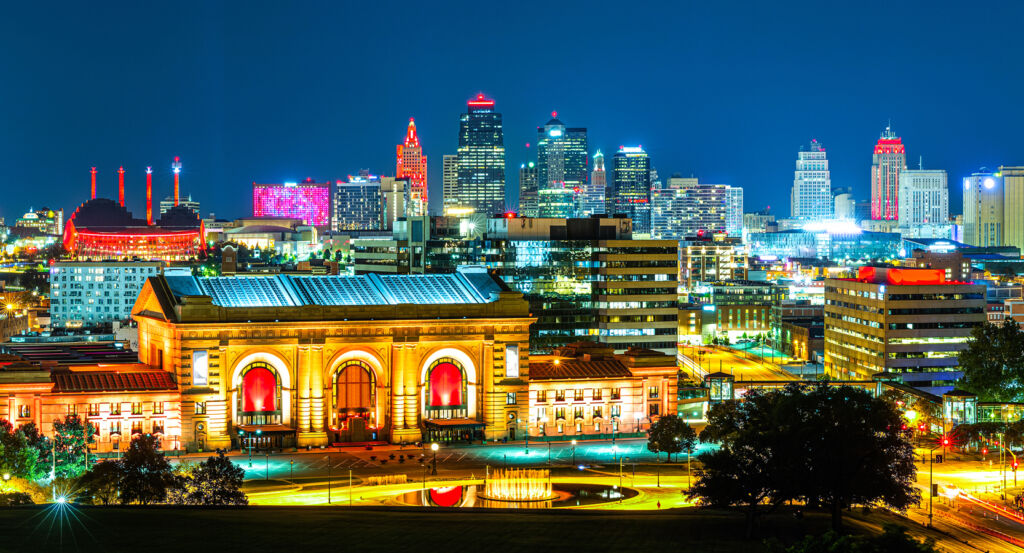
Overlooking Country Club Plaza from Ward Parkway near Wornall Road, InterContinental Kansas City at the Plaza occupies an elevated position above the district's southern commercial streets, with Brush Creek extending eastward beneath the surrounding residential neighborhoods and landscaped boulevards. The fourteen-story building presents a broad, symmetrical façade with projecting balconies, pale exterior surfaces, and a central entrance framed by substantial architectural volumes. Its upper elevations overlook the tiled roofs, decorative towers, and interconnected shopping streets of the surrounding district. A landscaped arrival court introduces the main entrance, connecting the building's substantial vertical scale with its residential surroundings. Inside, polished stone, decorative lighting, upholstered furnishings, and expansive public rooms establish the formal character of a metropolitan luxury hotel. Private balconies extend the accommodations beyond the building envelope, introducing views across the commercial district and surrounding residential landscape. The result is a substantial urban hotel whose elevated architecture establishes a distinctive relationship with Kansas City's principal historic shopping district.
What defines InterContinental Kansas City at the Plaza.
InterContinental Kansas City at the Plaza is best known for evolving from the Alameda Plaza Hotel into a prominent Kansas City luxury property through successive affiliations with Ritz-Carlton, Fairmont, and InterContinental. The original Alameda Plaza opened in 1972, introducing a substantial high-rise hotel overlooking one of the city's established commercial and residential districts. Its development coincided with the expansion of American luxury hospitality beyond traditional downtown business centers, placing an international-standard hotel beside a major suburban shopping destination. The property adopted the Ritz-Carlton name in 1989, introducing an association with a hotel brand whose standards emphasized formal service, residential luxury, and refined public entertaining. The Ritz-Carlton period also included substantial interior modernization, strengthening the building's position within Kansas City's upper-tier hospitality market. Fairmont assumed the hotel's character in 1999, beginning another chapter of international luxury management and extending its association with formal dining and major social occasions. The Procaccianti Group acquired the Fairmont Kansas City from Maritz Wolff & Co. in December 2005, preparing the property for a new international affiliation. InterContinental Hotels Group introduced the InterContinental Kansas City at the Plaza character in January 2006, incorporating the hotel into its worldwide luxury portfolio. The transition preserved the building's established relationship with Kansas City society through the Oak Room restaurant, Oak Bar, and substantial ballroom facilities. A $15 million restoration undertaken in 2007 transformed the accommodations and public interiors, updating the hotel's architectural character under the InterContinental brand. The project incorporated custom-designed furnishings, renewed decorative treatments, and extensive improvements to the property's principal social spaces. A subsequent ownership transaction in 2016 introduced another major capital investment program, with $15.9 million allocated to renovations throughout the building. New York-based dash design directed the resulting transformation, introducing contemporary interiors across the lobby, accommodations, corridors, and dining spaces. Completed in 2017 at a cost exceeding $16 million, the renovation also established American Slang Modern Brasserie as a new culinary character within the hotel. The restaurant opened on June 30, 2017, replacing the earlier Oak Room dining concept with a contemporary interpretation of French-American cuisine. Chef Drue Kennedy helped introduce the brasserie's culinary direction, connecting familiar American preparations with traditional French techniques. The property's continued evolution reflects successive efforts to maintain its position within Kansas City's luxury hospitality market through international brand partnerships, architectural investment, and changes in metropolitan dining culture.
American Slang Modern Brasserie establishes the hotel's principal culinary environment through a contemporary interpretation of the traditional French neighborhood restaurant. Its design combines upholstered banquettes, polished surfaces, decorative lighting, and an open social arrangement that connects dining with the surrounding public spaces. French culinary foundations shape a menu incorporating American ingredients and regional influences, establishing a relationship between European brasserie traditions and the food culture of the Midwest. The restaurant's outdoor terrace extends dining toward the surrounding commercial district, introducing an open-air counterpart to the interior's more formal atmosphere. The adjoining Oak Room Lounge preserves a separate dimension of the hotel's longstanding social character through live musical performances, cocktails, and evening gatherings. Its intimate seating arrangements and subdued lighting maintain the atmosphere of a traditional metropolitan hotel lounge, connecting the property with Kansas City's established musical culture. Club InterContinental introduces a more private interpretation of hospitality through an elevated lounge environment serving breakfast, refreshments, and evening selections. The accommodation interiors continue the building's residential character through generous proportions, upholstered furnishings, decorative textiles, and individual balconies. Larger suites introduce separate living and sleeping spaces, establishing a relationship between private entertaining and extended residential comfort. The Presidential Suite develops this tradition through substantial reception areas and expansive views over the surrounding district. The outdoor swimming pool occupies an elevated terrace, creating a seasonal recreational environment above the commercial streets. Its adjoining deck connects swimming and outdoor dining with the hotel's broad metropolitan views. The Alameda Ballroom provides the property's principal ceremonial setting, accommodating large weddings, formal celebrations, and corporate gatherings within an extensive interior space. Additional event rooms and an elevated ballroom extend the hotel's entertaining tradition across several scales of private and public occasion. This combination of French-American dining, live music, residential accommodations, and substantial ceremonial spaces preserves the hotel's role as a center of Kansas City social hospitality.
How InterContinental Kansas City at the Plaza fits.
InterContinental Kansas City at the Plaza works as the starting point for an exploration connecting Kansas City's European-inspired public sculpture, twentieth-century artistic patronage, and the architectural evolution of its major cultural institutions.
Begin at Fountain in Mill Creek Park, the expansive sculptural ensemble created by French artist Henri-Léon Gréber in 1910 for the Long Island estate of financier Clarence Mackay. Four equestrian figures represent the Mississippi, Volga, Seine, and Rhine rivers, establishing an elaborate allegorical composition around the central water basin. The sculptures arrived in Kansas City in 1951 and underwent restoration by Herman Frederick Simon before the fountain's dedication in 1960. The installation became a defining expression of Kansas City's extensive public fountain tradition, connecting European expansive sculpture with the city's twentieth-century civic landscape. Continue to Kemper Museum of Contemporary Art, founded by collectors Bebe and R. Crosby Kemper Jr. and opened in 1994 as Kansas City's first museum devoted exclusively to modern and contemporary art. Architect Gunnar Birkerts designed the building around a light-filled central atrium, introducing a distinctive modern architectural composition into the surrounding cultural district. The museum's collection developed through works by influential twentieth-century and contemporary artists, including Louise Bourgeois, Georgia O'Keeffe, and Helen Frankenthaler. Its exhibitions extend this foundation through painting, sculpture, photography, and experimental artistic practices, connecting private collecting traditions with contemporary creative developments. Conclude at The Nelson-Atkins Museum of Art, the encyclopedic institution established through the combined legacies of newspaper publisher William Rockhill Nelson and philanthropist Mary McAfee Atkins. The original Beaux-Arts building, designed by Wight & Wight, opened on December 11, 1933, establishing a major public collection encompassing European painting, Asian art, antiquities, and American artistic traditions. Steven Holl Architects introduced the Bloch Building in 2007, incorporating five illuminated glass lenses into a largely subterranean expansion that contrasts with the original limestone architecture. The surrounding Donald J. Hall Sculpture Park includes Claes Oldenburg and Coosje van Bruggen's Shuttlecocks, installed in 1994 as four expansive badminton shuttlecocks positioned around the museum's classical façade. The progression moves from Fountain in Mill Creek Park's European sculptural origins through Kemper Museum of Contemporary Art's modern collecting traditions and culminates in The Nelson-Atkins Museum of Art's encyclopedic collections and architectural expansion, connecting three generations of artistic patronage that transformed Kansas City's cultural landscape.
Where your story begins.
Foresyte Travel reveals places that feel extraordinary long before you arrive.
Enjoy editorial crafted for luxury travelers.
Foresyte may earn a commission when you book.