Why you should experience Kasa Grand Mile Chicago in Chicago, Illinois.
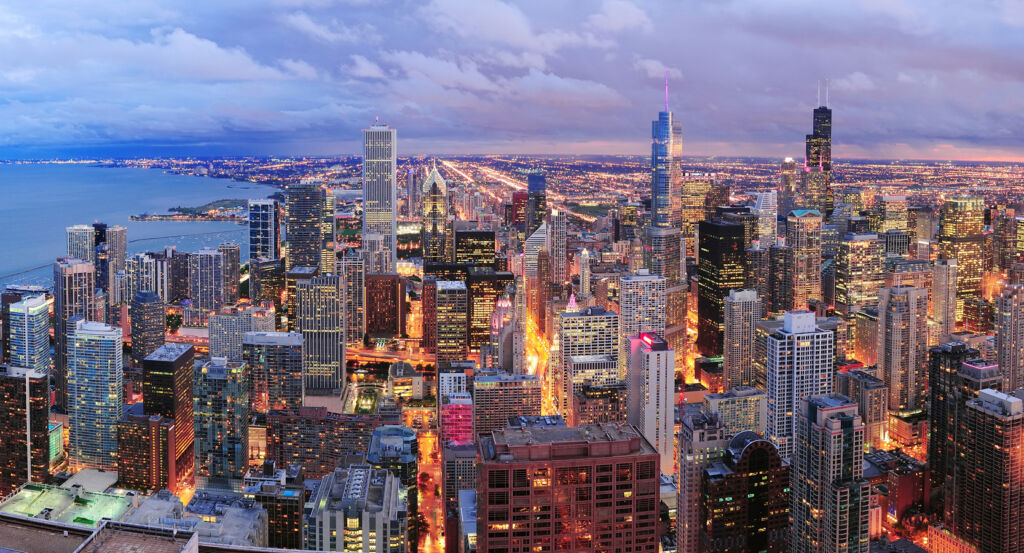
Kasa Grand Mile Chicago is a pioneering apartment hotel where River North's vertical resurgence, late-twentieth-century residential revival, development ambition and evolving relationship between permanent and temporary downtown living converge inside One Superior Place.
Set along West Superior Street near North State Street and just steps from Holy Name Cathedral, the property occupies a 52-story tower developed by Magellan Development Group and designed by Loewenberg Architects as Downtown emerged from an eight-year lull in major market-rate apartment construction. Construction began in 1997 before initial occupancy in 1999, producing 809 apartments within a 1,005,000-square-foot project developed for $101.9 million and incorporating 50,000 square feet of retail space with another 8,000 square feet devoted to offices. The program included a 32,000-square-foot Whole Foods Market and an immense parking component, establishing One Superior Place as a substantial wager on renewed demand for residential life in the Near North Side at the close of the twentieth century. The result is a property where Magellan and Loewenberg's early bet on downtown residential revival became the physical platform for Kasa's later experiment in technology-mediated hospitality.
What you should know about Kasa Grand Mile Chicago.
Kasa Grand Mile Chicago is best known for inserting Roman Pedan's technology-driven hospitality model into One Superior Place, placing furnished visitor accommodations within an 809-unit apartment tower rather than constructing a conventional purpose-built hotel. The property operates from 1 West Superior Street through Kasa, the hospitality company Pedan founded around partnerships with owners of existing multifamily and hotel real estate, while Hartz Mountain Industries succeeded Magellan Development Group as owner of the underlying tower. Kasa's Chicago operation preserves the fundamental residential logic of One Superior Place, with apartment-style accommodations functioning within the same Loewenberg Architects structure that entered occupancy in 1999. The combination of Pedan, Kasa, Hartz, Magellan and Loewenberg connects two distinct real-estate ideas across a quarter century, first the return of large-scale rental development to Central Chicago and later the conversion of portions of existing housing infrastructure into professionally operated short-term lodging.
One Superior Place supplies a particularly consequential architectural context because Magellan Development Group would become deeply associated with Chicago's subsequent downtown residential expansion, while Loewenberg Architects developed an extensive high-rise practice around the same urban shift. Its 52 stories concentrated 809 studio, one-bedroom and two-bedroom apartments within a million-square-foot structure, while the $101.9 million development represented a considerable commitment to River North before the neighborhood's twenty-first-century residential boom reached maturity. The tower's combination of housing, retail and office space anticipated the increasingly dense patterns of downtown habitation that would define surrounding blocks as Chicago's central population expanded during subsequent decades. Kasa's arrival consequently extends a development story already embedded in the building, turning a late-1990s experiment in bringing residents downtown into a contemporary experiment in blurring the operational boundaries between apartments and hotels.
How to fold Kasa Grand Mile Chicago into your trip.
Kasa Grand Mile Chicago works as the anchor for an afternoon tracing ecclesiastical rebuilding, Gilded Age private wealth and scholarly institution-building through River North and the adjoining Near North Side.
Begin at Holy Name Cathedral, where Irish-born Patrick C. Keely received the commission in 1874 after the Great Chicago Fire destroyed both the Cathedral of St. Mary and Church of the Holy Name, completing the Gothic Revival cathedral in 1875 within a career encompassing more than 600 churches; its interior incorporates 23,000 individually installed pieces of wood in the ceiling, Albert J. Friscia's bronze-and-glass Tree of Life and Ivo Demetz's Resurrection Crucifix. Continue to Richard H. Driehaus Museum, where Samuel Mayo Nickerson commissioned Burling & Whitehouse for the residence completed in 1883 at a cost of $450,000, with R. W. Bates & Co., William August Fiedler and George A. Schastey & Co. creating interiors whose material ambition earned the house its Marble Palace sobriquet. Conclude at Newberry Library, founded on July 1, 1887 through Walter Loomis Newberry's $2.2 million bequest and organized by first librarian William Frederick Poole, an American Library Association founder whose disagreements with architect Henry Ives Cobb influenced the design of the permanent building opened opposite Washington Square Park in 1893. The progression moves from Keely's post-Fire cathedral through Nickerson's private patronage into Newberry, Poole and Cobb's scholarly institution, revealing the nineteenth-century cultural foundations beneath the vertical River North that eventually produced One Superior Place.
Where your story begins.
Foresyte Travel reveals places that feel extraordinary long before you arrive.
Experience premium editorial crafted for luxury travelers.