
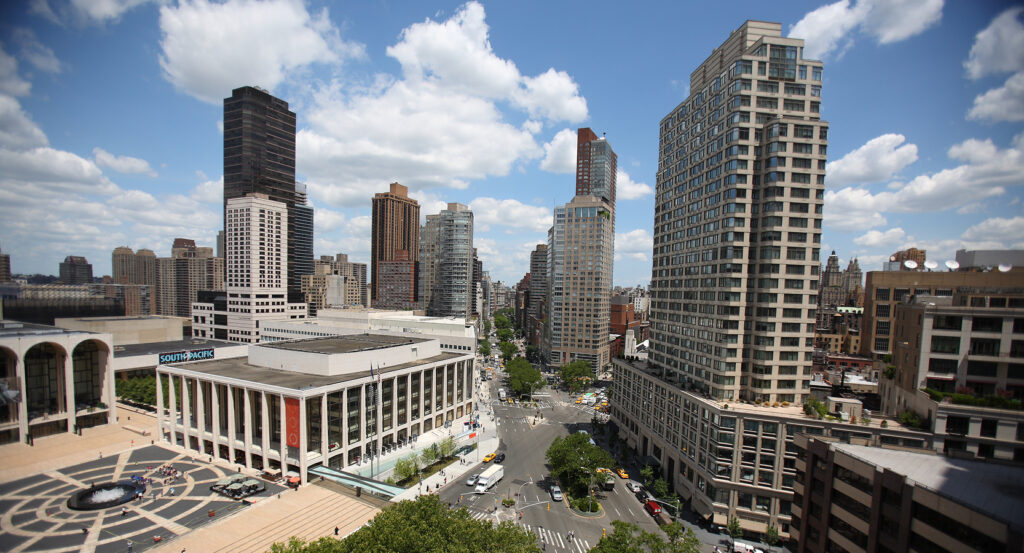
Why Revson Fountain matters.
Revson Fountain is a kinetic civic centerpiece where Lincoln Square's performing-arts culture meets choreographed water, precision engineering and a circular granite form at the center of Lincoln Center's principal plaza.
Set within Josie Robertson Plaza near Columbus Avenue and directly in front of the Metropolitan Opera House, the fountain occupies the central axis of a 28,000-square-foot forecourt framed by three major performance buildings. A shallow circular basin lies nearly flush with the surrounding paving, allowing the water surface to read as part of the plaza floor beneath a slim granite ring raised on narrow supports. Computer-controlled jets shift between low geometric formations and vertical bursts reaching 40 feet, with white illumination extending the changing water patterns after dark. The circular edge doubles as seating, placing people directly beside the moving water without interrupting long sightlines across the open forecourt. The result is a precisely engineered fountain whose low basin, suspended granite rim, choreographed jets and central position make moving water the visual focus of Lincoln Center's principal outdoor gathering place.
What defines Revson Fountain.
Revson Fountain is best known for carrying Philip Johnson's original 1964 Lincoln Center fountain into a technically advanced reconstruction completed during the campus-wide renewal led by Diller Scofidio + Renfro. The Revlon Foundation financed the first fountain through a gift honoring cosmetics executive Charles Revson, with New York City's Department of Parks constructing the feature from Johnson's design. City Council President Paul R. Screvane and Lincoln Center president William Schuman inaugurated it on April 6, 1964 during ceremonies connected with the New York State Theater. Johnson's installation employed 568 water jets and 88 lights, circulated 9,800 gallons per minute and used 26,000 watts of illumination, making electronically controlled water a substantial component of the newly built performing-arts campus. J. S. Hamel of Hamel and Lancer handled engineering, with 40 jets concentrated 16 lights at the core and additional concentric rings extending the water pattern outward. The fountain entered popular culture through appearances in films including The Producers, Manhattan, Ghostbusters and Moonstruck, giving the circular plaza feature a screen history extending across several decades. Lincoln Center subsequently embarked on a broad twenty-first-century campus renewal, and Diller Scofidio + Renfro developed a new architectural treatment for the fountain as part of that undertaking. WET Design rebuilt the water system between 2007 and 2009, with Beyer Blinder Belle participating in the project and Performance Structures engineering and fabricating the demanding external form. The reconstructed fountain returned in September 2009, preserving water as the plaza's central focus through a substantially different architectural and technical system.
The 2009 installation reorganized the fountain 353 computer-controlled nozzles, 272 lights and 24 pumps capable of circulating up to 16,500 gallons per minute. Three concentric nozzle rings permit multiple water formations, giving WET Design a broad field for programmed sequences across the circular basin. Automated wind sensors adjust pressure, height and volume when conditions change, reducing spray beyond the fountain while preserving the intended water formations. Diller Scofidio + Renfro lowered the water surface to plaza level and replaced the earlier substantial perimeter bench with the thin raised granite ring, opening clearer views across Josie Robertson Plaza. Performance Structures entered the project after the proposed exterior proved difficult to fabricate without altering its form, then re-engineered the structure so the architects' profile remained achievable. A $4 million multiyear grant from the Charles H. Revson Foundation supported the reconstruction, extending the Revson family's association with the fountain into its second major architectural chapter. Lincoln Center now programs daily water displays at the site, carrying the engineered system beyond static ornament through recurring sequences of changing height and formation. The reconstruction joined structural fabrication, computerized hydraulics, wind response, lighting and architectural refinement in a single installation built around the movement of water through the center of the plaza.
How Revson Fountain fits.
Revson Fountain works as the anchor for a Lincoln Square outing connecting self-taught art, an American Catholic order's nineteenth-century mother church and the institutional rise of contemporary craft and design.
Begin at American Folk Art Museum, founded on June 23, 1961 and devoted to folk and self-taught artists whose practices developed largely outside formal artistic training. The institution began as a small gallery above a delicatessen and built a collection now spanning thousands of works across four centuries and nearly every continent, encompassing portraits, quilts and work by living artists. Its first acquisition, Flag Gate, became the opening object in a collection that expanded the museum's remit from historic American folk art toward a broader field of self-taught production. The Lincoln Square home places that specialized collection within the performing-arts district while sustaining an institution created during New York's intense early-1960s cultural expansion. Continue to Church of St. Paul the Apostle, the mother church of the Paulist Fathers, where the cornerstone was laid in 1876 for a building conceived under founder Isaac Hecker and architect Jeremiah O'Rourke. West Point-trained Paulist George Deshon assumed architectural responsibility and brought the church to completion in January 1885, shaping a 284-foot-long granite structure drawing on early Christian basilicas and medieval European architecture. Stanford White later designed major interior elements, John La Farge supplied stained glass, Augustus Saint-Gaudens and Frederick MacMonnies contributed sculpture, and Bertram Goodhue created floor mosaics. The stone exterior incorporates granite salvaged from New York structures including parts of the Croton Aqueduct, the Croton Distributing Reservoir and Booth's Theatre. Conclude at Museum of Arts and Design, founded by craft patron Aileen Osborn Webb in 1956 as the Museum of Contemporary Crafts. Paul J. Smith's 1963 to 1987 directorship expanded its exhibition program, the institution became the American Craft Museum in 1979 and the Museum of Arts and Design name arrived in 2002 as its collecting scope widened. A successful bid for 2 Columbus Circle led to a new home by Brad Cloepfil of Allied Works Architecture, opened in September 2008 behind an exterior of glazed terra-cotta tile and fritted glass. That move placed an institution born from twentieth-century American craft advocacy inside a purpose-remade building devoted to art, design and skilled making. The progression moves from a museum advancing folk and self-taught artists through Hecker, O'Rourke, Deshon, White and La Farge's layered religious commission and culminates with Webb's craft institution and Cloepfil's architectural reinvention, tracing three distinct traditions of artistic authorship around Lincoln Square.
Where your story begins.
Foresyte Travel reveals places that feel extraordinary long before you arrive.
Enjoy editorial crafted for luxury travelers.
Foresyte may earn a commission when you book.







































































































