
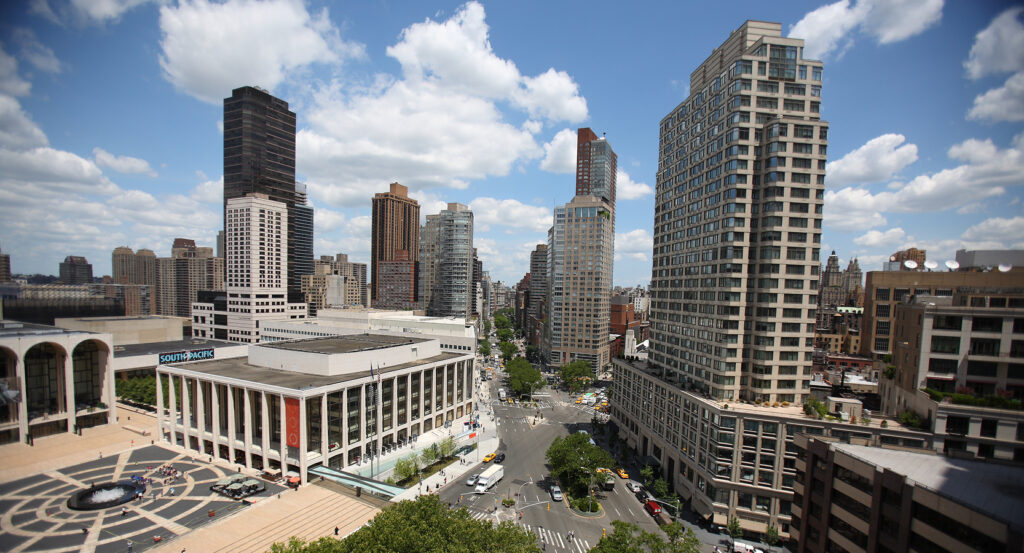
Why Lincoln Center for the Performing Arts matters.
Lincoln Center for the Performing Arts is a commanding cultural campus where Lincoln Square's arts corridor meets Modernist architecture, expansive public plazas and an extraordinary concentration of opera, orchestral music, ballet, theater and artistic education.
Set between Broadway and Amsterdam Avenue from West 62nd to West 66th Street and just north of Dante Park, the 16.3-acre campus occupies several city blocks organized around elevated plazas, pedestrian approaches and a central east-west axis. Travertine-clad performance buildings frame Josie Robertson Plaza, where broad staircases, arcades and open paving establish a formal architectural enclosure around Revson Fountain. The Metropolitan Opera House terminates the western axis through five immense arches, with David Geffen Hall and David H. Koch Theater facing one another across the northern and southern sides of the principal plaza. Secondary paths extend toward Juilliard, Alice Tully Hall, Damrosch Park and the Vivian Beaumont complex, giving the campus a sequence of distinct architectural precincts beyond its central composition. The result is a multi-building cultural district whose plazas, axial planning, Modernist facades and concentrated performance institutions turn several Manhattan blocks into an unusually complete architectural setting for the performing arts.
What defines Lincoln Center for the Performing Arts.
Lincoln Center for the Performing Arts is best known for consolidating major New York performing-arts institutions within a purpose-built cultural complex conceived during the sweeping redevelopment of Lincoln Square in the 1950s. The organization was incorporated in 1956, with John D. Rockefeller 3rd leading its creation, fundraising campaign and early presidency. Rockefeller assembled major philanthropic support from foundations and private donors, and New York State contributed $15 million through funding connected with the performing-arts component of the forthcoming World's Fair. President Dwight D. Eisenhower joined Rockefeller, Mayor Robert F. Wagner and performers Leonard Bernstein, Rise Stevens and Leonard Warren for the May 14, 1959 groundbreaking, which initiated construction of Philharmonic Hall. Wallace K. Harrison directed the campus master plan and designed the Metropolitan Opera House, Max Abramovitz designed Philharmonic Hall, Philip Johnson created the New York State Theater, Pietro Belluschi designed the Juilliard building, Gordon Bunshaft handled the performing-arts library and Eero Saarinen worked with theatrical designer Jo Mielziner on the Vivian Beaumont Theater. Philharmonic Hall opened in 1962, followed by additional buildings through the decade as the Metropolitan Opera, New York Philharmonic, New York City Ballet, New York City Opera, Juilliard and Lincoln Center's repertory theater established permanent homes on the campus. That ambitious cultural construction also carried a profound urban cost: development displaced San Juan Hill, a densely populated, working-class community with a substantial Black and Puerto Rican population, during the Lincoln Square renewal program. Lincoln Center now explicitly incorporates the history of San Juan Hill into its institutional treatment of the campus and its surrounding community.
A major architectural campaign beginning in the twenty-first century substantially altered how the original campus connected with surrounding streets. Diller Scofidio + Renfro worked with FXFOWLE on the redevelopment, whose first construction phase began along West 65th Street in June 2006. The undertaking reshaped pedestrian circulation, renovated Alice Tully Hall and the Juilliard complex, created new public areas and reconstructed Revson Fountain with Diller Scofidio + Renfro, Beyer Blinder Belle and WET Design. Another major intervention followed at David Geffen Hall, where a $550 million project paired Diamond Schmitt Architects under Gary McCluskie on the Wu Tsai Theater with Tod Williams Billie Tsien Architects on the public interiors. Acoustician Paul Scarbrough of Akustiks and theater planner Joshua Dachs of Fisher Dachs Associates joined a team that included Kohler Ronan, Thornton Tomasetti and Turner Construction Company. The rebuilt hall opened October 8, 2022, two years ahead of its earlier timetable, beginning with the world premiere of Etienne Charles's San Juan Hill: A New York Story, performed by Creole Soul with the New York Philharmonic under Jaap van Zweden. Lincoln Center subsequently turned toward the campus's historically isolated Amsterdam Avenue edge, announcing in 2025 a preliminary design by Hood Design Studio, WEISS/MANFREDI and Moody Nolan that removes the barrier wall beside Damrosch Park and reconnects the western side with surrounding streets. More than six decades after Harrison's master plan began taking physical form, successive architectural campaigns have continued revising how the cultural institutions relate to their city.
How Lincoln Center for the Performing Arts fits.
Lincoln Center for the Performing Arts works as the anchor for a Lincoln Square outing connecting American religious art, self-taught artistic production and the preservation of theater, dance, music and recorded sound.
Begin at Church of St. Paul the Apostle, where the Paulist Fathers laid the cornerstone of their new mother church on January 4, 1876 after founder Isaac Hecker developed plans for a major American Catholic building inspired by early Christian basilicas. Architect Jeremiah O'Rourke prepared the initial design before Paulist priest and West Point-trained engineer George Deshon assumed architectural leadership and brought the church to completion in January 1885. Rock-faced granite salvaged from Manhattan structures forms portions of the exterior, and the interior accumulated work by John La Farge, Augustus Saint-Gaudens, Stanford White, Lumen Martin Winter and William Laurel Harris, joining ecclesiastical architecture with an exceptional group of American artists. Continue to American Folk Art Museum, founded in 1961 and devoted to folk and self-taught artists whose practices developed largely outside formal artistic training. Its holdings now exceed 7,000 works spanning four centuries and nearly every continent, encompassing portraits, quilts and work by living artists alongside historic American objects. The institution's history has included several names and locations before its current Lincoln Square home became the center of a program devoted to expanding scholarly and public understanding of self-taught production. Its proximity to the major academies and performance institutions around Lincoln Center places an institution centered on artistic practice outside conventional training within one of Manhattan's densest cultural districts. Conclude at The New York Public Library for the Performing Arts, whose intellectual roots predate its Lincoln Center building by decades. The Theatre Collection began with David Belasco's papers in 1931, Carleton Sprague Smith proposed a dedicated performing-arts library and museum in 1932, sound collecting began in 1937 and the Dance Collection followed in 1944. Lincoln Center approached NYPL about a dedicated institution in 1957, building upon Smith's earlier proposal, and Gordon Bunshaft of Skidmore, Owings & Merrill designed the facility that opened November 30, 1965. The institution now holds extensive research collections across theater, film, dance, music and recorded sound, preserving creative work whose original form existed on stages, screens and in performance. The progression moves from Hecker, O'Rourke and Deshon's church enriched by major American artists through a museum devoted to self-taught production and culminates in Bunshaft's research institution for performing-arts history, linking creation, collecting and preservation across Lincoln Square.
Where your story begins.
Foresyte Travel reveals places that feel extraordinary long before you arrive.
Enjoy editorial crafted for luxury travelers.
Foresyte may earn a commission when you book.







































































































