Why you should experience Mission Cemetery in Hawaii.
The Mission Cemetery in Honolulu is among the city's most quietly powerful places, a sacred resting ground that bridges Hawaii's earliest written history with the living heartbeat of the islands today.
Tucked behind Kawaiahaʻo Church and shaded by ancient kiawe trees, the cemetery feels suspended in time. Weathered headstones lean gently over sunlit grass, their inscriptions etched with names that shaped Hawaii's 19th-century transformation, missionaries, aliʻi, educators, and translators who lived through an era of profound change. The air is heavy with reverence yet light with birdsong; the city hum fades to a hush as you walk its narrow pathways. It's not grand or manicured, but deeply human, a place where history rests. Each stone here tells part of the story of Hawaii's journey from oral tradition to written word, from isolated kingdom to global crossroads. Visiting the Mission Cemetery is less about sightseeing and more about remembrance, a quiet communion with the souls who helped lay the foundation of modern Hawaii.
What you should know about Mission Cemetery.
The Mission Cemetery, also known as the Kawaiahaʻo Church Cemetery, is the final resting place of many of Hawaii's earliest missionaries, but it also preserves the intertwined stories of Native Hawaiian leaders who embraced literacy, education, and faith on their own terms.
Established in the early 1820s, the cemetery grew alongside the Mission Houses across the street, serving as the burial site for both foreign settlers and Hawaiian converts during a time when Western influence was reshaping the islands. Among those interred here are Hiram and Sybil Bingham, members of the first company of missionaries who arrived in 1820; Reverend Asa Thurston and his wife Lucy, whose descendants include Hawaii's first elected officials; and Chiefess Kapiʻolani, who famously defied the fire goddess Pele to affirm her Christian faith, an act that symbolized the cultural shifts of the era. Yet, the cemetery is far from one-sided history. It's a reflection of coexistence, of the Hawaiians who guided, translated, and taught alongside these newcomers. The gravestones themselves are historical artifacts: some engraved in both Hawaiian and English, others barely legible, their carvings softened by salt air and rain. Walking here feels like turning the fragile pages of a living archive, one written not on parchment, but in stone and soil. Few visitors realize that the cemetery once served as a place of refuge during epidemics and political turmoil, standing quietly through the birth of the Hawaiian monarchy, the overthrow, and beyond.
How to fold Mission Cemetery into your trip.
A visit to the Mission Cemetery offers a contemplative counterpoint to the bright rhythm of Honolulu, an experience best taken slowly, with an open heart.
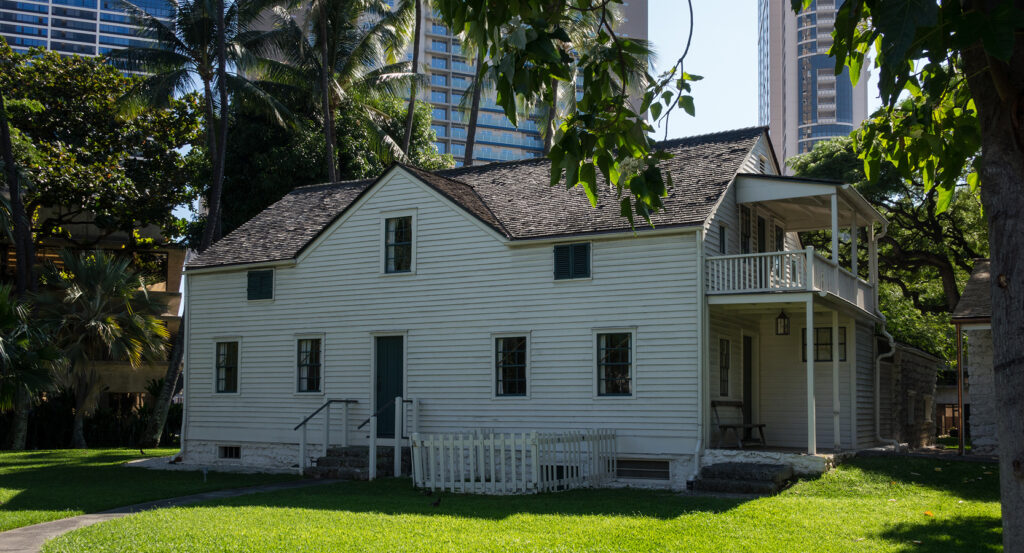
Start at Kawaiahaʻo Church, whose coral block walls rise just beside the cemetery, and take a moment to step into the sanctuary where many of those buried here once worshipped. Then wander through the gate into the cemetery grounds, letting the soft crunch of gravel underfoot set the pace. Each section reveals another layer of Hawaii's early identity, a mingling of cultures, languages, and legacies that shaped the islands' spiritual and intellectual life. Look for the graves of the Bingham, Thurston, and Cooke families, often adorned with leis left by visitors who still feel their presence in Hawaii's living story. Toward the back, beneath the sweeping branches of a monkeypod tree, lie smaller stones marking the graves of children, a somber reminder of the hardships faced by early settlers. The site pairs beautifully with a visit to the nearby Hawaiian Mission Houses Historic Site, where the stories of these same figures come vividly to life through preserved letters, journals, and artifacts. As you leave, take one last look across the gravestones toward the church steeple, the view has changed little in nearly two centuries. The Mission Cemetery isn't simply a burial ground; it's a sanctuary of memory, where the roots of Hawaii's written and spiritual heritage still reach quietly toward the sky.
Where your story begins.
Foresyte Travel reveals places that feel extraordinary long before you arrive.
Experience premium editorial crafted for luxury travelers.