Why Navy Pier matters.
Navy Pier is an expansive waterfront destination where Streeterville's Lake Michigan shoreline meets Daniel Burnham's civic planning ambitions, Chicago's maritime and military history and a century of public entertainment along one of America's most celebrated urban lakefronts.
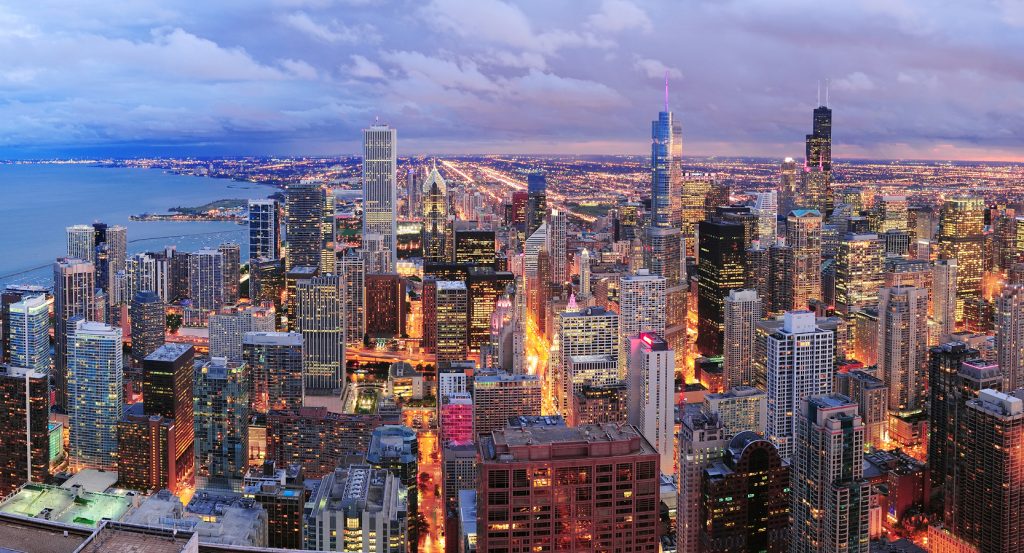
Extending east from East Grand Avenue near North Lake Shore Drive and just steps from Jane Addams Memorial Park, the 3,300-foot pier occupies a commanding position along Lake Michigan, projecting from the Streeterville shoreline into open water between the Chicago River's mouth and the residential towers of the Near North Side. Two expansive terminal buildings frame the western entrance, where classical ornamentation, broad façades and symmetrical architectural forms establish a ceremonial threshold between the city and the lake. A long central promenade connects landscaped gathering spaces, entertainment venues and waterfront terraces, with uninterrupted views toward the Chicago skyline and the expansive horizon of Lake Michigan. The eastern end culminates in a distinctive terminal building whose expansive proportions and historic architectural detailing preserve the character of the pier's original civic construction. The result is a waterfront complex whose extraordinary scale, classical architecture and commanding lakefront position connect Chicago's historic maritime infrastructure to one of the city's most recognizable public destinations.
What defines Navy Pier.
Navy Pier is best known for evolving from an expansive municipal shipping facility into a major American waterfront attraction through successive chapters of commercial transportation, military service, education and civic redevelopment. Daniel Burnham and Edward H. Bennett's 1909 Plan of Chicago envisioned a coordinated system of public improvements along the city's lakefront, establishing the broader planning ambitions that shaped the pier's development. Architect Charles Sumner Frost designed the structure, originally named Municipal Pier No. 2, as part of Chicago's investment in modern harbor infrastructure and public recreational facilities. Construction began in 1914, and the completed pier opened in July 1916 at a cost of $4.5 million, extending 3,300 feet into Lake Michigan. Its original program combined freight transportation, passenger steamship operations and public recreation, reflecting the city's effort to integrate commercial shipping with access to the waterfront. The pier's terminal buildings incorporated Beaux-Arts architectural elements, giving an industrial transportation facility the expansive civic character associated with Chicago's early twentieth-century planning movement. Passenger steamships operated from its docks during the following decades, connecting Chicago with destinations across the Great Lakes and bringing substantial seasonal activity to the waterfront. The United States Navy used the facility during World War I, establishing an early military association that subsequently became central to its historical development. Municipal Pier No. 2 received the name Navy Pier in 1927 in recognition of the naval personnel who served during the First World War. The pier's commercial shipping functions declined during the Great Depression, creating the conditions for another transformation as Chicago's transportation economy changed. During World War II, the United States Navy converted the complex into a major training center, preparing thousands of personnel for military service and establishing one of the pier's most consequential historical chapters. The naval training program included aviation instruction, with pilots practicing aircraft carrier operations aboard training vessels operating on Lake Michigan. Among those who trained through the Great Lakes naval aviation program was future President George H. W. Bush, connecting the pier's wartime operations to a significant figure in twentieth-century American history.
The University of Illinois established its Chicago undergraduate campus at Navy Pier in 1946, transforming the former naval facility into an educational institution serving returning military veterans and the expanding postwar student population. The campus became widely known as Harvard on the Rocks, a nickname reflecting the university's demanding academic programs and the pier's exposed position along Lake Michigan. Students attended classes in converted military buildings, creating an unusual academic environment within a structure originally designed for commercial shipping and public recreation. The university relocated its undergraduate operations to the new Chicago Circle campus in 1965, ending nearly two decades of higher education at the pier. Subsequent years brought declining activity and competing proposals for redevelopment as the city considered the future of its aging waterfront infrastructure. The Metropolitan Pier and Exposition Authority assumed responsibility for the property and developed a major transformation program intended to restore its role as a public destination. A $150 million redevelopment completed in 1995 introduced Festival Hall, the Chicago Shakespeare Theater's future home and a new generation of entertainment facilities, fundamentally changing the pier's relationship with the surrounding city. The original Ferris wheel became a central feature of the redeveloped complex, drawing inspiration from George Washington Gale Ferris Jr.'s revolutionary wheel constructed for the 1893 World's Columbian Exposition. A subsequent redevelopment introduced the Centennial Wheel in 2016, replacing the earlier attraction with a 196-foot structure commemorating the pier's hundredth anniversary. The wheel's enclosed gondolas and advanced engineering extended the tradition of expansive observation attractions associated with Chicago's international exposition history. The pier's contemporary cultural program includes Chicago Shakespeare Theater, the Chicago Children's Museum and extensive public performance spaces, establishing a concentration of educational and artistic institutions along the waterfront. Landscape improvements and redesigned public spaces have further strengthened the relationship between the pier and Lake Michigan, creating a continuous setting for festivals, exhibitions and seasonal gatherings. Navy Pier's evolution from municipal shipping infrastructure through military training, university education and public entertainment represents an exceptional sequence of institutional transformations within one of Chicago's most significant twentieth-century waterfront structures.
How Navy Pier fits.
Navy Pier works as the waterfront centerpiece for an outing connecting Streeterville's architectural transformation, Chicago's modern cultural institutions and the public landscapes that established Lake Michigan as the city's defining civic frontier.
Begin at Chicago Children's Museum, the major educational institution whose interactive exhibitions have introduced generations of families to science, art and creative exploration. The museum originated in 1982 through the efforts of the Junior League of Chicago, which sought to establish a permanent children's museum serving the city's diverse communities. Its early exhibitions operated from temporary locations before the institution established a permanent home at Navy Pier in 1995, becoming a central component of the waterfront's redevelopment. The museum's interactive installations explore engineering, construction, water systems and imaginative play, connecting hands-on learning to the industrial and architectural history of Chicago. Continue to Chicago Shakespeare Theater, the internationally respected performing arts institution founded by Barbara Gaines in 1986. The company developed from its original productions at the Ruth Page Theater into a major resident organization at Navy Pier, opening a purpose-built theater in 1999. Its Courtyard Theater draws inspiration from the intimate performance spaces of Shakespeare's Elizabethan England, combining a thrust stage with audience seating arranged around three sides of the performance area. The company subsequently expanded with The Yard, an adaptable performance venue opened in 2017, allowing productions to reconfigure the relationship between actors and audiences through movable seating towers. Conclude at Ohio Street Beach, the distinctive lakefront swimming and recreation area positioned near the entrance to the Chicago River and the eastern edge of Streeterville. The beach occupies a protected stretch of shoreline whose orientation creates an unusual relationship with the downtown skyline, allowing swimmers and pedestrians to look west toward the city's commercial towers. Its location reflects the extensive lakefront engineering that transformed Chicago's original shoreline through land reclamation, breakwaters and public park construction. The surrounding pedestrian routes connect the beach with Jane Addams Memorial Park and the Lakefront Trail, extending the city's network of public waterfront spaces along Lake Michigan. The progression moves from Chicago Children's Museum's interactive educational programs through Chicago Shakespeare Theater's internationally significant performing arts tradition and culminates in Ohio Street Beach's distinctive urban shoreline, placing Navy Pier within the cultural and recreational landscape that defines Chicago's relationship with Lake Michigan.
Where your story begins.
Foresyte Travel reveals places that feel extraordinary long before you arrive.
Enjoy editorial crafted for luxury travelers.
Foresyte may earn a commission when you book.