
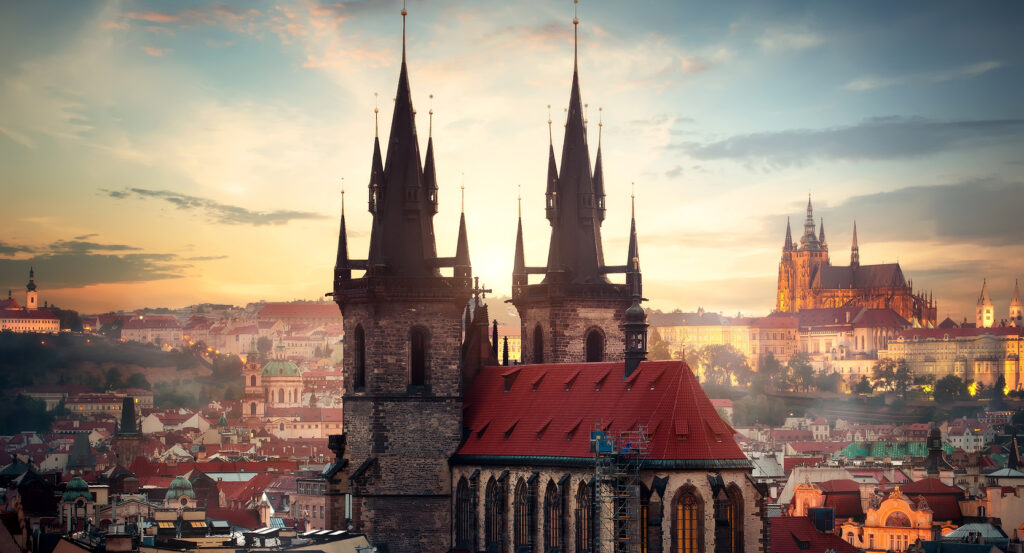
Why you should experience the Church of Our Lady before Týn at Old Town Square in Prague.
The Church of Our Lady before Týn is Prague's Gothic heartbeat, a cathedral of shadows and light, mystery and defiance.
Its twin spires, each crowned with four smaller turrets, dominate the skyline like dark flames frozen mid-flicker. Step into Old Town Square at twilight and you'll see them rise above the rooftops, backlit by gold and cloud, at once beautiful and foreboding. Inside, the air is thick with incense and centuries of whispered prayers. Candles tremble in the stillness; the vaulted ceiling disappears into darkness. You feel the weight of history here, the triumphs and heresies, the coronations and revolts. It isn't just a church; it's Prague's conscience, carved in stone.
What you should know about the Church of Our Lady before Týn.
Construction began in the 14th century, replacing an earlier Romanesque chapel that had served foreign merchants in the nearby Týn Courtyard.
Its rise coincided with the age of Charles IV, when Prague was the intellectual and spiritual heart of the Holy Roman Empire. But the church's legacy is as turbulent as its architecture. During the Hussite Wars, it became the principal Hussite church in Prague, a bold declaration of reformist faith at the heart of a Catholic empire. The golden chalice once displayed between its spires symbolized the Hussite movement's call for equality in communion, a statement so rebellious it reshaped Europe's religious landscape. When the Counter-Reformation swept through Bohemia, the chalice was removed, replaced with a gilded statue of the Virgin Mary holding a crescent moon, a symbol of Catholic restoration. Inside, the church is a treasury of art and allegory: altarpieces by Karel Škréta, the baroque tomb of astronomer Tycho Brahe, and the intricate organ pipes that have echoed through both war and worship since the 17th century. Few visitors realize that beneath the nave lie crypts dating back to the 1300s, where nobles and scholars rest beneath carved stone effigies. Every corner bears the mark of transition, from rebellion to reconciliation, from fire to faith renewed.
How to fold the Church of Our Lady before Týn into your trip.
Approach the church from the narrow passage behind the arcaded buildings of Old Town Square, the hidden entrance makes the reveal even more striking.
Step through the doorway and let your eyes adjust to the dimness: golden altars shimmer faintly, the flicker of votive candles dances across painted saints, and the organ's low hum seems to rise from the stones themselves. Spend time at Tycho Brahe's tomb, marked by the astronomer's emblem, a star and a compass, a reminder that faith and reason once shared the same space. Look up into the ribbed vaults, where carved angels float amid tracery like constellations. Visit at dusk; when you step back outside, the towers are ablaze in the last light of the day, their silhouettes mirrored in the windows of the square below. By night, they become something else entirely, an emblem of Prague's eternal duality: faith and doubt, beauty and melancholy, earth and heaven. The Church of Our Lady before Týn is not just an architectural masterpiece, it's a tribute to the endurance of spirit, standing watch over a city that has learned, time and again, to rise from its own ashes.
Where your story begins.
Foresyte Travel reveals places that feel extraordinary long before you arrive.
Experience premium editorial crafted for luxury travelers.





































































































