Why Omni Chicago Hotel matters.
Omni Chicago Hotel is a polished hotel where River North's commercial intensity meets City Place, a 1990 mixed-use tower whose blue glass, red granite and vertically integrated hotel floors brought large-scale suite lodging directly onto the Grand Mile.
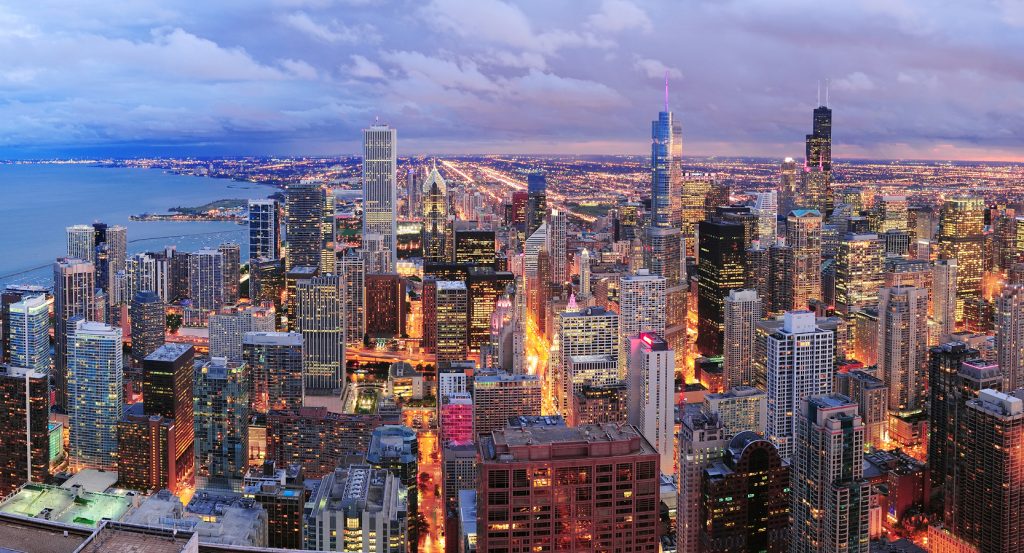
Set along North Michigan Avenue near East Huron Street and just steps from the Huron Street entrance to the Grand Mile, the hotel occupies the avenue's central retail stretch between Superior Street's gallery blocks, Chicago Avenue's northern commercial junction and River North's dense high-rises extending west toward Rush Street. Loebl, Schlossman & Hackl designed City Place as a forty-story postmodern tower, using blue glass and red granite to distinguish the mixed-use structure from the limestone and masonry buildings lining older sections of Michigan Avenue. A broad granite-framed base establishes the building at pedestrian scale before the glass tower rises above the retail frontage and surrounding lower structures. Hotel floors occupy the lower portion of the high-rise, placing private interiors close to the surrounding towers and the continuous commercial architecture lining Michigan Avenue. The result is a hotel whose red-granite base, blue-glass elevations and vertically layered construction capture the large-scale redevelopment that reshaped this section of North Michigan Avenue at the end of the twentieth century.
What defines Omni Chicago Hotel.
Omni Chicago Hotel is best known for beginning as Hyatt Regency Suites Chicago within City Place, a mixed-use development completed in 1990 at the southwest corner of North Michigan Avenue and East Huron Street. Fifield Realty Corporation and VMS Realty Partners developed the project, with Loebl, Schlossman & Hackl responsible for the architecture. The forty-story structure rose 470 feet and combined hotel and office functions inside a single concrete high-rise, establishing a substantial new commercial presence on a site previously occupied by lower-scale retail buildings. Hyatt Regency Suites opened in April 1990 as the hospitality component, introducing a suite-based format directly onto Michigan Avenue during a major period of hotel investment around the Grand Mile. Omni Hotels acquired the Hyatt Regency Suites in 1993 and renamed it Omni Chicago Hotel, adding the property during a national expansion that brought several existing upscale hotels into the Omni portfolio. TRT Holdings acquired Omni Hotels in 1996, placing the Chicago property under the ownership of Texas businessman Robert Rowling as the company entered a new phase of private investment and national growth. A $9.5 million reconstruction began transforming the hotel in 2005, with architect Jim McAuliffe of Culpepper, McAuliffe and Meaders directing a private-interior redesign informed by full-scale model testing. That campaign introduced honey-colored wood, granite surfaces and sepia architectural imagery across the hotel, connecting the contemporary interiors more deliberately with Chicago's built environment. Another multiyear reconstruction culminated in 2015 with an $11 million investment that renewed the entire hotel interior and established a substantially different visual program. Omni Chicago Hotel developed through three distinct chapters, from its Hyatt origins inside the purpose-built City Place complex through Omni's 1993 acquisition and successive capital programs that repeatedly reinterpreted the 1990 structure for later generations of the brand.
Where your story begins.
Foresyte Travel reveals places that feel extraordinary long before you arrive.
Enjoy editorial crafted for luxury travelers.